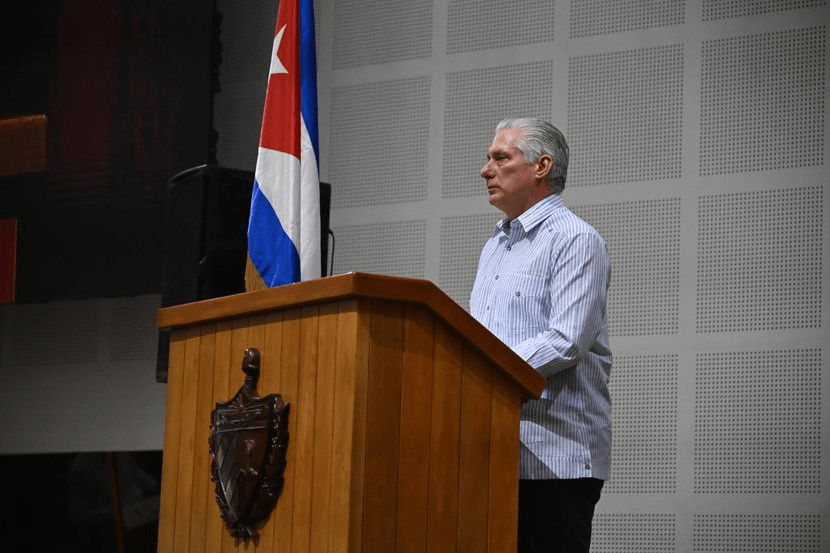
Miguel Díaz-Canel Bermúdez – May 2, 2026
Dear sisters and brothers of solidarity with Cuba and with the just causes of the world;
Friends who visit us from different latitudes:
Solidarity cannot be blocked. Long live solidarity! (Shouts of “Long live!”)
One of the first things that we have to recognize, which stems from the feelings and emotions of Cubans when we have this type of meeting, when we have the possibility of sharing with those who visit us giving us love, affection, friendship and offering solidarity, is gratitude for everything you do for us and recognition of the courage and decision with which you express yourselves. because we know that to be in these present times in Cuba and with Cuba you have to have courage (Applause).
Many of you talk about how you get excited when you come to Cuba. We are also moved when you come to Cuba and when you show us this affection and solidarity.
I believe that we can share solidarity, we can share ideals, we believe that a better world is possible, as Fidel taught us, precisely because we are recognizing that there can be another model, another possibility for those of us who live in this world that is so disordered and so chaotic, and that is when a cause is defended, when a model that is based on social justice and that puts man before the market and against profit is defended.
When it is said that we are an extraordinary and unusual threat to the United States – and we are sure that this is not the feeling of the American people, that is the pretext used by the American government to attack us – one wonders: What is the threat, what is extraordinary about that threat, what is unusual about that threat, when Cuba is a country of peace, when Cuba is a country that has served as the setting for the main peace dialogues in the Latin American and Caribbean region, when Cuba was the place where the Catholic Church and the Russian Orthodox Church came to meet to resolve the schism they had maintained for more than fifteen hundred years?
I try to answer that question every day, but, as Bruno explains, there is no pretext, there is no reason to justify military aggression against Cuba. Well, that “extraordinary and unusual threat” may be the example of resistance and creativity of the Cuban people.
When we talk about solidarity, I think we are talking about three elements that distinguish the value of international solidarity:
One is the tenderness of the peoples, because among all of us we have learned to share something that Fidel taught us, and that is that we do not give out of solidarity what we have left over, but we give what we have to share it among all.
The other value is that solidarity constitutes a strategic rearguard because it supports what we are doing, it supports the struggles of those of us who are seeking to confront genocidal aggressions such as the one imposed by the Government of the United States against Cuba, and each donation, each international mobilization, each of those acts that you carry out in different cities of the world is a lung of oxygen that you give us in the face of the economic siege and it is also a light that illuminates the Cuban nation and people.
A third value of solidarity, which we all share, is that it is an expression of resistance in the face of exclusion. It is an active denunciation of the aggression carried out by the Government of the United States against Cuba, it is an active denunciation of the inclusion of Cuba in a list of countries that allegedly support terrorism.
The vehemence, courage, decision and commitment with which you defend, in solidarity, the Cuban people shows us and assures us that Cuba is not alone and that Cuba will never be alone as long as there are people like you in our world.
I believe that yesterday we were all able to appreciate what was a magnificent demonstration of heroism, firmness, decision, convictions, militancy and combativeness of the Cuban people.
Yesterday the Cuban people staged two victories for these times: one, having achieved more than 80% of signatures from the Cuban active population over 17 years of age in favor of the Cuban Revolution; against the intensified blockade, against the energy blockade, against the danger of military aggression against Cuba. And it was a signature for the homeland, for the Revolution and for socialism (Applause).
And the other victory was that magnificent demonstration of support for the Revolution, when the people marched massively not only in Havana, which you experienced the magnitude of that parade in Havana, but in all the cities of the country. Where was the number of participants? More than 5 million were in the streets yesterday defending Cuba.
And this was not just any May Day. As many of you have said, this was May Day in the Centennial Year of Commander in Chief Fidel Castro Ruz (Applause and shouts of: “Long live Fidel!”)
And we can all share the conviction that our people, the Cuban people and you, the friends of solidarity of that people, who are also part of this homeland and of this people, gave the best possible tribute to the Commander in Chief in the Year of his Centennial on that May Day.
I think it was a response from the people that made it very clear that in Cuba the homeland is defended! (Applause and shouts of: “The homeland is defended!”)
Someone asked me yesterday what was extraordinary about this May Day. Well, it has to do with that commitment to the Commander in Chief, with the situation we are experiencing, with what we went to express on that May Day. But I believe that there is a very singular fact that you have not overlooked, and that is that new generations yesterday in Cuba raised our historical flags.
The enemies of the Revolution have spent millions trying to prevent Cuban youth from continuing the work of the Revolution. The enemies of the Revolution predicted that there would be no support from the people and that this was going to be a parade or a demonstration with little popular participation, and, as they say in the Cuban way: they caught their finger with the door. And the young people came out to defend the Revolution. But the Cuban youth came out to defend the Revolution, as part of that people, with the conviction that they are the youth of the Centennial of the Commander in Chief.
Therefore, yesterday we did not experience a march that “is the march despite the complex economic situation that our country presents, as part of the intensification of the blockade.” Not at all! Yesterday was a march of combative people and determined people against everything that affects the daily life and economy of our country. It was the combative speech of a dignified, brave and determined people who loud and clear said that they have every right to choose their political system, to defend their political system, to live and to develop. And that is why that people, together with you, yesterday exclaimed: no to the blockade! (Applause.) And as we have always said: let them remove the block to see how we play!
Let’s talk a little about the world. I believe that you have rigorously characterized the problems we have today. There is no doubt that there is a crisis of capitalism, there is a multidimensional crisis of capitalism, and there is an imperial crisis in the United States government as well.
There are other countries that offer, from the positions of multilateralism, other possibilities for the peoples and nations of the Global South. More and more voices are being raised against imperial abuses.
The fundamental representatives of the United States Government have a crisis of credibility also within the American people.
When capitalism and when the empire are in crisis, that is when the most ultraconservative ideas, the ideas of the extreme right, resurface, that is why fascism is resurfacing at the moment; and the current government of the United States is a fascist government (Applause). That is why genocidal acts are being committed in the world, such as the genocide that is being committed against the Palestinian people, such as the genocide that is being committed against the people in Lebanon; or we go to aggression and go to the language of war to resolve international conflicts.
And we are in the presence of an ideological war, a culture war and a media war.
Why is this war that the empire is trying to impose ideological? Because they are trying to impose their hegemonic ideas on the basis of domination. They want to dominate the world, they want to dominate us all, they want to dominate our peoples, they want to dominate our nations.
Why is it a culture war? Because to do so they have to appropriate and dominate our minds, and that is why they try to get our peoples to break with their roots, with their identity, with their culture. That is why they attack the culture and history of our peoples.
And it is also a media war, because they use this whole network of digital networks and the media to highlight supremacist values, xenophobia; to assassinate the reputations of nations, of leaders; to impose Western culture; to denigrate the peoples, the revolutionary processes, and they do so on the basis of perversity, using slander, lies, fake news, weaving media constructions so that the repetition of the lie and the narrative of the lie become a truth that is assumed by many in the world. Look, this is how they have acted in the last moments.
What was done against Venezuela? A narrative of narco-State began to be built in the media; they tried to lynch politically and in the media the legitimate president of the Bolivarian Revolution, Nicolás Maduro. They then came with a naval blockade of Venezuela, imposing the largest U.S. military presence in the last twenty years in the Caribbean area.
As part of this narrative, they have justified extrajudicial crimes against vessels that have never been proven whether or not they were linked to drug trafficking and whether those who were on those vessels were people linked to drug trafficking.
And when they had created all the conditions with that media artillery, they attacked the Venezuelan nation, kidnapped and extracted a legitimate President and his wife to make a false trial in the United States. You have to see how the Cartel of the Suns disappeared immediately after Maduro’s kidnapping, how the lie they had built had disappeared, but the consequences were already there.
Thus they were weaving the matrix that Iran was developing a nuclear energy program to have the nuclear bomb and that it was a threat to the entire world.
We have been watching the war in Iran for several weeks, seeing the heroic resistance of the Iranian people. And what we have not yet been able to see is an Iranian nuclear bomb, nor a threat from Iran with the use of nuclear bombs. Who’s talking about using the nuclear bomb? The Government of the United States.
And then there is the case of Cuba as well. They have mounted a huge campaign saying that we are an unusual and extraordinary threat to the United States, that we violate human rights, that we are a failed state, that we are in an economic collapse, that they are very concerned about the vicissitudes of the Cuban people, which is totally ironic and fallacious. If they are so worried, they should lift the blockade, because the main problems of the Cuban people have to do with the imposition of that blockade for so long.
As part of this campaign against Cuba, there are also the pressures they have exerted against the governments of a group of countries in which they have pressured their leaders to break off the medical collaboration that Cuba offers in solidarity.
In area-level meetings, the U.S. government has tried to “charm” some leaders of Latin American countries, and some have brought as a gift to break relations with Cuba or limit diplomatic relations with Cuba. And others, with tremendous cynicism and a lack of dignity, ingratiating themselves with the emperor, have said to him: when are you going to resolve the issue of Cuba?
So, in the midst of this situation, when Venezuela began to be blockaded from an energy point of view in December, Cuba began to stop receiving oil. We are talking about December. Then, in January, came the Executive Order of January 29; therefore, we went four months without receiving fuel until a fuel ship arrived from Russia that helped us, in the last fifteen days, to change the electro-energetic situation in the country; but that oil is already running out these days and we do not know when more fuel will enter Cuba.
And, as if that were not enough, they appeared yesterday as a May Day gift, it seems that May Day bothered them!, as they say here, it seems that they were stung by the enormous demonstration of firmness of the Cuban people, they released another Executive Order entitled “Imposition of sanctions on those responsible for repression in Cuba and threats to the national security and foreign policy of the United States”. They took the same pretext as the previous Executive Order.
This is a measure – and Bruno explained it in more detail than I am going to explain it – that is structured around three fundamental axes designed to collapse the Cuban economy and force what they aspire to as regime change.
First, it imposes expanded sectoral sanctions by blocking any U.S. property of individuals or entities operating in the island’s energy, defense, mining, and financial services sectors.
They are therefore attacking our vital sources of income, which have already been attacked and shocked in more than sixty years of blockade; then, of the blockade intensified from the second half of 2019, when Trump applied 240 measures to tighten the blockade; in January 2020, when we were included in the list of countries that allegedly support terrorism, and then how all those measures have been maintained throughout this time, first by the Biden administration, then by the second season of the Trump administration, and now intensified with the energy blockade and again with this Executive Order.
The second fundamental axis of this measure is that it establishes a global financial persecution by threatening banks from third countries with cutting off their access to the U.S. financial system if they carry out transactions with Cuban entities. Look at what level of internationalization they have given to this measure that further intensifies the blockade against Cuba.
And, thirdly, it decrees the immediate application of the sanctions, eliminating any period of prior modification and thus denying the possibility of a timely legal remedy.
Quite simply, sisters and brothers, from the perspective of international relations, this Executive Order is a case of direct and unilateral interference by the United States; it is an act of unacceptable interference in the internal affairs of another nation. It is a clear attempt to impose a political model by economic coercion, using a domestic law to dictate the policies of other nations to the detriment of multilateralism.
This policy not only seeks “regime change,” but also constitutes an act of regional destabilization by forcing the international community to an impossible choice between its relationship with Cuba and access to the U.S. market and financial system. The world either chooses to participate in the financial and economic system of the United States or chooses Cuba.
And I ask: How long is the world going to be tolerating this abuse? How long is the world going to bow to the killing of innocent children and an innocent people like in Gaza, like in Lebanon or like in Iran? How long will the world tolerate this policy of maximum pressure by the United States against the heroic Cuban people? Because the world has to be aware that what is done against Cuba, what is done against Palestine, what is done against Iran, is then done to anyone.
And that is why we say with every sense of responsibility, and someone said it here, that whoever rises up with Cuba at this moment rises up for all time, because in Cuba the dignity of the peoples is being defended.
In Cuba, the sovereignty and independence of the peoples is being defended. In Cuba, the right to self-determination of peoples is being defended. And in Cuba the conviction is being defended that a just cause defended by a heroic people is not abandoned. Therefore, let no one expect that there will be surrender in Cuba! (Applause and shouts of: “Cuba is not alone! Cuba is not alone! Cuba is not alone! Cuba is not alone!”)
All these elements of context that we are sharing with you, undoubtedly, have complicated our situation. And as you have lived, you have shared with the Cuban people, today we are experiencing many limitations increased to those we have already been experiencing. We have to ask ourselves how the economy of a country can be maintained, how can the services of a country that is denied fuel be maintained.
We are facing as a country, as a people, a multidimensional aggression from the most powerful power in the world.
And here the problem is a cumulative effect, because there are analyses that are made and the situation in Cuba at the present time is discussed. No, no, the situation in Cuba is the accumulation of problems from more than sixty years of blockade, of the blockade intensified since 2019, of the effects of COVID-19 and of the blockade now even more intensified with these two executive orders.
It is a collective punishment that they want to impose on us and a total asphyxiation that they want to impose on us, to achieve a social explosion and a change of regime. But Cuba is not sitting idly by (Shouts of “They can’t!”).
They won’t be able to, they won’t be able to! (Applause.)
We are not sitting idly by. Since an analysis was made in the direction of the country that Trump could win the elections and be accompanied by the others who make up his government, we knew that a danger of greater threat loomed over Cuba and we were working on a whole group of ideas, a whole group of plans, a whole group of programs that now, All the more reason, we have ratified, we have specified, we have updated and we are developing.
In the face of this multidimensional aggression, we have set ourselves three fundamental priorities and we want to share them with you so that you know and have all the arguments of what Cuba is doing.
First, there is the imminence of military aggression. And that is not something we want or desire. Cuba is a country of peace. Cuba defends peace. But the fact is that the Government of the United States talks about war every day, and every day it talks about threats, and every day the rhetoric of threat towards Cuba increases; but the Cuban people are not afraid (Applause).
And do you know why he is not afraid? Because when one assumes that one is willing to give one’s life for a just cause, which in this case is to be willing to give one’s life for our Revolution, to be willing to fight to the last consequences for our Revolution, and when there are many of us in this country who are willing to do that, there can be no fear. You made the decision of your life until the last consequences and the fear is over. And that was demonstrated by those people yesterday with the signatures and with their participation (Applause).
But this was demonstrated with tremendous heroism, which is an example for these times, by the 32 Cuban combatants who fell in Venezuela (Applause and shouts of: “Cuba and Venezuela a single flag!”).
Those Cuban combatants faced elite forces of the U.S. army that surpassed them technologically, outnumbered them. It had been conceived by the United States Government, by its army, that the operation to kidnap the President of Venezuela would be carried out in minutes, and it was complicated when our brave combatants faced that elite force of the United States and were fighting for more than 45 minutes in those conditions.
Imagine what would happen in a military aggression against Cuba where the example of those 32 million Cubans would be multiplied (Applause). And we tell you this with all responsibility, we are not talking like that because we want war. We do not want war!, we have even always stated that through dialogue bilateral differences with the Government of the United States can be resolved; But there has to be willingness, there has to be seriousness to find areas of cooperation that allow us to understand each other and move away from confrontation. But I also ratify here what we have said on other occasions: we are not afraid of war. And here there will be neither surprise nor defeat! (Applause.)
And that is why as a first priority we have been in recent months developing a plan to raise the readiness and readiness for defense in the interest of war of all our people.
Our defense strategy is a totally defensive strategy, it is not to attack anyone. It is based on the guerrilla experience of our country, on the experience of our struggles, how the Mambises fought, how the rebels fought in the Sierra Maestra; of the combative experiences we had when we went to Africa to contribute modestly to the liberation of African countries and to the elimination of apartheid in South Africa. It is based on our convictions.
It was a doctrine elaborated by Fidel, enriched by the Army General, which arose at another time as complex as this when the administration that was at that time at the head of the United States had also raised the possibility of direct aggression against Cuba. And in that defensive doctrine, every Cuban man and woman has a gun, every Cuban man and woman has a position in defense and has a mission to fulfill in defense of the homeland, the revolution and socialism.
So, the second priority has to do with the fact that they want to suffocate us, they want to suffocate us economically. Well, we discussed with the people at the end of last year, in December, and in the first weeks of January of this year we all discussed at the grassroots level a Government Program for economic and social development in the current conditions. Therefore, all our people gave their opinions, criticized, proposed, and at the end of all this debate of popular consultation, a more robust economic and social development program has been achieved, precisely because it was enriched by that popular participation. It contemplates a whole group of transformations that must be made in our Economic and Social Model, and that we also have to do with agility, without bureaucracy, with the greatest possible diligence.
I would say that, although there are several aspects, we could group them into three fundamental axes: Economic transformation, which has to do with how we achieve macroeconomic stabilization, how we enhance national production, how we achieve higher levels of exports.
It has another axis that is sovereignty and sustainability, and there we contemplate two fundamental programs: the food production program to achieve food sovereignty in the country, being aware that we are going to eat not what we import, we are going to eat what we are capable of producing in the country.
And you can tell me: but are you crazy? Now that you have less fuel, that you have fewer things, how are you going to achieve food sovereignty? Well, with the effort and talent of the Cubans, all of us working aware that we are going to eat what we are capable of producing, applying agroecology (Applause). And in the face of the lack of products and fertilizers, we are applying agroecology and we are developing an agricultural development program, food production, which is more environmentally friendly, which is sustainable in our conditions.
And the other important program is then, also for the country’s energy sustainability, the energy program, which has as a pillar a profound transformation of the country’s energy matrix, which we began last year. Last year we were able to make an investment of more than a thousand megawatts in photovoltaic parks, which made us jump, in a single year, from a 3% penetration in electricity generation with renewable energy sources to 10%; that is, we grew by 7% in that year.
We are struggling in the midst of adversity to also grow in a similar magnitude this year, in a program where by 2050 we can be self-sufficient in energy, using our resources. Our sun cannot block us, the air currents of Cuba cannot block us (Applause), the sea currents cannot block us, our rivers cannot block us. We are using biogas, promoting the use of biogas, the use of biomass.
Brazilian friends have insisted a lot on us to venture into the issue of biofuels, and we are also analyzing it.
As you know, when there was a whole taboo and it was said that Cuban crude oil could not be refined, our scientists have found the answer and we already have the technology developed in Cuba to be able to refine Cuban crude and have the necessary derivatives. Now, what do we have to do? Increase the production of that national crude oil to have national crude not only for electricity generation, but also to meet the needs of fuel and derivatives that the economy carries.
Of course, all these processes will take a long time, because that is not resolved from one day to the next in the midst of these conditions of adversity in the face of increasingly harsh coercive measures.
And the third strategic axis is that everything we do is without applying shock policies. It is with social justice, and each of the measures that we have to apply to overcome this situation must always first observe who can be left at a disadvantage, to prevent inequalities from growing and, on the contrary, to attenuate inequalities and that for each person, family or community in situations of vulnerability there is a differentiated response to prevent their situation of vulnerability from increasing. And that is social justice, and that is socialism, and that is what we defend in Cuba.
Therefore, I believe and dream, and we all dream, because remember that in Cuba, because of all this policy of maximum pressure and blockade applied for so many years, regardless of how great the work of the Revolution is, we have not been able to build all our dreams, we have pending dreams, we have pending projects. Some programs for the economic development of the country and its social impact have also been paralyzed over time. But we continue to dream and we continue to do, we continue to fight and we continue to work, and we continue to have achievements even in the most difficult circumstances.
And we leave these arguments, because we believe that one of the fundamental roles that solidarity can play, that you can play, is the mobilization of public opinion in a circumstance like this, above all, because of the contribution that you can make to persuade and spread the truth about Cuba at a time of fierce media siege. of manipulation, lies and economic coercion, and also in the face of the danger of military aggression.
Working like this in difficult times, how do you see the future of Cuba? We will have a future with an enlightened country using our own energy sources; but we will have the country enlightened, but without waste (Applause).
We will have a more productive Cuba with efficiency (Applause).
And we will continue to have a fair Cuba, with spaces and possibilities for all.
We will continue to provide solidarity; we will continue to support the world’s just causes; we will continue to support the Palestinian cause, the cause of the Lebanese people, the Bolivarian Revolution, the liberation of President Maduro and his wife Cilia (Applause), the cause of the Saharawi people, the cause of Puerto Rico (Applause), the cause of the Iranian people (Applause).
We will be supporting the cause of those who have led the Gaza flotilla (Applause), of those who have supported Cuba with the convoys of humanitarian aid and solidarity (Applause).
And we will also be fighting with you for the release of Thiago and any other militant comrade who is unjustly imprisoned.
We are convinced that the true strength of a nation lies in its people, in its people and in the workers who build a dignified future. Today that strength in our country is multiplied thanks to you, demonstrating that international solidarity is the most powerful weapon against global selfishness. The heroism, resistance, creativity, dignity and history of the Cuban people, together with you and with your solidarity, will give us victory. And we have no doubt about that! (Applause.)
But when you give us so much solidarity, you also impose an enormous commitment on us, because we know that we cannot let you down. Therefore, you must also be convinced that the Cuban people are committed to continuing to be a place of hope in the Caribbean for all those in the world who want it to be better. We will not fail you because to fail you would be to fail the hope of all the humble of this planet.
Long live peace! (Shouts of “Long live!”)
Down with the war! (Shouts of “Down!”)
Down with the blockade! (Shouts of “Down!”)
Long live the workers of the world! (Shouts of “Live!”)
Long live internationalist solidarity! (Shouts of “Long live!”)
Cuba is not alone! (Shouts of “Cuba is not alone!”)
Until Victory Always! (Ovation.)
Spanish Language Text:
Discurso pronunciado en la clausura del Encuentro Internacional de Solidaridad con Cuba
Nacionales
- Miguel Díaz-Canel Bermúdez
- 2 de Mayo de 2026
Discurso pronunciado por Miguel Mario Díaz-Canel Bermúdez, Primer Secretario del Comité Central del Partido Comunista de Cuba y Presidente de la República, en la clausura del Encuentro Internacional de Solidaridad con Cuba, en el Palacio de Convenciones, el 2 de mayo de 2026, “Año del Centenario del Comandante en Jefe Fidel Castro Ruz”.
Queridas hermanas y hermanos de la solidaridad con Cuba y con las causas justas del mundo;
Amigas y amigos que nos visitan desde diferentes latitudes:
La solidaridad no se puede bloquear. ¡Viva la solidaridad! (Exclamaciones de: “¡Viva!”)
Una de las primeras cosas que tenemos que reconocer, que parte del sentimiento y las emociones propias de las cubanas y los cubanos cuando tenemos este tipo de encuentros, cuando tenemos la posibilidad de compartir con los que nos visitan dándonos amor, dándonos cariño, dándonos amistad y ofreciendo solidaridad, es la gratitud por todo lo que hacen por nosotros y el reconocimiento a la valentía y a la decisión con que ustedes se expresan, porque sabemos que para estar en estos tiempos presentes en Cuba y con Cuba hay que tener valor (Aplausos).
Muchos de ustedes hablan de que se emocionan cuando vienen a Cuba. Nosotros también nos emocionamos cuando ustedes vienen a Cuba y cuando ustedes nos manifiestan estos afectos y esta solidaridad.
Creo que podemos compartir solidaridad, podemos compartir ideales, creemos en que un mundo mejor es posible, como nos enseñó Fidel, precisamente porque estamos reconociendo que puede haber otro modelo, otra posibilidad para los que habitamos en este mundo tan desordenado y tan caótico, y es cuando se defiende una causa, cuando se defiende un modelo que se basa en la justicia social y que antepone al hombre contra el mercado y contra el lucro.
Cuando se habla de que somos una amenaza extraordinaria e inusual para los Estados Unidos –y estamos seguros de que ese no es el sentimiento del pueblo norteamericano, ese es el pretexto que usa el Gobierno norteamericano para agredirnos–, uno se pregunta: ¿Cuál es la amenaza?, ¿qué es lo extraordinario de esa amenaza?, ¿qué es lo que es inusual en esa amenaza, cuando Cuba es un país de paz, cuando Cuba es un país que ha servido como escenario de los principales diálogos de paz en la región de América Latina y el Caribe, cuando Cuba fue el lugar donde vinieron a reunirse la Iglesia católica y la Iglesia ortodoxa rusa para resolver el cisma que habían mantenido durante más de mil quinientos años?
Yo trato de contestarme esa pregunta todos los días, pero, como explica Bruno, no hay pretexto ninguno, no hay razón ninguna que justifique una agresión militar contra Cuba. Bueno, pues esa “amenaza extraordinaria e inusual” tal vez sea el ejemplo de resistencia y creatividad del pueblo cubano (Aplausos).
Cuando hablamos de solidaridad, creo que estamos hablando de tres elementos que distinguen el valor de la solidaridad internacional:
Uno, es la ternura de los pueblos, porque entre todos hemos aprendido a compartir algo que nos enseñó Fidel, y es que no damos por solidaridad lo que nos sobre, sino damos lo que tenemos para compartirlo entre todos.
El otro valor es que la solidaridad constituye una retaguardia estratégica porque apoya lo que vamos haciendo, apoya las luchas de los que vamos buscando enfrentar agresiones genocidas como la que impone el Gobierno de los Estados Unidos contra Cuba, y cada donación, cada movilización internacional, cada uno de esos actos que realizan ustedes en diferentes ciudades del mundo es un pulmón de oxígeno que ustedes nos dan frente al cerco económico y es también una luz que ilumina a la nación y al pueblo cubanos.
Un tercer valor de la solidaridad, que compartimos entre todos, es que es una expresión de resistencia ante la exclusión. Es una denuncia activa contra la agresión que realiza el Gobierno de los Estados Unidos contra Cuba, es una denuncia activa contra la inclusión de Cuba en una lista de países que supuestamente apoyan el terrorismo.
La vehemencia, el valor, la decisión y el compromiso con el que ustedes defienden, desde la solidaridad, al pueblo cubano nos demuestra a nosotros y nos asegura que Cuba no está sola y que Cuba nunca estará sola mientras exista gente como ustedes en nuestro mundo (Aplausos).
Yo creo que ayer entre todos pudimos apreciar lo que fue una magnífica demostración de heroísmo, de firmeza, de decisión, de convicciones, de militancia y de combatividad del pueblo cubano.
Ayer el pueblo cubano protagonizó dos victorias para estos tiempos: una, haber logrado más de un 80 % de firmas de la población activa cubana mayor de 17 años a favor de la Revolución Cubana; en contra del bloqueo recrudecido, en contra del bloqueo energético, en contra del peligro de agresión militar contra Cuba. Y fue una firma por la patria, por la Revolución y por el socialismo (Aplausos).
Y la otra victoria fue esa magnífica demostración de apoyo a la Revolución, cuando el pueblo desfiló masivamente no solo en La Habana, que ustedes vivieron la magnitud de ese desfile en La Habana, sino en todas las ciudades del país. ¿Por dónde estaba la cifra de participantes? Más de 5 millones ayer estuvieron en las calles defendiendo a Cuba (Aplausos).
Y es que este no era un Primero de Mayo cualquiera. Como muchos de ustedes han dicho, este fue el Primero de Mayo en el Año del Centenario del Comandante en Jefe Fidel Castro Ruz (Aplausos y Exclamaciones de: “¡Viva Fidel!”)
Y todos podemos compartir la convicción de que nuestro pueblo, el pueblo cubano y ustedes, los amigos solidarios de ese pueblo, que son parte también de esta patria y de este pueblo, dimos el mejor homenaje posible al Comandante en Jefe en el Año de su Centenario en ese Primero de Mayo (Aplausos).
Creo que fue una respuesta de pueblo que dejó bien claro que ¡en Cuba la patria se defiende! (Aplausos y Exclamaciones de: “¡La patria se defiende!”)
Alguien me preguntó ayer qué era lo extraordinario en este Primero de Mayo. Bueno, tiene que ver con ese compromiso con el Comandante en Jefe, con la situación que estamos viviendo, con lo que fuimos a expresar en ese Primero de Mayo. Pero creo que hay un hecho muy singular y que ustedes no lo han pasado por alto, y es que nuevas generaciones ayer en Cuba levantaron nuestras banderas históricas.
Los enemigos de la Revolución han gastado millones tratando de evitar que la juventud cubana sea continuadora de la obra de la Revolución. Los enemigos de la Revolución vaticinaban que no iba a haber apoyo del pueblo y que este iba a ser un desfile o una manifestación con poca participación popular, y, como se dice a lo cubano: se cogieron el dedo con la puerta. Y los jóvenes salieron a defender a la Revolución. Pero la juventud cubana salió a defender a la Revolución, como parte de ese pueblo, con la convicción de que son la juventud del Centenario del Comandante en Jefe (Aplausos).
Por lo tanto, ayer no vivimos una marcha que “es la marcha a pesar de la situación económica compleja que presenta nuestro país, como parte del recrudecimiento del bloqueo”. ¡Para nada! Ayer fue una marcha de pueblo combativo y pueblo decidido contra todo lo que afecta la vida cotidiana y la economía de nuestro país. Fue el discurso combativo de un pueblo digno, valiente y decidido que alto y claro dijo que tiene todo el derecho a escoger su sistema político, a defender su sistema político, a vivir y a desarrollarse. Y por eso ese pueblo, junto a ustedes, ayer exclamó: ¡no al bloqueo! (Aplausos.) Y como siempre hemos dicho: ¡que nos quiten el bloqueo para ver a cómo tocamos!
Vamos a hablar un poco del mundo. Creo que ustedes han caracterizado con todo rigor la problemática que hoy tenemos. Es indudable que hay una crisis del capitalismo, hay una crisis multidimensional del capitalismo, y hay una crisis imperial también en el Gobierno de los Estados Unidos.
Hay otros países que ofrecen, desde las posiciones del multilateralismo, otras posibilidades para los pueblos y para las naciones del Sur Global. Cada vez son más las voces que se alzan en contra de los abusos imperiales.
Los representantes fundamentales del Gobierno de los Estados Unidos tienen una crisis de credibilidad también dentro del pueblo norteamericano.
Cuando el capitalismo y cuando el imperio están en crisis es entonces cuando resurgen las ideas más ultraconservadoras, las ideas de extrema derecha, por eso está resurgiendo el fascismo en estos momentos; y el Gobierno actual de los Estados Unidos es un gobierno fascista (Aplausos). Es por eso que se cometen actos genocidas en el mundo, como es el genocidio que se comete contra el pueblo palestino, como es el genocidio que se está cometiendo contra el pueblo en el Líbano; o se va a las agresiones y se va al lenguaje de la guerra para resolver los conflictos internacionales.
Y es que estamos en presencia de una guerra ideológica, de una guerra cultural y de una guerra mediática.
¿Por qué esa guerra que trata de imponer el imperio es ideológica? Porque están tratando de imponer sus ideas hegemónicas sobre la base de la dominación. Quieren dominar el mundo, nos quieren dominar a todos, quieren dominar a nuestros pueblos, quieren dominar a nuestras naciones.
¿Por qué es una guerra cultural? Porque para hacerlo se tienen que apropiar y tienen que dominar nuestras mentes, y por eso tratan de buscar que nuestros pueblos rompan con sus raíces, con su identidad, con su cultura. Por eso atacan la cultura y la historia de nuestros pueblos.
Y es una guerra también mediática, porque usan todo ese entramado de redes digitales y de medios de comunicación para resaltar los valores supremacistas, la xenofobia; para asesinar reputaciones de naciones, de líderes; para imponer la cultura occidental; para denigrar a los pueblos, a los procesos revolucionarios, y lo hacen sobre la base de la perversidad, usando la calumnia, la mentira, las falsas noticias, tejiendo construcciones mediáticas para que la repetición de la mentira y la narrativa de la mentira se conviertan en una verdad que sea asumida por muchos en el mundo. Fíjense, así han actuado en los últimos momentos.
¿Qué se hizo contra Venezuela? Se comenzó a construir mediáticamente una narrativa de narco-Estado; trataron de linchar políticamente y mediáticamente al legítimo presidente de la Revolución Bolivariana, Nicolás Maduro. Vinieron entonces con un bloqueo naval a Venezuela, impusieron la presencia militar norteamericana más grande en los últimos veinte años en el área del Caribe.
Como parte de esa narrativa han justificado crímenes extrajudiciales contra embarcaciones que nunca ha podido ser comprobado si estaban o no vinculadas al narcotráfico y si los que estaban en esas embarcaciones eran personas vinculadas al narcotráfico.
Y cuando tuvieron creadas todas las condiciones con esa artillería mediática, agredieron a la nación venezolana, secuestraron y extrajeron a un Presidente legítimo y a su esposa para hacerles un falso juicio en los Estados Unidos. Hay que ver cómo el Cartel de los Soles desapareció inmediatamente después del secuestro de Maduro, cómo la mentira que habían construido había desaparecido, pero ya las consecuencias estaban.
Así fueron tejiendo la matriz de que Irán desarrollaba un programa de energía nuclear para tener la bomba nuclear y que era una amenaza para el mundo entero.
Llevamos varias semanas viendo la guerra en Irán, viendo la heroica resistencia del pueblo iraní (Aplausos). Y lo que no hemos podido ver aún es una bomba nuclear iraní, ni una amenaza de Irán con el uso de las bombas nucleares. ¿Quién está hablando de usar la bomba nuclear? El Gobierno de los Estados Unidos.
Y ahí está entonces el caso de Cuba también. Han armado una enorme campaña diciendo que nosotros somos una amenaza inusual y extraordinaria contra Estados Unidos, que violamos los derechos humanos, que somos un Estado fallido, que estamos en un colapso económico, que ellos están muy preocupados por las vicisitudes del pueblo cubano, lo cual es totalmente una ironía y una falacia. Si están tan preocupados, que levanten el bloqueo, porque los principales problemas del pueblo cubano tienen que ver con la imposición de ese bloqueo durante tanto tiempo.
Como parte de esa campaña contra Cuba están también las presiones que han ejercido contra los gobiernos de un grupo de países en los cuales han presionado a sus líderes para que rompan la colaboración médica que Cuba ofrece de manera solidaria.
En reuniones a nivel de área, el Gobierno de los Estados Unidos ha tratado de “encantar” a algunos líderes de países latinoamericanos, y algunos han llevado como regalo romper las relaciones con Cuba o limitar las relaciones diplomáticas con Cuba. Y otros, con un cinismo tremendo y una falta de dignidad, congraciándose con el emperador, le han dicho: ¿cuándo va a resolver el tema de Cuba?
Entonces, en medio de esa situación, ya cuando Venezuela en diciembre empezó a ser bloqueada desde el punto de vista energético, Cuba empezó a dejar de recibir petróleo. Estamos hablando de diciembre. Después, en enero, vino la Orden Ejecutiva del 29 de enero; por lo tanto, estuvimos cuatro meses sin recibir combustible hasta que llegó un barco de combustible de Rusia que nos sirvió para, en los últimos quince días, cambiar la situación electroenergética que había en el país; pero ese petróleo se agota ya en estos días y no sabemos cuándo más va a entrar combustible a Cuba.
Y, como si eso fuera poco, se aparecen ayer como regalo del Primero de Mayo, ¡parece que molestó el Primero de Mayo!, como se dice aquí, parece que les picó la enorme demostración de firmeza del pueblo cubano, dieron a conocer otra Orden Ejecutiva titulada “Imposición de sanciones a los responsables de la represión en Cuba y de las amenazas a la seguridad nacional y la política exterior de Estados Unidos”. Tomaron el mismo pretexto de la anterior Orden Ejecutiva.
Esta es una medida –y Bruno lo explicó con más detalles de lo que yo lo voy a explicar– que se estructura sobre tres ejes fundamentales diseñados para hacer colapsar la economía cubana y forzar lo que ellos aspiran como cambio de régimen.
En primer lugar, impone sanciones sectoriales ampliadas bloqueando cualquier propiedad estadounidense de personas o entidades que operen en los sectores –fíjense qué sectores escogieron–: energético, de defensa, minero y de servicios financieros de la isla.
Por lo tanto, están atacando nuestras fuentes vitales de ingresos, que han sido atacadas ya y han sido conmocionadas en más de sesenta años de bloqueo; después, de bloqueo recrudecido a partir del segundo semestre del 2019, cuando Trump aplicó 240 medidas de recrudecimiento del bloqueo; en enero del 2020, cuando nos incluyeron en la lista de países que supuestamente apoyan el terrorismo, y después cómo todas esas medidas han sido mantenidas en todo este tiempo, primero por la administración Biden, después por la segunda temporada de la administración Trump, y ahora recrudecida con el bloqueo energético y nuevamente con esta Orden Ejecutiva.
El segundo eje fundamental de esta medida es que establece una persecución financiera global amenazando a bancos de terceros países con cortar su acceso al sistema financiero estadounidense si realizan transacciones con entidades cubanas. Fíjense qué nivel de internacionalización le han dado a esta medida que recrudece aún más el bloqueo contra Cuba.
Y, en tercer lugar, decreta la aplicación inmediata de las sanciones, eliminando cualquier periodo de modificación previa y negando así la posibilidad de un recurso legal oportuno.
Sencillamente, hermanas y hermanos, desde la óptica de las relaciones internacionales, esta Orden Ejecutiva es un caso de injerencia directa y unilateral por parte de Estados Unidos; es un acto de intromisión inaceptable en los asuntos internos de otra nación. Es un claro intento de imponer un modelo político por coerción económica, utilizando una ley doméstica para dictar las políticas de otras naciones en detrimento del multilateralismo.
Esta política no solo busca un “cambio de régimen”, sino también constituye un acto de desestabilización regional forzando a la comunidad internacional a una elección imposible entre su relación con Cuba y el acceso al mercado y al sistema financiero de Estados Unidos. El mundo, o escoge poder participar en el sistema financiero y económico de Estados Unidos o escoge a Cuba.
Y yo pregunto: ¿Hasta cuándo el mundo va a estar tolerando este abuso? ¿Hasta cuándo el mundo se va a plegar a que maten niños inocentes y a un pueblo inocente como en Gaza, como en el Líbano o como en Irán? ¿Hasta cuándo el mundo va a tolerar esta política de máxima presión de los Estados Unidos contra el heroico pueblo cubano? Porque el mundo tiene que estar consciente de que lo que se hace contra Cuba, lo que se hace contra Palestina, lo que se hace contra Irán, después se lo hacen a cualquiera (Aplausos).
Y por eso nosotros decimos con todo sentido de responsabilidad, y alguien lo dijo aquí, que quien se levanta con Cuba en este momento se levanta para todos los tiempos, porque en Cuba se está defendiendo la dignidad de los pueblos (Aplausos).
En Cuba se está defendiendo la soberanía y la independencia de los pueblos. En Cuba se está defendiendo el derecho a la autodeterminación de los pueblos (Aplausos). Y en Cuba se está defendiendo la convicción de que una causa justa defendida por un pueblo heroico no se abandona. Por lo tanto, ¡que nadie espere que en Cuba habrá rendición! (Aplausos y exclamaciones de: “¡Cuba no está sola! ¡Cuba no está sola! ¡Cuba no está sola! ¡Cuba no está sola!”)
Todos estos elementos de contexto que estamos compartiendo con ustedes, indudablemente, han complejizado nuestra situación. Y como ustedes han vivido, han compartido con el pueblo cubano, hoy vivimos muchas limitaciones acrecentadas a las que ya veníamos viviendo. Hay que preguntarse cómo puede mantenerse la economía de un país, cómo se pueden mantener los servicios de un país al que le es negado recibir combustible.
Nosotros estamos enfrentando como país, como pueblo, una agresión multidimensional de la potencia más poderosa del mundo.
Y aquí el problema es un efecto acumulado, porque hay análisis que se hacen y se habla de la situación de Cuba en el momento actual. No, no, la situación de Cuba es la acumulación de problemáticas de más de sesenta años de bloqueo, de bloqueo recrudecido a partir del 2019, de los efectos de la COVID-19 y del bloqueo ahora más recrudecido aún con estas dos órdenes ejecutivas.
Se trata de un castigo colectivo que nos quieren imponer y de una asfixia total que nos quieren imponer, para lograr que exista un estallido social y que haya un cambio de régimen. Pero Cuba no está cruzada de brazos (Exclamaciones de: “¡No podrán!”).
¡No podrán, no podrán! (Aplausos.)
Nosotros no estamos de brazos cruzados. Desde que se hizo un análisis en la dirección del país de que Trump podía ganar las elecciones y estar acompañado de los otros que componen su Gobierno, sabíamos que se cernía un peligro de mayor amenaza sobre Cuba y estuvimos trabajando todo un grupo de ideas, todo un grupo de planes, todo un grupo de programas que ahora, con más razón, hemos ratificado, hemos puntualizado, hemos actualizado y estamos desarrollando.
Ante esta agresión multidimensional nosotros nos hemos planteado tres prioridades fundamentales y queremos compartirlas con ustedes para que sepan y tengan todos los argumentos de lo que hace Cuba.
Primero, hay la inminencia de una agresión militar. Y eso no es algo que nosotros queremos ni deseamos. Cuba es un país de paz. Cuba defiende la paz. Pero es que el Gobierno de los Estados Unidos todos los días habla de guerra, y todos los días habla de amenaza, y todos los días sube la retórica de amenaza hacia Cuba; pero el pueblo cubano no tiene miedo (Aplausos).
¿Y saben por qué no tiene miedo? Porque cuando uno asume que está dispuesto a entregar la vida por una causa justa, que en este caso es estar dispuesto a dar la vida por nuestra Revolución, estar dispuesto a luchar hasta las últimas consecuencias por nuestra Revolución, y cuando somos muchos en este país los que estamos dispuestos a hacer eso, no puede haber miedo. Tú tomaste la decisión de tu vida hasta las últimas consecuencias y ya se acabó el miedo. Y eso lo demostró ese pueblo ayer con las firmas y con su participación (Aplausos).
Pero eso lo demostraron con un heroísmo tremendo, que es un ejemplo para estos tiempos, los 32 combatientes cubanos que cayeron en Venezuela (Aplausos y exclamaciones de: “¡Cuba y Venezuela una sola bandera!”).
Esos combatientes cubanos enfrentaron a fuerzas élites del ejército norteamericano que los superaban tecnológicamente, los superaban numéricamente. Se había concebido por parte del Gobierno de Estados Unidos, por parte de su ejército, que la operación de secuestro del Presidente de Venezuela se hacía en minutos, y se les complicó cuando nuestros bravos combatientes enfrentaron a esa fuerza élite de los Estados Unidos y estuvieron combatiendo durante más de 45 minutos en esas condiciones (Aplausos).
Imagínense qué pasaría en una agresión militar a Cuba donde estaría multiplicado el ejemplo de esos 32 por millones de cubanos (Aplausos). Y se lo decimos con toda responsabilidad, no estamos hablando así porque queramos la guerra. ¡No queremos la guerra!, incluso siempre hemos planteado que desde el diálogo se pueden resolver las diferencias bilaterales con el Gobierno de los Estados Unidos; pero tiene que haber disposición, tiene que haber seriedad para encontrar áreas de cooperación que nos permitan entendernos y alejarnos de la confrontación. Pero también ratifico aquí lo que hemos dicho en otras ocasiones: no le tememos a la guerra. ¡Y aquí no habrá ni sorpresa ni derrota! (Aplausos.)
Y es por eso que como primera prioridad hemos estado en los últimos meses desarrollando un plan de elevación de la preparación y la disposición para la defensa en interés de la guerra de todo nuestro pueblo.
Nuestra estrategia de defensa es una estrategia totalmente defensiva, no es para agredir a nadie. Parte de la experiencia guerrillera de nuestro país, de la experiencia de nuestras luchas, cómo lucharon los mambises, cómo lucharon los rebeldes en la Sierra Maestra; de las experiencias combativas que tuvimos cuando fuimos al África a contribuir modestamente con la liberación de países africanos y a eliminar el apartheid en Sudáfrica. Parte de nuestras convicciones.
Fue una doctrina elaborada por Fidel, enriquecida por el General de Ejército, que surgió en otro momento tan complejo como este cuando la administración que estaba en ese momento al frente de Estados Unidos había planteado también la posibilidad de una agresión directa contra Cuba. Y en esa doctrina defensiva cada cubana y cada cubano tiene un fusil, cada cubana y cada cubano tiene una posición en la defensa y tiene una misión que cumplir en defensa de la patria, la revolución y el socialismo (Aplausos).
Entonces, la segunda prioridad tiene que ver con que nos quieren asfixiar, nos quieren asfixiar económicamente. Bueno, discutimos con el pueblo a finales del pasado año, en diciembre, y en las primeras semanas de enero de este año entre todos discutimos a nivel popular un Programa de Gobierno para el desarrollo económico y social en las condiciones actuales. Por lo tanto, todo nuestro pueblo opinó, criticó, propuso, y al final de todo este debate de consulta popular se ha logrado un programa de desarrollo económico y social más robusto, precisamente porque fue enriquecido por esa participación popular. En él se contempla todo un grupo de transformaciones que hay que hacer en nuestro Modelo Económico y Social, y que tenemos también que hacerlo con agilidad, sin burocracia, con la mayor diligencia posible.
Yo diría que, aunque son varios los aspectos, podríamos agruparlos en tres ejes fundamentales: Transformación económica, que tiene que ver con cómo logramos la estabilización macroeconómica, cómo potenciamos la producción nacional, cómo logramos mayores niveles de exportación.
Tiene otro eje que es de soberanía y sostenibilidad, y ahí contemplamos dos programas fundamentales: el programa de producción de alimentos para alcanzar la soberanía alimentaria del país, estando conscientes de que vamos a comer no lo que importemos, vamos a comer lo que seamos capaces de producir en el país.
Y ustedes me podrán decir: pero ¿estás loco?, ahora que tienes menos combustible, que tienes menos cosas, ¿cómo vas a lograr soberanía alimentaria? Bueno, con el esfuerzo y con el talento de los cubanos, trabajando todos nosotros conscientes de que vamos a comer lo que seamos capaces de producir, aplicando la agroecología (Aplausos). Y ante la falta de productos y fertilizantes, estamos aplicando agroecología y estamos desarrollando un programa de desarrollo agropecuario, de producción de alimentos, que es más amigable con el medio ambiente, que es sostenible en nuestras condiciones.
Y el otro programa importante es entonces, también para la sostenibilidad energética del país, el programa energético, que tiene como un pilar una profunda transformación de la matriz energética del país, que la iniciamos ya el pasado año. Nosotros el pasado año pudimos hacer una inversión de más de mil megawatts en parques fotovoltaicos, lo cual nos hizo saltar, en un solo año, de un 3 % de penetración en la generación eléctrica con fuentes renovables de energía a un 10 %; o sea, crecimos un 7 % en ese año.
Estamos luchando en medio de la adversidad para este año también crecer en una magnitud similar, en un programa donde en el año 2050 podamos ser autosuficientes en energía, usando nuestros recursos. No nos pueden bloquear nuestro sol, no nos pueden bloquear las corrientes de aire de Cuba (Aplausos), no nos pueden bloquear las corrientes marinas, no nos pueden bloquear nuestros ríos. Estamos usando el biogás, promoviendo el uso del biogás, el uso de la biomasa.
Los amigos brasileños nos han insistido mucho en incursionar en el tema de los biocombustibles, y también lo estamos analizando.
Como ustedes conocen, cuando había todo un tabú y se decía que el crudo cubano no se podía refinar, nuestros científicos han encontrado la respuesta y ya tenemos la tecnología desarrollada en Cuba para poder refinar crudo cubano y tener los derivados necesarios. Ahora, ¿qué tenemos que hacer? Incrementar la producción de ese crudo nacional para tener crudo nacional no solo para la generación eléctrica, sino también para ir supliendo las necesidades de combustible y de derivados que lleva la economía.
Por supuesto, todos estos procesos llevarán un tiempo largo, porque eso no se resuelve de un día para otro en medio de estas condiciones de adversidad ante medidas coercitivas cada vez más duras.
Y el tercer eje estratégico es que todo lo que hagamos es sin aplicar políticas de choque. Es con justicia social, y cada una de las medidas que tengamos que aplicar para superar esta situación siempre tiene que observar primero a quién puede dejar en alguna desventaja, para evitar que crezcan desigualdades y que, al contrario, se atenúen las desigualdades y que para cada persona, familia o comunidad en situaciones de vulnerabilidad haya una respuesta diferenciada para evitar que se incremente su situación de vulnerabilidad. Y eso es justicia social, y eso es socialismo, y eso es lo que defendemos en Cuba (Aplausos).
Por lo tanto, yo creo y sueño, y todos soñamos, porque recuerden que en Cuba, por toda esta política de máxima presión y de bloqueo aplicado durante tantos años, independientemente de lo grande que es la obra de la Revolución, no hemos podido construir todos nuestros sueños, tenemos sueños pendientes, tenemos proyectos pendientes. Se nos han paralizado en el tiempo también algunos programas para el desarrollo económico del país y su impacto social. Pero seguimos soñando y seguimos haciendo, seguimos combatiendo y seguimos trabajando, y seguimos teniendo realizaciones aun en las circunstancias más difíciles.
Y dejamos estos argumentos, porque nosotros creemos que uno de los papeles fundamentales que puede desempeñar la solidaridad, que pueden desempeñar ustedes, es la movilización de la opinión pública en una circunstancia como esta, sobre todo, por la contribución que pueden hacer ustedes de persuadir y extender la verdad sobre Cuba en momentos de un feroz asedio mediático, de manipulación, de mentiras y de coerción económica, y también ante el peligro de una agresión militar.
Trabajando así en tiempos difíciles, ¿cómo uno ve el futuro de Cuba? Tendremos un futuro con un país iluminado usando nuestras propias fuentes de energía; pero tendremos el país iluminado, pero sin derroche (Aplausos).
Tendremos una Cuba más productiva con eficiencia (Aplausos).
Y seguiremos teniendo una Cuba justa, con espacios y posibilidades para todos (Aplausos).
Seguiremos brindando solidaridad; seguiremos apoyando las causas justas del mundo; seguiremos apoyando la causa palestina, la causa del pueblo libanés, la Revolución Bolivariana, la liberación del presidente Maduro y su esposa Cilia (Aplausos), la causa del pueblo saharaui, la causa de Puerto Rico (Aplausos), la causa del pueblo iraní (Aplausos).
Estaremos apoyando la causa de los que han protagonizado la flotilla de Gaza (Aplausos), de los que han apoyado a Cuba con los convoyes de ayuda humanitaria y solidaria (Aplausos).
Y estaremos luchando con ustedes también por la liberación de Thiago y de cualquier otro compañero militante, combatiente que sea injustamente apresado (Aplausos).
Nosotros tenemos la convicción de que la verdadera fuerza de una nación reside en su pueblo, en su gente y en los trabajadores que construyen un futuro digno. Hoy esa fuerza en nuestro país se multiplica gracias a ustedes, demostrando que la solidaridad internacional es el arma más poderosa contra el egoísmo global. El heroísmo, la resistencia, la creatividad, la dignidad y la historia del pueblo cubano, junto a ustedes y junto a la solidaridad de ustedes, nos van a dar la victoria. ¡Y de eso no tenemos ninguna duda! (Aplausos.)
Pero cuando ustedes nos dan tanta solidaridad, también nos imponen un enorme compromiso, porque sabemos que no los podemos defraudar. Por lo tanto, tengan también la convicción de que el pueblo cubano se compromete a seguir siendo un sitio de esperanza en el Caribe para todos los que en el mundo quieren que este sea mejor. No les fallaremos porque fallarles a ustedes sería fallar a la esperanza de todos los humildes de este planeta.
¡Que viva la paz! (Exclamaciones de: “¡Viva!”)
¡Abajo la guerra! (Exclamaciones de: “¡Abajo!”)
¡Abajo el bloqueo! (Exclamaciones de: “¡Abajo!”)
¡Vivan los trabajadores del mundo! (Exclamaciones de: “¡Vivan!”)
¡Viva la solidaridad internacionalista! (Exclamaciones de: “¡Viva!”)
¡Cuba no está sola! (Exclamaciones de: “¡Cuba no está sola!”)
¡Hasta la Victoria Siempre! (Ovación.)

