Dear G
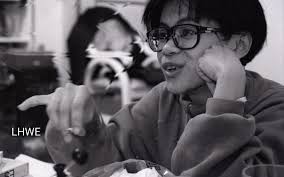
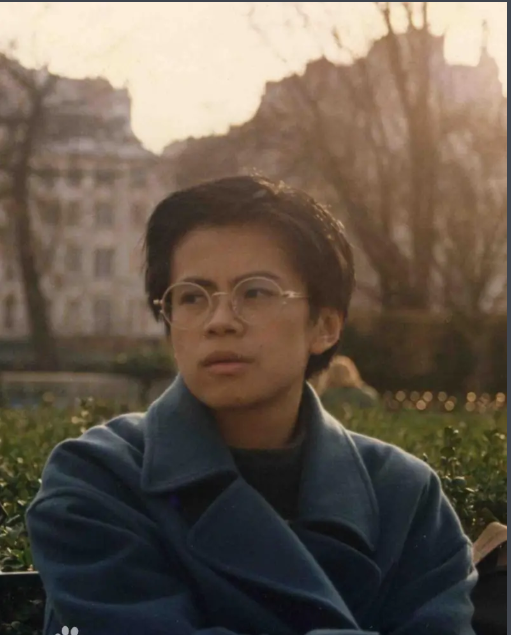
What are my views regarding Qiu Miaolin (邱妙津) [1969-1995]? Goodness me – you certainly have done your research. The Chinese surname of my life-partner is “Yau” (邱) – this is how the Cantonese pronounce the Northern surname of “Qiu” (邱) which originated in Shandong province. Indeed, my partner’s family were the servants of the Kong ((孔) family – whose famous son is known in the West as “Confucius” (孔子 – Kong Zi) [551-479 BCE] – literally “Kong Master” in this context (although it can be read “Kong Son”). However, his actual birth-name was “Kong Qiu” (孔丘) – and the story (preserved in the Chinese-language “Name-Books”) is that he was so grateful for the loyality (and sense of duty) displayed by the peasant-workers his family kept as “servants” – that he honoured them by granting his first-name of “Qiu” (丘) as a surname to be used only by their family. At this time in feudal China – only a small amount of privileged Chinese people (perhaps as small as 10%) possessed a surname, could read and write, controlled the means of production, and were allowed to worship their ancestors at the local and national tombs.
The other 90% of the population were tasked with farming, soldiering, and construction work. The “Qiu” family were immediately lifted-out of the amorphous of the peasantry and propelled into the ranks of the minor nobility (indeed, the Kong family were of minor nobility and only one rank away from the peasantry themselves). Later, an Emperor took exception to the “Qiu” family daring to possess a name directly linked to Confucius (Confucius only became famous hundreds of years after his death – and lived in abject poverty during it). And ordered that the “丘” recognise that he has “told them off” by adding a right-hand “ear” (阝- Fu4) to the name (a contraction of the ideogram “邑” [yi4] meaning “nation” and “concern” – featuring a person kneeling out of respect [阝] – surrounded by the safety of the city-wall [囗]) – forming the modified “邱” (qui1). Some branches of the family “listened” (邱 – loyal to the later Emperor – as Confucius demanded through his teachings) – whilst other branches did not (丘 – loyal to Confucius himself – suggested as the “higher” loyality) – and this is how it stands today. As Confucius possessed certain boney bumps on his skull – he was nicknamed “Qiu” (丘) by his parents – a form of descriptive Chinese humour (“Qiu” literally refers to a “mound” , “dune”, or “hill”). Whatever the case, the “Qiu” family migrated into South China – as part of the Hakka movement – and became known locally as “Yau”.
I suspect the family of Qiu Miaolin (邱妙津) [1969-1995] may be a Taiwan Hakka that pre-existed the Nationalist invasion – or entered the island with the Nationalist invasion of 1949 (as did millions of Nationalist-supporters). A genocide of local Taiwanese seeking unification with Socialist China then ensued (backed by the US) – killing tens of thousands. Indeed, it was only in the late 1980s that democratic elections were introduced into Taiwan – after a Hakka (pro-PRC) armed-uprising plot was discovered to be in the making. I find it odd that Qiu Miaolin makes no mention of any of this history in her small number of books (I believe four – including the suicide note). After-all, these events would have been the major incidents that defined her childhood and coming of age teenage years.
Her books read like a typical “White” US teen going to a typical bourgeois college in North America – whilst “finding herself”. Although she is supposed to have died in Paris (France) there is a doubt as to the exact date – and even the means of her suicide (it is believed she stabbed herself in the heart with a kitchen knife). Why the Westernised dramatics? After the 1989 Tiananmen Incident – a small number of professional Chinese men and women appeared in the US – all said to be “escapees” (?) from China. When journalists investisgted these individuals it was found they had no pre-history and could not prove the stories they were telling the world media. It is thought they were Western-born Chinese actors tasked to play the part of the Eurocentric “heros”. Interestingly, the Mainland of China has published her suicide note (2021) – in an expanded edition supposedly including genuine letters written by Qiu Miaolin. This CPC (PRC) acknowledgement has served to recognise her previous books in China-proper.
Is Qiu Miaolin genuine? I do not know. I am trained to point-out inconsistencies and contradictions. Chinese culture is not Western culture – it is not enthused with a Judeo-Christian dichotomy of “good” and “evil” – and there is no reason for a Chinese youth to manifest within this particular narrative – as Qiu Miaolin seems to do. I would argue that non-White cultures (not crushed by Eurocentric imperialism) possess a scale of sexual and gender manifestation that is far more fluid than that found in th West. Much more is tolerated with far less reactionary resistsnce. Married Chinese men can be effeminate – just as married Chinese women can be masculine – it is not that big a deal in the everyday world of Chinese existence. Teenagers naturally discover their sexuality and identity without the interference of the State define this or punishing that – so what exactly was Qiu Miaolin rebelling against? Was it the Nationalist domination of Taiwan? Was it the fascist (patriarchal) reality of Kuomintang (KMT) reality?
Was it the obvious US domination of her Chinese culture? Was it the left-over influence of the Imperial Japanese presence on the island? I note that in the Chinese-language assessments of Qiu Miaolin – the “gay” Japanese fascist – Yukio Mishima is mentioned. After WWII, Mishima propagated a male gay cult that practiced homo-erotic martial arts whilst dreaming of over-throwing the US-dominated government and returning Japan to its feudal greatness (he would lead a failed military uprising in the early 1970s – before committing ritual suicide). Mishima, of course, was an anti-China racist – so why admire him? I am not a woman and am not a lesbian – so I advise the reader to research freely and to think for themselves.
Thanks
Adrian
English Language Reference:
Notes of a Crocodile (1994)
Last Words from Montmartre (1996)
from “Last Words from Montmartre”
Chinese Language Reference:
 SANGHA KOMMUNE (SSR)