Author’s Note: What would a workers’ police be like? Within Socialist societies the workers police themselves through a layer of voluntary police comprised of local citizens. Although uniformed – these “People’s Guards” – are known to the population at large and exist to “assist” and not to “supress”. Above these volunteers are the professional police that exist to protect the public from destructive crime, investigate organised crime and threats to the State (Counter-Revolution). Within the Bourgeois State – police suppression is justified through the idea that “justice” is being upheld. This idea functions rather like a religious dogma – which justifies and empowers the actions of all State actors. This dogma is not permitted to be questioned – as such a questioning undermines the authority of the police. The Bourgeois State relies upon the idea that the workers remain disunited and cannot operate with solidarity in the face of police activity (the bourgeois lie is that the UK population is policed by “consent” – but the workers are never asked). The workers must remain selfish individuals in the face of State oppression. In reaity the workers do not need to be oppressed to or forced to uphold a law – providing such a law is in their best interests. ACW (29.8.2026)
In a liberal, democratic society, an individual (such a society is premised upon the “Individual” and their rights and duties) – votes once every four or five years to select a government of “Representatives” who are tasked with representing the voters so that they conform to the requirements of the Bourgeois State. In this regard, the power such an individual has in choosing said government amounts to the exact length of time it takes to mark an “X” on the voting-slip – that is it (merely a few seconds). There is no way of recalling those voted-in – as the individual must wait until the next general election. Meanwhile, the Representative lives off the taxpayer and can do whatever they want for their party and the State – usually to the detriment of the voter that elected them into power (higher taxes, going to war, cutting welfare, cutting education, cutting housing, cutting healthcare, and supporting toxic allies, etc).
While all this disempowerment is unfolding – the propaganda-arm of the State is busy teaching children at school, youths at college, and adults at university – that they live in a “free” society. This message is reflected through the press and entertainment industries. For a few seconds holding a crayon or pencil – the bourgeoisie fools the proletariat into thinking it has a say in bourgeois class interests – this is untrue and false. The police are a totalitarian institution that operates within civil society whilst performing the role of the military. As the bourgeoisie might need the military to defend its control of the means production – it is kept out of direct contact with the general public (except in unusual cases). In the UK – the bourgeoisie seized control of the means of production from the aristocracy during the English Civil Wars in the 1640s and 1650s (there had been other civil wars in the past – but the control of the means of production did not change hands). The 1600s was different as the last absolute monarch was deposed and executed – with Cromwell abolishing forever the status of “absolute monarch”.
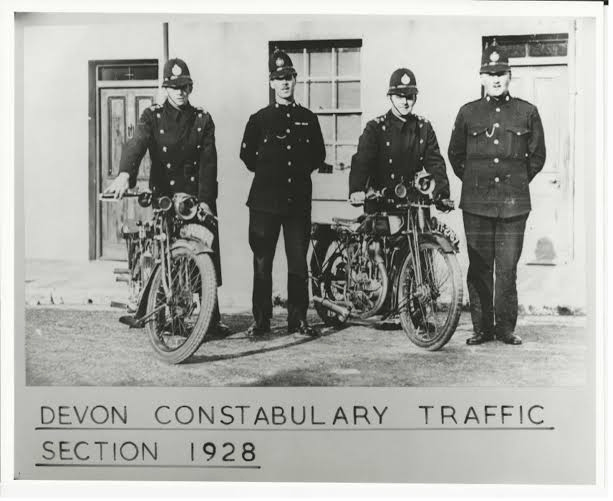
Following the Renaissance, Enlightenment, and Industrial Revolution, the bourgeoisie became very rich in the UK – but constituted a vulnerable minority of the population. The bourgeoisie ruthlessly exploited the majority who are the workers and treated them appallingly. This led to a rapid growth in crime which saw outlaws (disguised workers) “steal” from the rich as a means of forcibly re-distributing wealth. The workers were forced to do this as the bourgeoisie would not listen to the unions or curb their excesses. To remedy this threat to their immense wealth (surplus profit) the English invented the “police” (Greek “polis” – meaning “State”). from around 1800 onwards, various police forces were developed so that constables could be placed everywhere amongst the masses and throughout society. They were even used to stand at cross-roads and act as traffic-lights prior to 1930. As the police are a tyrannical outfit – they are not democratic but authoritarian. When a worker encounters the police – their rights are suspended during the encounter. The extent of this suspension will depend upon the purpose of the encounter.
Liberal, democratic freedom is replaced with a despotic emphasis of law. This can result in fines, charges, and even imprisonment. Therefore, when ordinary citizens encounter the police they should be aware of the dynamics of the situation. Everything has to be regulated by law and not by will. Indeed, it is this loss of will that takes many younger people by surprise – and leads to the individual being subjected to ever more draconian police activity. Remember – the Bourgeois State manipulates the law so that police officers, at the point of contact, are always protected and empowered by the State, whilst the “suspect” is ever further disempowered. The only way out of this situation is to engage a lawyer – who pretends to represent the individual concerned, whilst in reality protecting the State and generating financial income out of the entire affair. Remaining “silent” (other than giving your details) and engaging a lawyer is the only path permitted by the Bourgeois State. Of course, many workers cannot afford a lawyer and must therefore submit to everything the State wants to do. The worker suffers the true tyranny of the Bourgeois State – whilst having been brainwashed at school to falsely believe that the Bourgeois State is the “freest” socio-economic construct in the world.
Herein lies the root contradiction that often leads to a profound shock with many workers suffering PTSD when encountering police officers. And this even before being handcuffed and locked in a cell is experienced. This experience is precisely how a Fascist State operates all the time. The liberals claim their version of society is superior to fascism – but it inflicts a fascist-type law enforcement upon its citizens. This is an interesting contradiction to consider. Liberal democracy possesses very little freedom to chose from in reality – and has the tendency to inflict a fascist-style suppression upon its own population. Should the workers group together and demonstrate solidarity in the face of police oppression – then the Bourgeois State will unleash the military. Whereas the police deprive an individual of freedom (and occasionally of life) – the military always deprives the individual of life. After-all, the bourgeoisie secured its political power by force of arms – and retains its power by force of arms.

