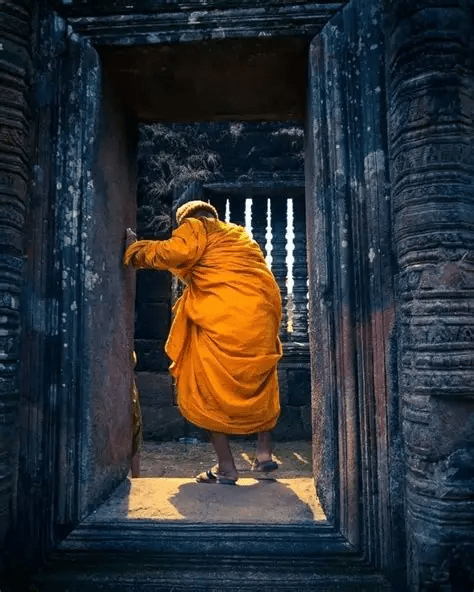
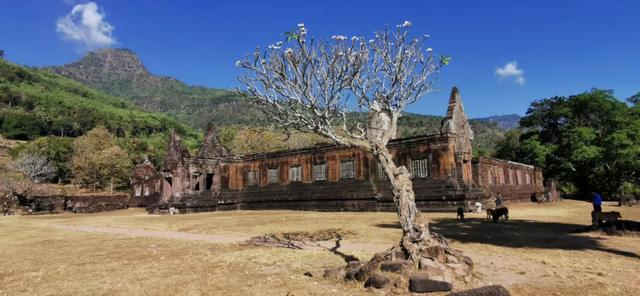
Wat Phu (ວັດພູ) – literally “Temple Mountain” (or “Mountain Temple”) – is a historical (religious) site that is a “Buddhist-Hindu Temple” situated in the Champasak Province area of Laos. It is located 8 kilometres northeast of Champasak town – on the slopes of Phu Gao Mountain (at an elevation of 1200 metres). The name can also be translated as “Stone Temple”. Its architectural complex stretches over hundreds of metres along the mountainside, and is entirely constructed from ornate carved stone blocks, being a relic of the Khmer-era style of building prevalent during the 7th to 12th centuries – similar to Cambodia’s Angkor Wat. Together these two major Khmer sites were designated in 2001 as the core of Champasak’s cultural landscape. Although Theravada Temples are “free” to enter – it seems that when these sites become a UNESCO site – a charge is levied on visitors (an example of typical pollution through capitalist association). As Laos is a poor and developing country (due to the US aggression in the area) the charge in Laotian money might be quite high – namely 55,000 kip (220 baht). In English money this amounts to £4.49 – or nearly a fiver. For a well-off Western tourist this is affordable – but it amounts to a month’s pay for a welll-paid middle class Laotian! Even then, this would be a high amount. I am told the local Laotian people either do not have to pay – or pay a very small fraction of this amount. However, the Dhamma-teachings are clear – no one is to charge when teaching the Buddha’s words. All temples must remain “free” and “open” to all beings. Capitalism should not be allowed to destroy Buddhism or Socialism.
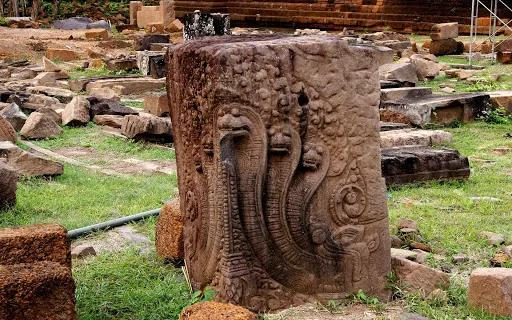
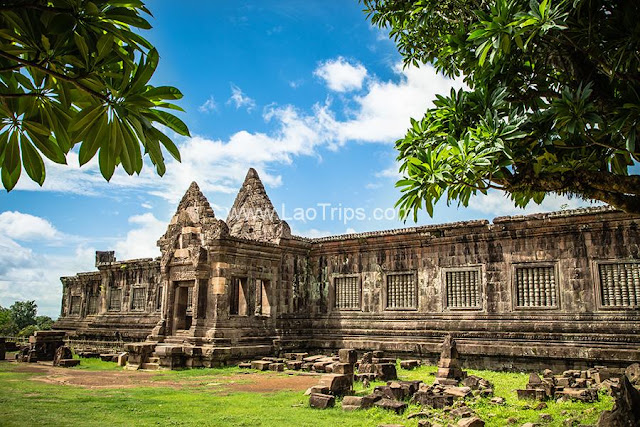
The main Buddha Hall is located on a flat slope beneath the giant rocks that comprise the “Sacred House.” The stone walls are carved with mythological scenes such as (the Hindu) Hanuman monkey-god fighting demons and Gisna tearing apart the Dragon King. Inside the hall are numerous Buddha statues and a stone statue of King Phayakamata of Champasak. The site area preserves the foundations of two stone palaces, scattered stone figures and beasts, and a sacred lake measuring 300 metres by 200 metres. The lakeside pavilion in the centre connects with the ruins of the Western Hall. The temple is said to have been built in the 7th century, with most existing ruins dating back to the 10th-century – during the peak period of the Khmer Empire. Every year from late January to early February, the Wat Phu Festival is held, featuring various religious ceremonies and activities.
Lao Language Text:
https://laotour2.blogspot.com/p/wut.html
Chinese Language Text:

