Blogger’s Note: The Asia-Pacific Economic Cooperation (APEC) represents 21 trading entities within the Pacific Rim area – designed to encourage “free trade” (i.e. capitalism). As such, China did not officially join it until 1991 (denoting a shift in how Socialist China interfaces with capitalist market forces). Chinese workers have been migrating around the world for hundreds of years during the Qing Dynasty (1644-1911) and beyond – with many dynasties forbidding ordinary Chinese subjects from travelling in this manner (outside of authorised merchants). Since the 1911 Nationalist and 1949 Socialist Revolutions – this process has increased significantly. Even before this, however, those Chinese citizens living within Czarist Russian, Japanese and European colonies were often used as a source of cheap labour and exported all over the British Empire, the Americas, Russia, other parts of Asia, Africa, and Europe, etc. The capitalist West has also weaponised Chinese migration (out of China) in recent years – in an attempt to undermine Socialism in China (the post-2020 mass importing of Hong Kong Rioters into the UK is a prime example of this cynical policy). The term “Qiaoqi” (侨企) refers to a) “侨” (qiao) = residing abroad – and “企” (qi) = enterprise. ACW (17.11.2026)
2026-11-16 Ecns.cn Editor:Mo Honge
(ECNS) — Original letters and remittance documents that overseas Chinese sent home, known as “qiaopi,” were exhibited together for the first time Sunday at the cultural exchange area of the media center for the 2026 APEC Economic Leaders’ Week in Shenzhen, in southern China’s Guangdong province.
Qiaopi, a combination of remittance voucher and family letter, has drawn renewed public attention following the success of the Chinese film “Dear You.” Qiaopi served both practical and emotional purposes: overseas Chinese used them to send money to support their families while conveying news and messages to loved ones.
In 2013, the qiaopi archives were inscribed on UNESCO’s Memory of the World Register, recognizing their value in documenting global migration history.
Among the exhibits is a qiaopi sent from Melbourne, Australia, then known among Chinese migrants as New Gold Mountain, to Dawan village in Guangdong province in 1930. Its handwritten recipient details remain clearly legible. The document records how an overseas Chinese migrant entrusted a fellow villager with delivering money and a letter to family back home.
Another exhibit is a 1920 qiaopi sent from Papua New Guinea to Guanghai town in Jiangmen, Guangdong. At the time, Chen Lianke, an overseas Chinese migrant, used a remittance agency to transfer money to his family.
These letters show that overseas Chinese had already traveled and settled in many parts of the world, said Yan Kangxin, director of the media center’s cultural exchange area.
The exhibition brings together original documents spanning more than a century, from a 1901 return-remittance package sent from Guangzhou to San Francisco to a 2002 letter sent from Chile to Zhangzhou in east China’s Fujian province, Yan said.
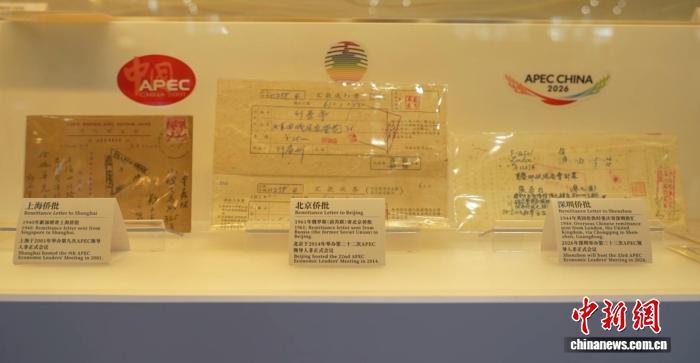
The exhibition features three qiaopi documents displayed side by side, each associated with one of the three Chinese cities that have hosted or will host APEC Economic Leaders’ Meetings — Shanghai, Beijing and Shenzhen. Their corresponding APEC logos are placed above the documents, creating a visual link between personal correspondence and the history of Asia-Pacific cooperation.
“Seeing this letter addressed to Shenzhen is quite moving. In the 1940s, Shenzhen was still a small fishing village. Today, it has become a modern metropolis,” Yan said.
Through the exhibition, organizers hope to highlight the long history of economic, trade and cultural exchanges among Asia-Pacific economies as their leaders gather for talks, Yan said, adding that they hope regional partners will continue to work together.
(By Gong Weiwei)

