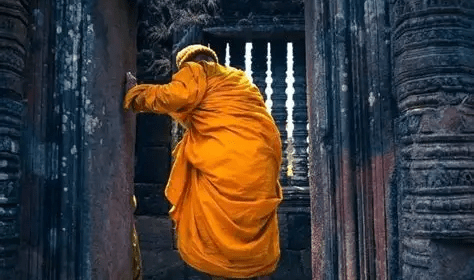
A Theravada Buddhist Monk in the Ruins of “Wat Phu (ວັດພູ)”!

Buddhist-Socialist Laos: “Wat Phu (ວັດພູ)” – An Example of a Khmer-Era Buddhist-Hindu Temple! (6.8.2026)

The stone walls are carved with mythological scenes such as (the Hindu) Hanuman monkey-god fighting demons and Gisna tearing apart the Dragon King. Inside the hall are numerous Buddha statues and a stone statue of King Phayakamata of Champasak. The site area preserves the foundations of two stone palaces, scattered stone figures and beasts, and a sacred lake measuring 300 metres by 200 metres. The lakeside pavilion in the centre connects with the ruins of the Western Hall. The temple is said to have been built in the 7th century, with most existing ruins dating back to the 10th-century – during the peak period of the Khmer Empire. Every year from late January to early February, the Wat Phu Festival is held, featuring various religious ceremonies and activities.

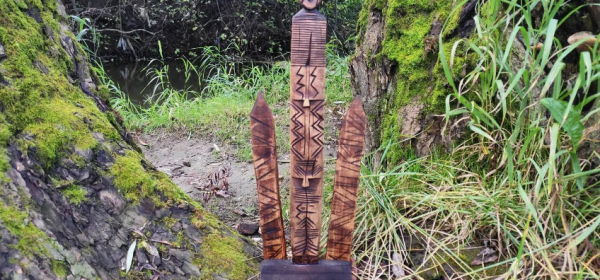
Russia: The Enigma of the Asiatic Giant Shigir Idol (Большой Шигирский идол) – Where Ancient Russians Really Seventeen-Feet Tall? (12.3.2023) 

I have heard a number of Slavic academics stating that they believe that some of the patterning on the exterior of the Great Shigir Idol constitutes a written ‘language’. If correct, this finding would constitute the world’s ‘oldest’ written language! I am not adverse to this idea and I believe such a suggestion requires further investigation! Based upon the mythology of the Ugrians, Natalia Chairkina sees in these images a reflection of a vertical model of the universe logically divided into the Upper, Middle and Lower worlds (similar to the ‘trigram’ and ‘hexagram’ of the Chinese book ‘Classic of Change’) – which accommodate seven spheres of empty space. Archaeologist Peter Van Petersen of the National Museum of Denmark has suggested that the idol may have served as a warning at the border of a forbidden territory to scare off invaders or undesirables – or to test the courage of an individual or group. A number of Archaeological experts also note the similarity of design with the monumental stone ruins in Göbekli Tepe in Turkey (which is of a similar age). As many of the marking are both difficult to see and ambiguous in design – it is currently very difficult to produce a definitive interpretation. The best policy is for everyone to ‘look’ at this remarkable structure themselves – and up their own mind. Conventional science has already proven its improbable age! Let’s follow Lenin’s example and sit in our kitchens and ‘think’ great thoughts!