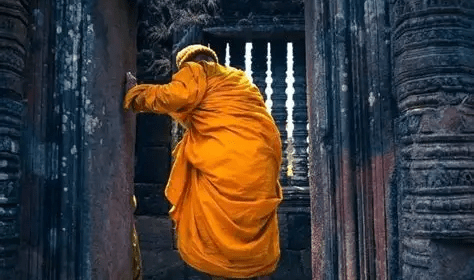
A Theravada Buddhist Monk in the Ruins of “Wat Phu (ວັດພູ)”!

Buddhist-Socialist Laos: “Wat Phu (ວັດພູ)” – An Example of a Khmer-Era Buddhist-Hindu Temple! (6.8.2026)

The stone walls are carved with mythological scenes such as (the Hindu) Hanuman monkey-god fighting demons and Gisna tearing apart the Dragon King. Inside the hall are numerous Buddha statues and a stone statue of King Phayakamata of Champasak. The site area preserves the foundations of two stone palaces, scattered stone figures and beasts, and a sacred lake measuring 300 metres by 200 metres. The lakeside pavilion in the centre connects with the ruins of the Western Hall. The temple is said to have been built in the 7th century, with most existing ruins dating back to the 10th-century – during the peak period of the Khmer Empire. Every year from late January to early February, the Wat Phu Festival is held, featuring various religious ceremonies and activities.
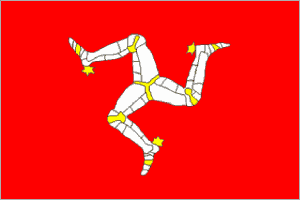
Three Armoured-Legs Moving Clockwise in the Direction of the Sun!

Isle of Mann: The 5,000-Year-Old Grave on a Manx Front Lawn! (3.8.2026)

As Celts, we are very much on our path toward a progressive future. After the English Civil Wars of the 1640s-1650s – the absolute monarchy was permanently abolished and has never been bought back. What we have is a “Constitutional Monarchy” that possesses no political power and acts as an unelected Head of State – employed by the democratically elected Parliament – the winner of the Civil War(s). The term “Crown” is a misnomer – as in this instance the term “Crown” refers to “Parliament” – or that (bourgeois) body which now possesses control of the means of production (which it took-off the aristocracy by force of arms – executing King Charles I in the process). Cromwell was centre-left – but after his death, his son was overthrown and a centre-right bourgeois government took its place. It has been this way since 1659 – with every attempt of a Socialist Revolution being defeated. This centre-right bourgeois government even brought back a very weakened CofE, etc. So, the Isle of Mann (Manx) is an island of 85,000 Celts who live on an island in the Irish Sea between West England and East Ireland. The Celts used to occupy all the islands in this part of the world and shared a common identity. There are graves like this in Stonehenge, etc.

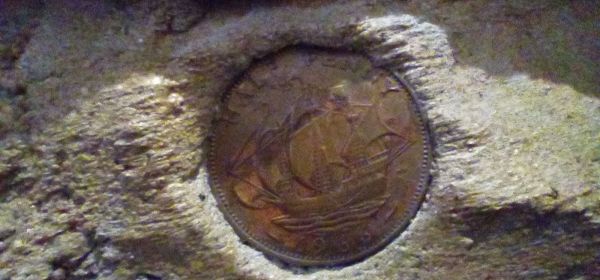
Half-Penny from 1966

Brixham: Coins in the Wall! (2.4.2026)

Administrative matters aside – I notice the above “interior” wall looks as if it used to be an “external” wall – as it looks weather-beaten and worn. Furthermore, in the UK, builders often leave a coin featuring the year any renovations were carried-out as a form of “good luck”. Usually, we find these coins under floor-boards, carpets, and lino, etc. Sometimes they are lodged between wooden joints or under various structures. In this wall, the coins seem cemented on the outside of the wall. There is a 1966 half-penny, and a 1960 three-penny. When I was first at school in the early 1970s – these coins were still in use. The old half-penny would today possess the buying power of £5 – whilst the three-penny bit could buy about £30s worth of goods. This was before the UK joined the EEC (1.1.1973). Prior to this, a British pound was comprised of 240 pence – afterwards it was deliberately devalued to just “100” pence. What a disgrace all this was!

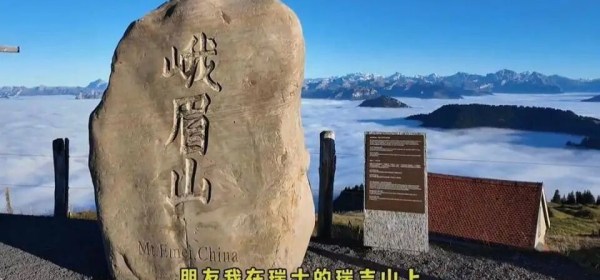
The Emei Mountain stone on Mount Rigi

Chinese Stone from Mount Emei Found in Switzerland! (25.10.2025)

According to reports, on Sept. 29, 2014, a 2.6-metric-ton conglomerate rock from Mount Rigi was installed at the Golden Summit of Mount Emei. In return, on July 31, 2015, an 8-metric-ton basalt rock from Mount Emei was set up at Rigi’s summit, Rigi Kulm.

According to the Leshan municipal government website, Emei and Rigi officially became sister mountains in 2009. The two sides agreed to exchange rocks to be placed at both summits as symbols of friendship.

The Mount Emei stone is a basalt rock formed around 260 million years ago. It is 2.6 meters tall, 1.5 metres wide, 1.5 metres thick at its deepest point, and weighs about 8.05 metric tons. (Gong Weiwei)

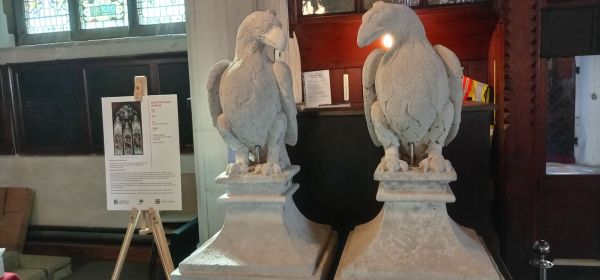
Two Rectory Eagles Restored!

Sutton: St Nicholas Church – Where Stone Eagle’s Dare! (13.9.2025)

Why did a Sutton Town Planner come up with the idea of a) demolishing the Old Rectory (which should have been a listed building), and b) placing the Gate-Eagles on two-plinths jutting-out of Council Flat walls? Was this an example of Free Masonry gone mad – or madder than their usual schemes? I spent about 15-minutes talking with a local historian in St Nicholas Church, Sutton, during an exhibition of the stain-glassed window and various stones. He told me that the Rectory Gates were originally in West Street – but the eagles ended up on the main road situated on the exterior walls of the new Council Houses – now named “Beech Tree Place” – effectively around the corner in a different street.

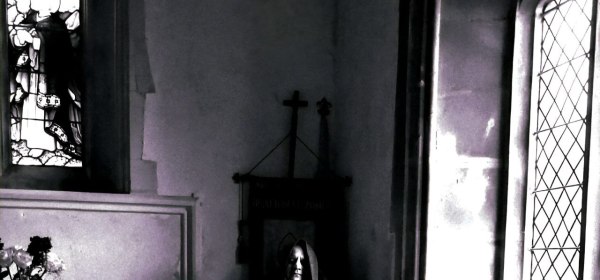
Adrian the Monk - 2025

Report: Ghost Hunting in North Devon! (29.8.2025)

With most of the lights off by 11pm, I sat on my religious chair (the Church dates back to the 14th century – and so does the chair). I cleared my mind and immersed myself into the ancient nature of the stone-work. The stone was cool to the touch – I went bare-foot to ground myself – and felt the calm structure of the place. No fear, no deception, and nothing to worry about, Although I neither support or oppose theology – I sensed the spiritual feel that all the attendees developed and projected into rge physical structure of the place. In many places in the UK, the Christians deliberately built their Churches on already existing Pagan sites of ancient spirituality – with nothing to do with a Christian god. The mistake that Christians make is that their own mind creates the religion they believe in – but they mistakenly believe that their religion exists “outside” their heads, independent of the mind that generates it. The perception is inverted and the wrong way around.

1 2