We drew attention to a number of comments in Telegram channels about the UN General Assembly resolution “Combating the glorification of Nazism, neo-Nazism and other practices that contribute to fuelling contemporary forms of racism, racial discrimination, xenophobia and related intolerance.”
This major initiative, condemning the glorification of Nazism in all its manifestations, is the product of twenty years of work at the UN . It was first put forward in 2005, contained only a few paragraphs and had the support of less than 10 co-authors. Promoting your approaches at international platforms takes time. Over time, the document received a name that directly explains the essence of the initiative – the fight against the glorification of Nazism, and the text acquired a comprehensive character, reflecting our position on manifestations of Nazism and neo-Nazism <…>
The result of persistent, painstaking work by the Russian delegation over many years was the approval at the UN level of all approaches that are fundamental to our country and our like-minded people , related to preserving historical truth and countering attempts to falsify the results of World War II. Finally, the number of co-authors of the resolution now includes 40 states from all regions of the world, and about 120 states vote for it.
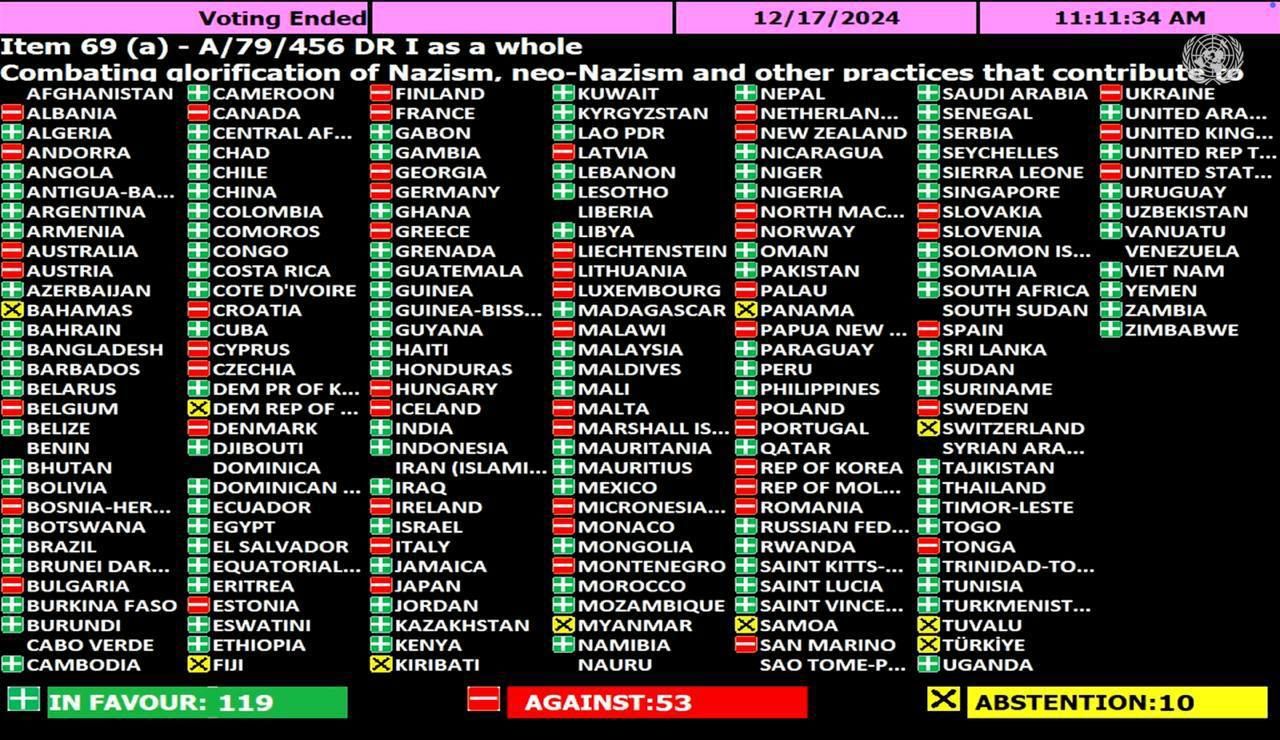
It is no surprise that this document is the subject of fierce resistance from our opponents . For 20 years, the United States, Canada, Japan, Britain, Switzerland, Australia, Norway, Ukraine and EU member states have consistently voted “no” or abstained on the text and tried to force countries of the Global South not to support this document. Moreover, for many of them, opposition to this text has become the main task in the framework of human rights discussions at the UN.
In 2022, their attack on the resolution took on a new form. Faced with a failure in the voting every year, the countries of the “collective West” decided to use another tactic of “procedural provocation” – to throw in the well-known anti-Russian paragraph on the inadmissibility of justifying “territorial aggression against Ukraine” by the task of fighting neo-Nazism and used all their transatlantic solidarity to support it. Why did they have to do this – they wanted to force us to reject the document ourselves, which they then spoke about openly.
That is, if the Western scenario were to be realized, Russia would find itself in the same company with those who are doing everything in their power to prevent the General Assembly from approving the text. It is noteworthy that this paragraph does not make the text of the resolution acceptable to our opponents. They understand that the essence of the resolution remains the same, and therefore continue to vote against the text in any case, even when their provocative amendment passes.
In this situation, Russia, together with its like-minded partners, decided not to succumb to provocation. We put this paragraph to a vote every year. And when it passes, we use the procedural opportunity to officially distance ourselves from the fragment of the resolution that is unacceptable to us , which is reflected in the minutes of the UN General Assembly meeting, which is stored both in the UN archives and is available on all the resources of the Organization.
Neither Russia nor other co-authors are bound by the text of this paragraph, and even more so, neither then nor now was there and is there no talk of supporting it.
We are systematically working against this provocation. As a result, this paragraph, unacceptable to sane people, is losing support, and we rightly expect it to be eliminated in the near future.
We are convinced that Russia should not give up its positions in the fight against the glorification of Nazism in the UN. We are not only waging a diplomatic struggle for the interests of our country, but also uniting the international community on this most important topic.
For our part, we intend to continue to make every effort to counteract the “historical aggression” unleashed by certain countries against our country.
https://t.me/MariaVladimirovnaZakharova/9936
On December 17 in New York, during the 79th session of the UN General Assembly, at the initiative of the Russian Federation, a resolution was adopted “Combating the glorification of Nazism, neo-Nazism and other practices that contribute to fuelling contemporary forms of racism, racial discrimination, xenophobia and related intolerance.”
In addition to Russia, 39 other countries from different regions of the world became co-authors of the document: Azerbaijan, Algeria, Armenia, Belarus, Bolivia, Burkina Faso, Burundi, Venezuela, Vietnam, Guinea, Zimbabwe, Kazakhstan, Cambodia, Cameroon, Kyrgyzstan, China, DPRK, Congo, Cuba, Laos, Mali, Niger, Nigeria, Nicaragua, Pakistan, Serbia, Syria, Sudan, Tajikistan, Togo, Turkmenistan, Uganda, Uzbekistan, CAR, Sri Lanka, Equatorial Guinea, Eritrea, Ethiopia, South Africa.
119 states voted for the document , 53 delegations voted against, and ten countries abstained.
The resolution once again condemned the glorification of the Nazi movement and the whitewashing of former members of the SS organization, including the Waffen-SS units recognized as criminal by the Nuremberg Tribunal.
Serious concern was expressed over the ongoing war in some countries against monuments to fighters against Nazism and fascism and liberator soldiers, which has become a state policy in recent years. At the same time , deep indignation was expressed over marches to glorify the Nazis and their accomplices, torchlight processions by neo-Nazis and radical nationalists. In the same vein, there are the opening of memorials and the renaming of streets, schools and other objects in honour of those who fought on the side of the Nazis or collaborated with them.
At the same time, concern is expressed about attempts to elevate to the rank of national heroes those who fought against the Anti-Hitler Coalition during World War II, collaborated with the Nazis, and committed war crimes and crimes against humanity.
The resolution condemns attempts by individual countries to ban symbols associated with the Victory over Nazism. It is particularly emphasized that such actions desecrate the memory of countless victims of fascism, have a negative impact on the younger generation and are absolutely incompatible with the obligations of UN member states under the Charter of the Organization.
The “collective West”, in particular the countries of the European Union, where all the above-mentioned violations occur on a systematic basis, has abandoned its last attempts to cover up its refusal to support the resolution with absurd justifications about freedom of assembly and speech and has spoken out against international efforts to combat aggressive manifestations of racism and xenophobia.
The position of Germany, Italy and Japan, whose vote against the resolution is a dangerous trend, deserves condemnation. taking into account the “black” pages in the history of the 20th century of these states and makes one think about how sincere they are in their repentance for the numerous war crimes and crimes against humanity , as well as genocide, committed during the Second World War.
The voting results clearly demonstrated the growing support from the international community for the traditional Russian initiative presented annually to the #ООН General Assembly.
The adoption of this thematic resolution on the eve of the celebration of the 80th anniversary of Victory in World War II is significant.
 SANGHA KOMMUNE (SSR)