Dear Dr Wyles,
How do you see the work of Pannaloka (Prof)? I think he understands Chinese Buddhism.
Thanks
HH
Dear HH
Around 6-years ago, I managed to contact Ven Pannaloka [Wisdom Divine-Sky] (via email) after contacting his Publisher (I think in India). I have a high respect for this erudite bhikkhu and have communicated with him a number of times. The Ven. Pannaloka adds this data to the foot of his email:
Dr. Rev. Wadinagala Pannaloka
Senior Lecturer and Academic Co-ordinator
Dept. of Buddhist Philosophy
Postgraduate Institute of Pali and Buddhist Studies (UOK)
113, Dutugemunu Street
Kohuwala
TP: +94-711134120
http://www.kln.ac.lk/institutes/pgipbs/
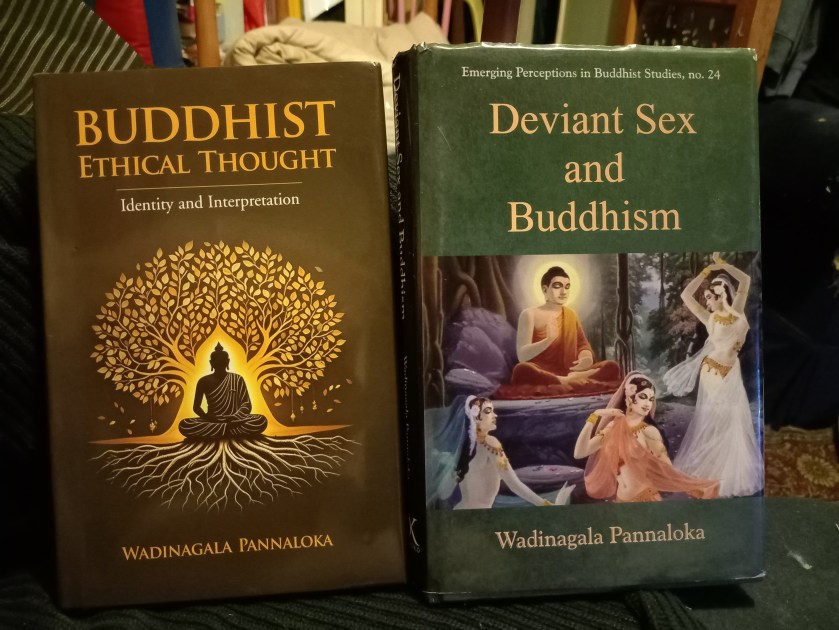
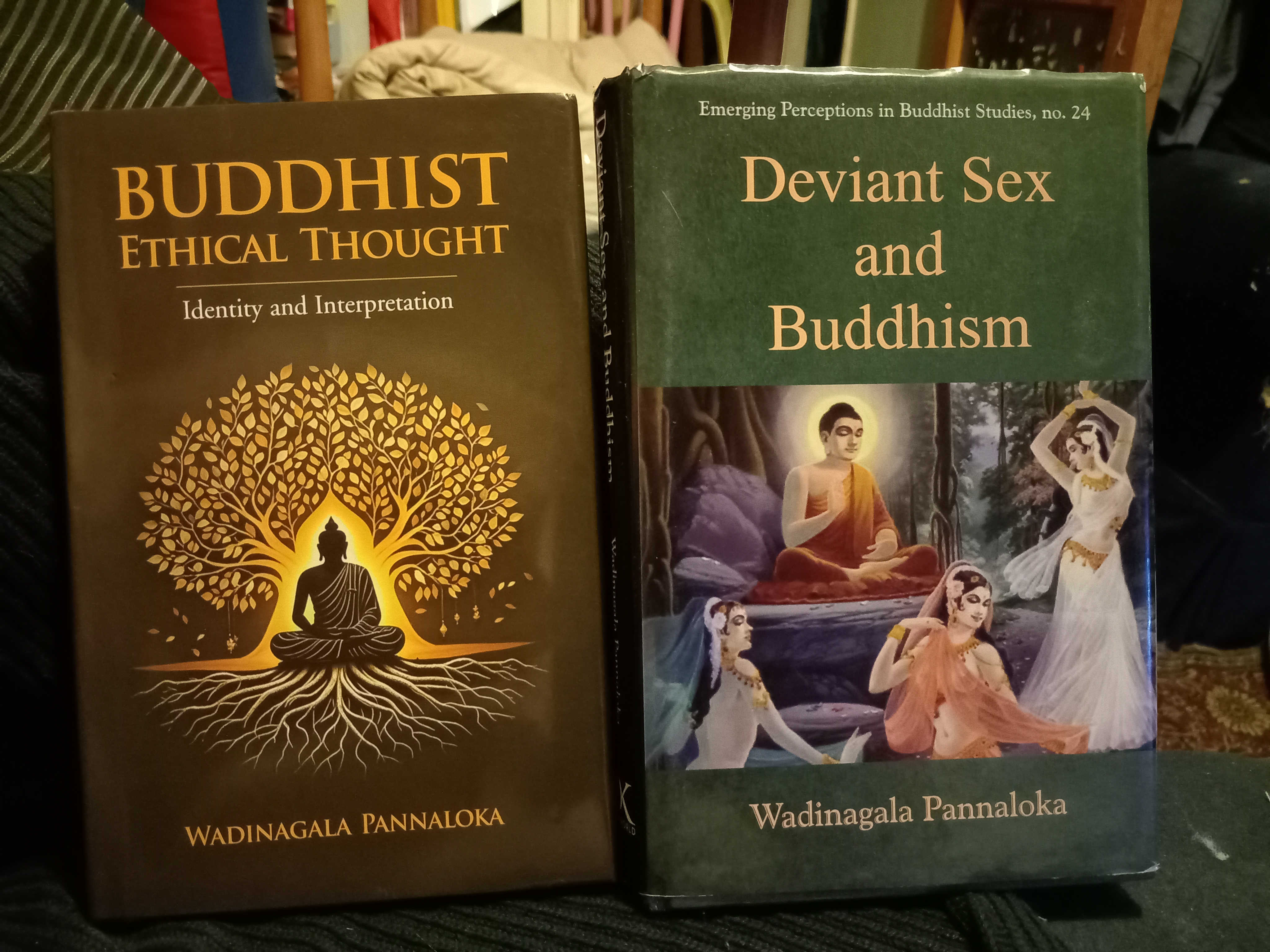
The book that encouraged me to contact the Venerable is his [2020] “Deviant Sex and Buddhism” (No. 24 in the “Emerging Perceptions in Buddhist Studies”). I had spent sometime in Sri Lanka (during 1996) studying a Forest Tradition of Theravada Buddhism under Mangala Thero at the Ganga Ramaya Temple, Moragalla, Beruwela, Sri Lanka (situated in the Kalutara District, Western Province – on the Southwest coast). Since childhood, I have been immersed in the correct Pali and Sanskrit Dhamma and Dharma (the latter in the Chinese tradition), and am well aware of the differences between how the West interprets Buddhism – and how the Buddhism is actually practiced in the East. A number of Sri Lanka teachers have taught me how the West misinterprets and misunderstands Buddhist teachings (further complicated by the integration of Buddhist practice with exploitative capitalist endeavour). This area is extensive and I cannot go into all of it here – but I found the Ven. Pannaloka’s [2020] book to be in the tradition of “correcting” the Western narrative with regards to understanding and interpreting “morality” (Sila). To be far, I do not think this was the Ven. Pannaloka’s motivation as such. He simply produced a very well researched tome clarifying the Dhamma.
In recent days I picked up the Venerable’s [2020] book and began reading it again – as part of my general Vinaya studies (Buddhist morality for the laity is not exactly what the Western [Judeo-Christian] tradition suggests it is – this is a Eurocentric distortion and over-simplification – as the Buddha was far more pragmatic than many realise). As I read, I was inspired to email Ven. Pannaloka to thank him for his efforts in spreading the Dhamma (my first email to him in six-years) and the Venerable Professor replied – stating he has just published a new book entitled “Buddhist Ethical – Identity and Interpretation” (2026) – which I ordered online (from an Indian Publisher – Munshiram) – costing about £40 including shipping (when looked at in rupees – this is a huge amount in India – again – nothing to do with the Venerable bhikkhu). So far so good. The book dropped through my door yesterday – and I was slightly surprised by the content. The book is good quality, well-written, and soundly published. As I am of the Chinese Buddhist tradition you can imagine my surprise to discover that the Ven. Pannaloka had studied for his PhD under Prof. Shui Chuen Lee, Director of Research Center for Chinese Philosophy (the incorrect spelling of “centre” demonstrates the US influence) – further described as the “the Former Director of Graduate Institute of Philosophy, National Central University, Taiwan”. (The Venerable monk is known as “Shi Ming Kuang” in Taiwan – “Ven. Bright Light”).
To be clear, this is what the dust-cover says about Ven. Pannaloka and his academic expertise:
‘Wadinagala Pannaloka (PhD – National Central University, Taiwan) is a Sri Lankan British monk trained in both Theravada and Mahayana monastic education. He has authored two monographs, Deviant Sex and Buddhism and Mahadukkhakkhamdha Sutta: Study on Pali and Chinese Parallels. Currently he is serving as a Senior Lecturer at the Postgraduate Institute of Pali and Buddhist Studies, University of Kelaniya, Sri Lanka.’
However, where my Chinese family is linked to Mainland China via Hong Kong – my Buddhist experience (as a “bhikshu”) is from the Ch’an tradition as extant within Mainland China. Even the lay (Caodong) tradition I inherited is linked directly to Master Xu Yun (1840-1959) – although via Charles Luk and his Western disciple Richard Hunn. Whilst working for the Buddhist Prison Chaplaincy Organisation in the UK (a Thai Buddhist mission visitiing inmates in the UK prisons) – we would receive free Buddhist books for distribution from a Taiwan publisher. This has been one of the positive experiences of Taiwan (a US colony) that I have experienced. The Taiwan Buddhist Temple near Oxford Street, when we have visited, is set to “sell” goods and services, so we no longer frequent that place (they were also rude regarding the passing of Richard Hunn who had donated an expensive Chinese-English dictionary to their library – they would not issue a prayer on his death as he was “not a paid-up member of the temple”). Like many ethnic Chinese people in the UK – we do not accept these Taiwan manifestations as representing a genuine expression of Dharma.
Having said this, I do know a number of Taiwanese people in Taiwan who do possess a good and positive attitude – and there are many who view the Mainland as their cultural ancestor (not the US). Of course, none of this has anything to do with the Ven. Pannaloka – but I mention it as it contextualises my thoughts and opinions. Back to business. Although Ven. Pannaloka’s latest “published” book is his 2026 time – it is NOT his latest “written” book. Far from it, the basis of this text is the Venerable Bhikkhu’s PhD Dissertation written whilst he was studying in Taiwan (I cannot see an exact date for this text – but as the Venerable Bhikkhu was born in 1974 – I assume he may have been studying during the 1990s or thereafter). Twenty-years after writing my dissertation (2006) – I can safely say that accept in very broad assumptions – I probably no longer agree with any of it (as my thought processes have developed and moved onwards in understanding). As to the content, although the Ven. Pannaloka atempts a parallel between Theravada Buddhist ethics and the philosphy of Aristotle, John Stuart Mill, and Kant, etc.
This is not what I expected as the average Westerner has no working knowledge of the Western philosophical tradition and is more likely to be informed by Judeo-Christian thinking and US consumerist capitalism – the reality is that basic. As regards my translation career of Chinese Buddhist texts into English – the reality has been encouraging Westerners to abandon their in-built bias (regarding other cultures) and learn the basic principles about Chinese Buddhism anew. Although parallels can be drawn between this and that – it is the “escaping” of suffering that is omitted. As the Buddha advised – if a physical body can be produced through (karmic) conditioning – it is also possible to undo that conditioning (through meditation and moral discipline). As suffering is bound-up with the conditioning process – the abandonment of conditioning (by uprooting the asavas of sensation, individuality, delusion, and ignorance – and realising the empty mind ground) is the method of escaping suffering. This Buddhist perspective is important when compared to the Western philosophers – who merely reposition key ideas within their surface minds (achieving no discernible shift in reality). Kant is probably the most obscure of these “thought-shifters” who offers very little in the emancipation from suffering. Besides, it is Karl Marx (who corrected the inverted thinking processes of Hegel) who is arguably the greatest Western thinker – and unfortunately the Ven. Pannaloka does not mention him.

