The Mind Must Be Calm and Serene!

BMA-UK: Buddhist Practice of “Accepting” & “Rejecting” Food Donations – The Politics of the Buddha’s Begging Bowl! (8.9.2026)

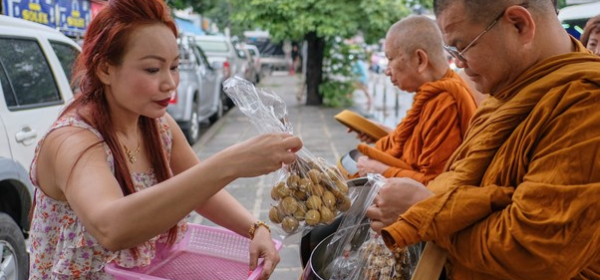
Rules in the Dhammic-sense serve only as basic guides toward moral-behaviour – hence the obvious latitude found in the night-life of places such as Thailand. Obviously, a lay-Buddhist is free to follow whatever path they perceive is correct for themselves and the circumstances they inhabit – after-all – it is their karma-producing habit. One issue is not to inflict suffering on others – including animals (this is why my family will never hurt animals in anyway). Hunger striking, in this sense, only physically “hurts” the individual participating in it – although a case can be made that those watching or caring “from afar” might suffer emotional pain. Of course, in the poor parts of Asia, Buddhist monastics exist whilst eating every other day – as the laity is so poor they have very little to share – but what an effort they make! Although starving themselves, the Buddhist laity will put aside a small amount for the Buddhist monastics. I was told that in the Northern forests of Thailand food is so scarce that Buddhist monastics often sieve a type of algae out of the local rivers – using their begging bowls – and share this to eat.
Richard Hunn: The South-Paw Guitar Player! (15.10.2023)

his is how I ended-up training under Mangala Thero (in 1996) at the Ganga Ramaya Temple (in Beruwela) – situated in Sri Lanka. I have subsequently discovered that Mangala Mahathero has passed away after spending the last decade of his life living and meditating in isolation. I am told that Richard Hunn would sit ‘still’ for hours on end in various Zen Temples throughout the Kyoto area. Although outwardly he was practicing ‘Zen’ – inwardly he was practicing ‘Caodong’ Ch’an – the preferred lineage of Master Xu Yun (1840-1959). Although none of us know how long we will be on this Earth – we must remain vigilant and use our time effectively and productively! Not a single second must be wasted when it comes to self-cultivation! Instead of reading this board – look within! Richard Hunn was my academic and spiritual teacher between 1989-2006. He taught me to read and translate properly every modern and traditional Chinese language ideogram – whilst also conveying to me the teachings of the authentic Chinese Ch’an Buddhist tradition!

Buddhism: Pali Bhavana and Chinese Ch’an

Chinese transliterations and translations are useful as the early Chinese scholars had to understand the Indian Pali and Sanskrit terms before they could be rendered effectively into the Chinese language. Obviously, some of the early transliteration of Indian Buddhist terms are purely ‘phonetic’ in nature and in themselves do not convey much meaning as ideograms. This represents an initial process of a slow, careful and gradual building-up of knowledge in China about a thoroughly ‘foreign’ Indian philosophy that had to develop an ‘interface’ with existing Chinese culture.