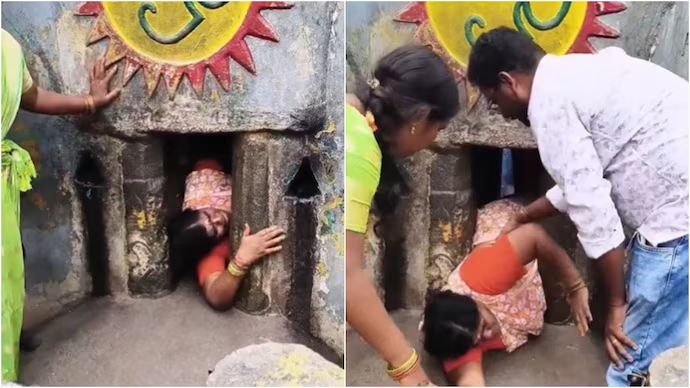
Blogger’s Note: In the (Dravidian) Telegu language of South India – “మోక్ష మార్గం” (Moksha Margam) translates into English as “Liberation Pathway”. Within Buddhist Pali this is transliterated as “mokkha-magga” (मोक्ख-मग्ग’) – and refers to the extinguishing of greed, hatred, and delusion (karma-producing events in the mind and body) – so that the individual attains a permanent state of “release” from the cycle of material suffering that is birth, life, and death. This demonstrates that the Buddha, whilst transcending Hindu theology, nevertheless made use of a number of Brahmanical philosophical concepts, whilst doing this. To achieve this break with deluded habit – a practitioner must meditate (control and discipline the mind) – and control and discipline the body (for the Buddhist this involves good “moral” behaviour). Being kind to others and not eating meat, etc, also contributes to this ongoing process. For the Hindu – who worships a pantheon of gods – this process also involves painful and/or selfless acts (similar to the self-flagellation found within Medieval Christianity). Whilst a Buddhist, for a time, might feel pain whilst deliberately “not doing something” they are used to doing (like an addict giving-up the desired object) – the Hindu will quite often willingly “invite” pain and suffering into their mind and body as a means to “purify” the senses, remove the obscuring karma, so that the “Atman” (soul) can clearly perceive (and unite) the deity in question. At the temple below, this process involves squeezing through a narrow stone passage. This indicates that “Dharma” (the spiritual path of self-purification) – is both “narrow” and “restrictive” – which is true. However, the path of Dharma tends to indicate that behaviour during everyday life is controlled and restricted as regards “choices”. This stone passage seems to be a metaphor in concrete terms – teaching the adherent that everyday freedom must be “restricted” (the stone tunnel) – if ultimate freedom is to be achieved – (emerging from the narrow tunnel). Ironically, the adherent often imerges from the tunnel just as deluded as when they went in. Herein lies why the Buddha propagated the message he did – which sees the practitioner understand [whilst meditating] that the “Atman” [soul] does not exist – and cannot unite with a god [that does not exist]). ACW (22.8.2026)
India Today – India Today Trending Desk – Chennai – UPDATED: Jul 29, 2026
Published By: Srimoyee Chowdhury
Published On: Jul 29, 2026 16:22 IST
A 36-year-old devotee from Andhra Pradesh died after getting stuck in the Moksha Margam rock passage in a temple in Tamil Nadu. A resurfaced video of another devotee trapped at the same spot has renewed calls for safety measures.
Days after a man died after getting trapped inside the narrow Moksha Margam passage at a temple in Tamil Nadu, a chilling video has resurfaced showing another devotee struggling to escape from the very same spot months earlier.
The video resurfaced after 36-year-old Manikumar from Andhra Pradesh died on July 24 while attempting to crawl through the narrow rock passage on the southern path of Arunachala Giri during his pilgrimage to the Annamalaiyar Temple, The Hindu reported.
Manikumar got trapped inside the tight opening and soon experienced severe breathing difficulties. Fire and Rescue Services personnel, assisted by local devotees, managed to pull him out. However, he was declared dead after being taken to a hospital.
As news of the tragedy spread, a video recorded months before the incident began circulating widely on social media.
The clip shows a woman trapped inside the same narrow passage while attempting to pass through the Moksha Margam. Unable to move and visibly struggling to breathe, she remained stuck for several minutes as devotees desperately tried to pull her free.
She was eventually rescued unharmed, narrowly escaping what could have become another fatal accident.
Meanwhile, devotees and social activists have urged authorities to introduce immediate safety measures, including installing warning signs, restricting access for people who may not be able to safely pass through the narrow gap, deploying safety personnel, and improving crowd management to prevent similar incidents.
The passage is located near the Idukku Pillayar Temple, one of the shrines visited by devotees during the 14-km Girivalam, or circumambulation, of Arunachala Hill.
Over the years, many devotees have come to believe that squeezing through the narrow rock gap, popularly known as Moksha Margam, or the “path to liberation”, brings spiritual benefits such as removing obstacles, warding off negative energies and helping one attain moksha, or liberation from the cycle of birth and death.
However, this belief stems from local folklore rather than established religious doctrine. There is no scriptural basis stating that passing through the narrow rock passage grants moksha.
Spiritual teachers generally describe moksha as a state attained through self-realisation, righteous living and devotion, rather than through a physical act. The recent tragedy, coupled with the resurfaced video, has intensified calls for authorities to prioritise safety so that faith does not come at the cost of human lives.

