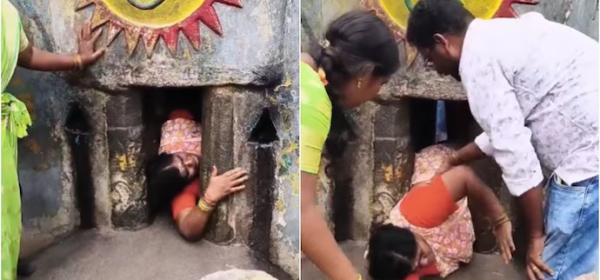
For the Hindu – who worships a pantheon of gods – this process also involves painful and/or selfless acts (similar to the self-flagellation found within Medieval Christianity). Whilst a Buddhist, for a time, might feel pain whilst deliberately “not doing something” they are used to doing (like an addict giving-up the desired object) – the Hindu will quite often willingly “invite” pain and suffering into their mind and body as a means to “purify” the senses, remove the obscuring karma, and clearly perceive the deity in question. At the temple below, this process involves squeezing through a narrow stone passage. This indicates that “Dharma” (the spiritual path of self-purification) – is both “narrow” and “restrictive” – which is true. However, the path of Dharma tends to indicate that behaviour during everyday life is controlled and restricted as regards “choices”. This stone passage seems to be a metaphor in concrete terms – teaching the adherent that everyday freedom must be “restricted” (the stone tunnel) – if ultimate freedom is to be achieved – (emerging from the narrow tunnel). Ironically, the adherent often imerges from the tunnel just as deluded as when they went in. Herein lies why the Buddha propagated the message he did.