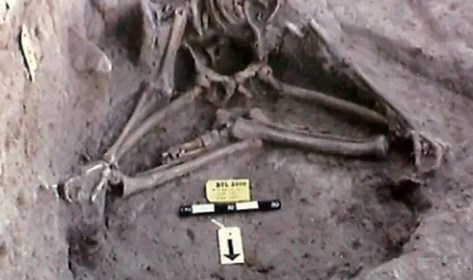
A Tamil Nadu temple has come under spotlight for its narrow 'Moksha passage'. (Photo: X)

India: “Moksha Passage” of Tamil Nadu Temple Claims Life – Another Escapes! (22.8.2028)

For the Hindu – who worships a pantheon of gods – this process also involves painful and/or selfless acts (similar to the self-flagellation found within Medieval Christianity). Whilst a Buddhist, for a time, might feel pain whilst deliberately “not doing something” they are used to doing (like an addict giving-up the desired object) – the Hindu will quite often willingly “invite” pain and suffering into their mind and body as a means to “purify” the senses, remove the obscuring karma, and clearly perceive the deity in question. At the temple below, this process involves squeezing through a narrow stone passage. This indicates that “Dharma” (the spiritual path of self-purification) – is both “narrow” and “restrictive” – which is true. However, the path of Dharma tends to indicate that behaviour during everyday life is controlled and restricted as regards “choices”. This stone passage seems to be a metaphor in concrete terms – teaching the adherent that everyday freedom must be “restricted” (the stone tunnel) – if ultimate freedom is to be achieved – (emerging from the narrow tunnel). Ironically, the adherent often imerges from the tunnel just as deluded as when they went in. Herein lies why the Buddha propagated the message he did.

Sheldrake Lecture - 2004

UK: Should Cambridge University Investigate Rupert Sheldrake? (12.8.2026)

The Buddha does not contain ALL knowledge as if it were lying dormant in his mind at any given moment (therefore he is not “omniscient” in this sense) but he does say that an enlightened being can direct the mind in any direction he or she wishes (like a net enveloping and collecting all things) throughout the world, and in so doing bring any part of it into his enlightened conscious awareness.  This lasts for as long as concentration is held in that direction and then fails away – remember that the true nature of the mind is “empty” and spacious – so that all phenomena seems to arise and pass away within it.  In fact the Buddha states a long list of abilities and powers he possesses – including the ability for his mind’s awareness to travel to other worlds.  What happened over-time is that through various commentaries and translations, the fact that the Buddha could move his mind’s awareness in any direction (or none) became conflated with the idea that his mind’s awareness was already in every place and at every time.

PRC Buddhism is Socialist!

BMA-UK: Zhao Zhihao (赵志浩) – Promoting the Further Sinicization of Buddhism & Integration with Socialist Society! (3.8.2026)

As the Mahayana Sutras became more popular in China than the Pali Suttas – the idea of strict vegetarianism (which had spread from India via various Vinaya Discipline texts) took root (even though it was only meant initially for the monastic order). Buddhist vegetarianism was not invented in China (as the author of the below [translated] text seems to imply). It is true that at least two Emperors in China did ban meat-eating in their respective countries – and instigated an expansive vegetarianism amongst the general public (Buddhist and non-Buddhist). This meant that Buddhist monastic vegetarianism was spread throughout the Buddhist laity and beyond – and this was a transformation of Buddhist practice in general that has persisted into modern times. Much, if not all of the interfacing Chinese philosophy that at least gave structure to Chinese Ch’an (Dhyana) Buddhism arose from the “Change Classic”

Laos and Cuba have reaffirmed their long-standing partnership in sports and physical education by signing a new Memorandum of Understanding (MoU) to expand cooperation and strengthen sports development in the Lao PDR.

Laos: Sports Partnership Renewed with Cuba to Boost Athletic Development! (30.6.2026)

The renewed MoU builds on the enduring friendship between Laos and Cuba and continues bilateral cooperation in sports, physical education and arts education. It also establishes a framework for the exchange of knowledge, technical expertise and consultations in other mutually agreed areas, further enhancing cooperation and mutual understanding between the two governments.

Cuba has been a longstanding partner in supporting Laos’ human resource development. Over the years, it has awarded scholarships to Lao students to study sports and physical education, as well as Spanish, medicine and law. These educational opportunities have helped strengthen the country’s professional capacity across a range of sectors.

The Re-Arranged Family Shrine - 2026

UK: The Family Shrine Re-Arranged for the Passing of My Father! (18.6.2026)

Even if no member of a Chinese family has not trained in a formal spiritual order – incense will be regularly lit, and fresh flowers and fruit will be added every so many days. Of course, some shrines are kept-up at a greater degree than others – but this does not matter in the end. A family shrine is a door-way between one plane and another. It is a two-way structure that permits a solemn respect to traverse from the material realm into the immaterial realm – and allows a positive spiritual reality to emanate from the immaterial plane to the material realm. Today, I talked to my deceased father – and I did this via a photograph that my mother took and printed-out for me probably around 2010. The photograph was taken in the front garden of our old home at 2 Torbay Road, Torquay Road, Torquay, Devon (the shyster landlord took over a hundred thousand pounds in rent between 2002-2018 before applying a no-fault eviction because we requested a repair be made). As this was 16-years ago – my father would have been around 68-years old at the time. I suppose my father was at the peak of his power as an elderly person! Tomorrow we will collectively lit incense. It is the next stage of respectful mourning.

80 000 Wooden Blocks of Complete Collection of Buddhist Scriptures

DPRK: Buddhist Sutras on Display! (17.6.2026)

On a slightly different note, there was an English man called “Stephen Bachelor” who travelled to South Korea and joined a Buddhist monastic order. Indeed, I believe he eventually met the woman who would become his wife – at the time a Buddhist “nun”. Upon returning to the UK he established a Buddhist College in Devon – but as the years went by he started to describe himself as an “atheist” who do not believe in any form of religion or mysticism. He even banned Buddha statues from his meditation rooms – and when my teacher – Richard Hunn – was invited to teach, he also banned all incense. Of course, Buddhism is not a religion with the Buddha being described as “non-theist” (he said gods only seem to exist until believers realise they are non-existent). Yes – monotheism was unknown in the Buddha’s time – so it is interesting to consider what exactly it was that Mr Bachelor was reacting to? Did he think Buddhism was a religion – and the Buddha a god? Is this what they were teaching in South Korea?

1 2 3 34