Krishna & mohsha

UK: Emails – Looking for “Inner” Moksha! (22.8.2026)

Younger people today, perhaps due to the instant gratification the internet entails, seem to lack the ability to be diplomatic and to ration perception. This leads to violence and aggression between groups due to differences in perception. The interior differences spill-out into the material world – and violence ensues. The stone passage in the temple prevents any unnecessary lateral movement of the body – but the individual should also limit the inner movement of the mind. Then it does not matter whether the body “moves” through the gap or not. Remember, Western sentiment does not operate in this temple. Even if the body “dies” – a mind free of the cycle of birth, life, and death – is a mind (and spiritual-being) free of all suffering. Losing the body in this context is viewed as a win-win for the liberated individual. A disembodied spiritual being is now free to roam in any dimension (and epoch of time) whilst being no longer limited to this plane of existence. What, then, is the issue? Well, it seems that a trapped-body results in a confused and frightened mind – which fastens the individual ever-tighter to the cycle of birth. life, and death. Once the Indian Fire Brigade extracts the compressed being from the birth-canal – an enhanced suffering unfolds!

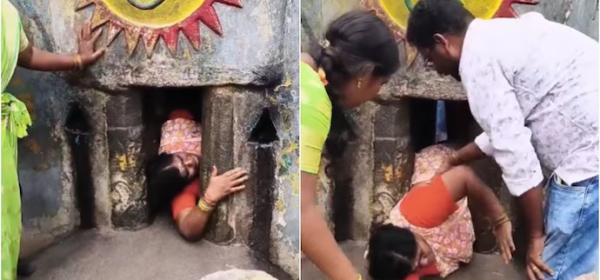
A Tamil Nadu temple has come under spotlight for its narrow 'Moksha passage'. (Photo: X)

India: “Moksha Passage” of Tamil Nadu Temple Claims Life – Another Escapes! (22.8.2028)

For the Hindu – who worships a pantheon of gods – this process also involves painful and/or selfless acts (similar to the self-flagellation found within Medieval Christianity). Whilst a Buddhist, for a time, might feel pain whilst deliberately “not doing something” they are used to doing (like an addict giving-up the desired object) – the Hindu will quite often willingly “invite” pain and suffering into their mind and body as a means to “purify” the senses, remove the obscuring karma, and clearly perceive the deity in question. At the temple below, this process involves squeezing through a narrow stone passage. This indicates that “Dharma” (the spiritual path of self-purification) – is both “narrow” and “restrictive” – which is true. However, the path of Dharma tends to indicate that behaviour during everyday life is controlled and restricted as regards “choices”. This stone passage seems to be a metaphor in concrete terms – teaching the adherent that everyday freedom must be “restricted” (the stone tunnel) – if ultimate freedom is to be achieved – (emerging from the narrow tunnel). Ironically, the adherent often imerges from the tunnel just as deluded as when they went in. Herein lies why the Buddha propagated the message he did.