
Blogger’s Note: Socialist Science abolishes all the internal barriers of false privilege and blatant discrimination that defines the bourgeois academic system. Indeed, the bourgeois education system is premised upon the expertise gained whilst maintaining a “contrived-limitation”. This is a type of “focusing” that whilst achieving results in a very narrow sense – does not allow a three-dimensional approach which would include the criticism of capitalism. The criticism of capitalism is no permitted – and should an academic produce work that does this, he or she would be immediately “cancelled”. Criticism of capitalism, liberalism, or liberal democracy is not allowed to develop and manifest within the bourgeois system outside of superficial treatments that do exceed or transcend the average 40-minute lecture. Oh yes, the “questioning” of the liberal (bourgeois) system might be superficially examined in a lecture regarding “free-thought” – the guiding implication is that those who operate “free-thought” in this way are usually the mentally-ill, or criminally-deficient (so do not do it). Indeed, within Alain Badiou’s book – entitled “Communist Hypothesis” – he states that even the best bourgeois universities are limited in their scope of research – as they must stay firmly within the realms of capitalist norms. Therefore, progress is slow, predictable and controllable – as that is its point. The internal barriers of oppressive division of labour ensures that this system is never transcended or diverted into a more “free-thinking” model – such as that found within the “Socialist System”. This is how the capitalist system stultifies creative growth – by deliberately limiting its direction of movement. Capitalist science edges forward in a painfully-slow and one-directional manner (although the results are only permitted to benefit the middle-class). The creative forces are “trapped” by the barriers required to maintain the (inverted) bourgeois system that only allows for a moment of non-inverted clarity. Socialist science is superior as it rejects the “inverted” bases of the bourgeois system – whilst dismantling the internal barriers that maintain racism, discrimination, and oppression. Lenin predicted that without much more effort other than simply re-orientating the creative powers inherent within the working-class – the Soviet Union would rapidly develop, catch-up with the West, and soon transcend its capitalist achievements. This is why Lenin advised that all men, women, and children should sit down in the kitchen, discuss ideas designed to make society better, and communicate these ideas to the Authorities. Working-class science emanates-out from below – originating from within the ranks of the proletariat (those who have nothing to sell but their labour – or bodily movement). Yes – workers can become “experts” in scientific endeavours – but they cannot exclude the lumpen proletariat from its creative process. Bourgeois academia, by way of contrast, is elitist and exists as an oppressive “top-down” process. By comparison, working-class science is “up-lifting” and “inspirational” – as can be seen from the contents of the below article! ACW (8.8.2026)
2026-08-07 Ecns.cn Editor:Zhang Dongfang
(ECNS) — A student satellite team from Harbin Institute of Technology successfully launched its self-developed Lilac-3 satellite into orbit, marking a milestone for a young team involved in independent satellite development.
The satellite was launched aboard a Gravity-1 Y4 carrier rocket from waters near Shanghai at 10:54 a.m. on July 22. Telemetry data was successfully received at 11:41 a.m., confirming the mission’s success.
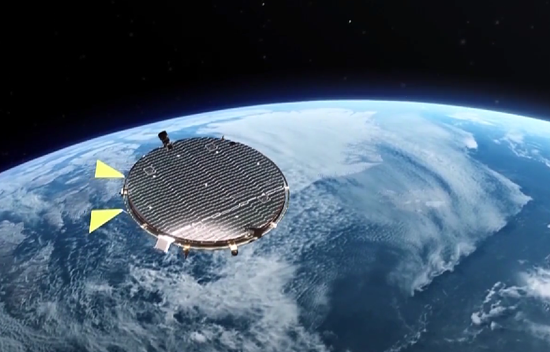
Lilac-3 features an ultra-flat disk-shaped design, with its main body measuring less than 5 centimeters in thickness. The design allows satellites to be stacked more efficiently during launches and is expected to support future low-orbit constellation deployment.
When the project began, about 70% of team members were undergraduates, with an average age of 22. Most had no previous experience with complete satellite engineering projects and learned new technologies during the development process.
After the first Lilac-3 failed to enter orbit due to a launch failure earlier this year, the team rebuilt the satellite within three months, improving its performance and adding new experimental tasks.
Founded in 2012, this team is the first university student team in China to independently complete satellite design, development and mission management. Lilac-3 is the fourth satellite successfully launched by the team.
(By Intern Liu Shuangjing, Zhang Dongfang)

