Translated By Adrian Chan-Wyles PhD
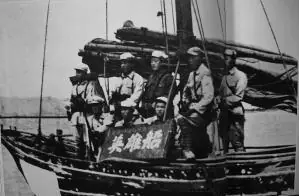
Translator’s Note: It is interesting to read that Hainan – which is an island roughly the size of Belgium situated in the South China Sea – was liberated on “May Day” (May 1st) 1950. Just over 9000 PLA soldiers had tried to liberate Hainan on October 24th, 1949 (just 23-days after Mao Zedong announced the Liberation of China on October 1st, 1949) – but the very well-armed Nationalist Army managed to wipe-out that effort to a man. This was the Battle of Kinmen (October 24th– 27th 1949) which was supposed to act as a bridge-head for a larger invasion force. However, the Nationalists managed to encircle the landing, destroy the boats, and prevent any reinforcements from landing. The PLA soldiers either died fighting, were wounded and captured, or died of lack of resources, etc. Just six-months later – the CPC was reading to try again with an army of over 100,000 men. This time the plan worked, and Hainan was liberated (men were told to move off the beaches quickly into the hinterland and not gather as a target for the advanced US weapons the Nationalists possessed). The PLA suffered over 4,500 casualties (killed and wounded) whilst the Nationalists lost 33,000 (killed and wounded). The PLA possessed NO combat boats. Instead, every fishing boat was commandeered – even those with holes (which were quickly repaired). The idea was to move massive numbers across the sea before the US warplanes could destroy them with aerial bombing. The liberation of Hainan was a remarkable feat of arms hardly noticed in the West. It led to virtually all the islands controlled by the Nationalists being recovered – except for Taiwan and one or two irrelevant coastal places in Fujian and Zhejiang. A few months later the Chinese Peoples Volunteers would be in direct action against the US troops in Korea – inflicting tremendous defeats! ACW (14.7.2026)
Hainan Daily – 1.5.2025 – Commemorating the 75th Anniversary of the Liberation of Hainan
From the News Archives – Liberation of Hainan (4)
News Archives are the bonds that cross time and the most loyal chroniclers of history. Seventy-five years ago (a of 2025), battle flags fluttered and boats set-out together into an uncertain future. The battle-bugle sounded during the crossing – and echoed across the sea – as the land of Qiongzhou welcomed a new dawn. Yellowed old photographs, annotated battle maps, and mottled telegrams… It is precisely the content of these old archives that deeply engrave all the magnificent moments of history. On the occasion of the 75th anniversary of Hainan’s liberation (as of 2025), the Hainan Daily, together with the Hainan Provincial Archives Bureau (Museum), launched the “Archives Tell the Story of Hainan’s Liberation” column. Relying on rare archival resources, it presents precious historical scenes from Hainan’s liberation process in the form of “old photographs and text,” tracing Revolutionary memories in Red Archives and letting old documents illuminate the river of time.
Wang Caifeng (王才丰) – Hainan Daily All-Media Reporter
From April 16th-24th, 1950, the main force of our Cross-Sea Combat Corps split into two echelons to forcefully cross the Qiongzhou Strait, successfully joining forces with the Qiongya Column and the Advance Force of the Cross-Sea Combat Corps already on Hainan Island, rapidly encircling and annihilating the enemy in depth.
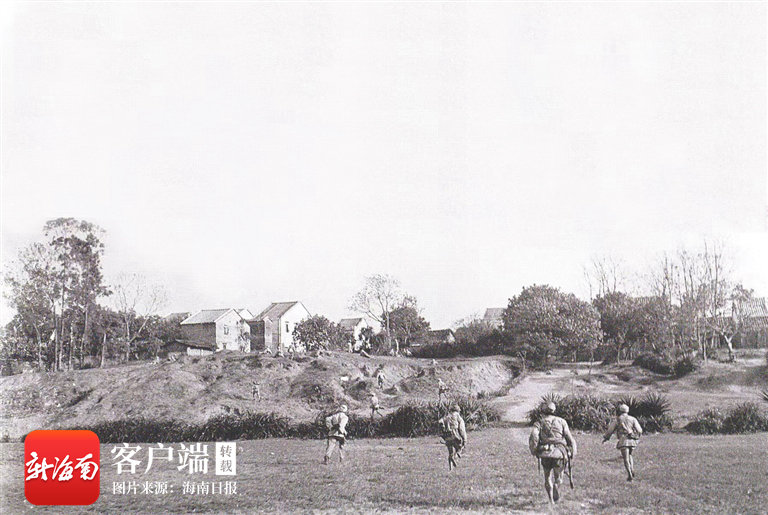
China’s Advanced Force and Qiongya Column launched attacks on the enemy deep within Hainan Island. (File photo)
As seen in the old photographss in this column, our soldiers charged through the crisscrossing countryside, walking deep into enemy lines. At that time, the transportation network on Qiongdao was in ruins. Our soldiers mainly relied on forced marches on foot, while the Nationalist Army had fighter jets and bombers capable of aerial reconnaissance and bombing.
In terms of weaponry, the PLA arms mainly consisted of captured rifles and a small number of light and heavy machine guns, while artillery mainly consists of small-calibre mortars and mountain guns, with some homemade weapons having limited performance. The Nationalist Army possessed a large amount of advanced American and Japanese weaponry, equipped with large-calibre howitzers, armoured vehicles, and more.
With such a huge disparity in combat equipment, how can our soldiers reduce casualties? What ingenuity was used during combat to break through enemy encirclement? With these questions in mind, Hainan Daily All-Media reporters interviewed Ma Hainan (马海南), President of the Hainan Province Cross-Sea Operations History Research Association, who has long been dedicated to seeking out veteran soldiers and shipmen from the maritime operations to liberate Hainan Island, and to sorting out and interpreting historical materials related to the Hainan Island campaign.
“My father, Ma Zhengxin (马正新), once served as the platoon leader of the 1st Platoon, 2nd Company, Guard Battalion, 128th Division, 43rd Army, Fourth Field Army. During sea crossings, he was responsible for protecting confidential personnel and radio stations.” Ma Hainan once heard his father recall the scenes of the crossing operation: at dawn on April 17th, 1950, two reinforced regiments of the 43rd Army, part of the first echelon of the Cross-Sea Army, landed at Yubao Port in Chengmai County and immediately advanced in-land.
“The troops would stop and go; when the soldiers saw enemy planes approaching, they would immediately scatter and lie down or hide in the woods.” Ma Hainan said, “My father led the Radio Detachment forward but encountered a blockade by enemy machine gun positions. Due to delays, the Radio Detachment gradually pulled away from our frontline combat units.” The Radio Detachment was equipped with only a small number of pistols, and its firepower was weak. If we delayed, there was a risk of being encircled by the enemy. We had to quickly pass through this blockade while the enemy was unaware of our situation. ”
Ma Zhengxin had served as a Machine Gun Squad Leader and was familiar with the machine gun’s burst firing rules. He calculated the number of bullets the enemy fired, using the enemy’s ammunition exchange to alert his comrades ahead to break through the blockade. Ma Hainan recounted, “The enemy is a skilled marksman who changes bullets quickly.” Many of us hadn’t made it before the machine gun fired again. My father, accompanied by a comrade, crawled down the ditch to the side of the enemy machine gunner, and shot two enemy gunners with two bullets. In the end, Ma Zhengxin and his comrades broke through the enemy’s blockade and caught up with the troops.
After the decisive battles at Huangzhu and Meiting, on April 22nd, 1950, the Kuomintang Army collapsed across the entire front. Our forces pressed the advantage, advancing toward Haikou, and on April 23rd, captured Haikou. To annihilate the remaining Kuomintang Forces, our army pursued from eastern, central, and western routes, successively capturing Yulin, Sanya Port, Beili, Basuo Port, and other locations. On May 1st, the entire island of Hainan was liberated, and the red flag was planted across the land of Qiongzhou!
In addition, in the recent Hainan Daily special project entitled “Happiness Photograph Studio · Veteran Story” – a micro-documentary series for the 75th anniversary of Hainan’s liberation – we are able to see the resilience and wisdom forged by the soldiers through the memories of Qiongya Column veterans Gong Hualan (龚花兰) and Wang Dajin (王大中).
As an Intelligence Agent, Gong Hualan risked her life to “outwit” the enemy: She “Hid intelligence notes in bamboo tubes, putting the tubes in a dustpan, covering them with cow dung as a disguise.” Sometimes the journey is long, requiring two days and nights, and being alone and without companions easily draws attention. Wang Dajin clearly explained a special “battlefield code”: when the PLA and the Qiongya Column faced difficulties in identifying due to dialect differences, he used the turning of the hat brim as a code to distinguish friend from foe: “Turning the brim of the hat backward means the Communist Party.”
Looking back at the turbulent years of the Battle to Liberate Hainan Island, the Qiongya Column’s three major military offensives in autumn, spring, and summer laid a solid foundation for the Cross-Sea Operations to Liberate Hainan. At the same time, the Qiongya Column fully leveraged its local advantages, working closely with the Cross-Sea Combat Corps to compose a magnificent victory together. (Hainan Daily, Haikou, April 30th)
Editor: Zhou Yumin (周玉)
Author: Wang Caifeng (王才丰)
Chinese Language Text:
档案述说海南解放 | 解放海南岛战役,战士们何以智计破难关?
海南日报2025-05-01 08:06:32
纪念海南解放75周年
档案述说海南解放④
档案是穿越时光的纽带,是历史最忠诚的记录者。75年前,战旗猎猎,舟船齐发,渡海战役的号角响彻海天,琼州大地迎来新生曙光。一张张泛黄的老照片、写满批注的作战地图、字迹斑驳的电报……正是这些档案,深深镌刻了波澜壮阔的历史瞬间。时值海南解放75周年之际,海南日报联合海南省档案局(馆)推出“档案述说海南解放”专栏,依托珍贵档案资源,以“老照片+文字”形式呈现海南解放过程中的珍贵历史画面,回溯红色档案里的革命记忆,让档案文献照亮岁月长河。
海南日报全媒体记者 王才丰
1950年4月16日至24日,我军渡海作战兵团主力部队先后分两个梯队强渡琼州海峡,成功与琼崖纵队、渡海作战兵团先遣部队在海南岛上会师,以迅猛之势向纵深围歼敌军。
如本专栏老照片所见,我军战士们在阡陌纵横的乡野间奔袭,徒步深入敌阵。彼时琼岛大地上,交通网络残破不堪,我军战士主要依靠步行急行军,而国民党军队有战斗机、轰炸机,可进行空中侦察、轰炸。
在武器装备上,我军以缴获的步枪、少量轻重机枪为主,火炮多为小口径迫击炮、山炮,部分自制武器性能有限。国民党军队有大量美式、日式精良装备,配备大口径榴弹炮、装甲车等。
在作战装备如此悬殊之下,我军战士如何降低战斗伤亡?在作战过程中运用哪些巧思突破敌人围困?带着这些问题,海南日报全媒体记者采访了长年致力于寻访解放海南岛渡海作战老战士、老船工,梳理解放海南岛战役史料的海南省渡海作战史研究会会长马海南。
“我父亲马正新曾任第四野战军第43军128师警卫营2连1排排长,在渡海作战时负责保卫机要人员和电台。”马海南曾听父亲回忆当时的渡海作战场景,1950年4月17日拂晓,渡海大军第一梯队中的第43军2个加强团在澄迈县玉包港登陆,立马向纵深发展。
“部队走走停停,战士们看到敌人飞机来了,就立即分散卧倒或躲到林子里隐蔽。”马海南说,“我父亲率电台分队前进,遇到了敌人机枪阵地的封锁,由于受阻耽搁,电台分队逐渐与我军前方战斗部队拉开距离。电台分队仅配备少量手枪,火力薄弱。一旦拖延,有被敌人包抄的危险,要趁敌人还不了解我们情况的时候,快速通过这个封锁口。”
马正新当过机枪班班长,熟悉机枪的点射规律。他计算着敌人射击的子弹数量,利用对方换子弹的机会提醒前方战友冲过了封锁线。马海南讲述道:“敌人是个老练的射手,子弹换得很快。我们还有很多人没有冲过去,机枪就又响了起来。父亲带着一位战友顺着流水沟,匍匐到敌人机枪射手的侧面,用两发子弹打掉了敌军两个射手。”最终,马正新和战友们突破了敌人的封锁,赶上了部队。
历经黄竹、美亭决战,1950年4月22日,国民党军队全线崩溃。我军乘胜追击,向海口挺进,4月23日,攻克海口。为歼灭国民党军残余部队,我军分东、中、西三路追击,先后攻克榆林、三亚港、北黎、八所港等地。5月1日,海南全岛解放,红旗插遍琼州大地!
此外,在《海南日报》近期推出的海南解放75周年特别策划“幸福照相馆·老兵story”系列人物微纪录片中,我们也得以在琼崖纵队老兵龚花兰和王大进的回忆里照见战士们在枪林弹雨中淬炼出的坚韧品格与智慧谋略。
作为情报员,龚花兰是这么冒死与敌人“斗智”的:“把情报放在竹筒里,竹筒装在簸箕里,用牛粪来掩盖伪装。有时候路途遥远,要走两天两夜,只有自己一个人,有同伴容易引人注意。”王大进则清晰地讲述了一段特殊的“战场密码”,在解放军与琼崖纵队因方言差异存在身份识别困难时,就用转帽檐做暗号区分敌我关系,“帽檐往后转代表是共产党。”
回溯解放海南岛战役的烽火岁月,琼崖纵队发起的秋、春、夏季三大军事攻势,为解放海南渡海作战奠定了很好的基础。同时,琼崖纵队也充分发挥了本地优势,与渡海作战兵团密切协同,共同谱写了壮丽的胜利凯歌。(海南日报海口4月30日讯)
责编:周玉
作者:王才丰

