2026-07-13 Ecns.cn Editor:Mo Honge
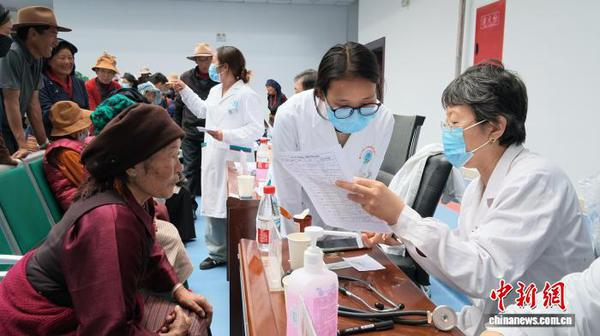
(ECNS) — Nearly 1,000 doctors and medical specialists from more than 200 institutions across China arrived in Lhasa, Xizang Autonomous Region, by train on July 4. They provided free medical care and professional training in local communities along the Qinghai-Xizang Railway.
The journey took the team across sections of the railway more than 4,000 metres above sea level.
Specialists in more than 20 fields, including cardiology, neurology, orthopaedics, and gynecology, opened temporary clinics for local residents and railway workers.
During the programme, doctors provided consultations, health screenings, medicines, and follow-up care, while some performed operations alongside local medical teams and demonstrated clinical techniques.
The initiative also focused on strengthening local healthcare so that it would continue after the visiting team’s departure on July 12. Participants trained medical workers, shared treatment expertise, and established contacts for continued professional support.
Innovative care provides hope for Tibetan patient
2026-03-19 09:32:30China DailyEditor: Mo Honge
Amid a gentle cascade of cherry blossoms, Pema Drolma reached from her wheelchair to catch a petal, her smile reflecting the resilience of the Gesang flower, an emblem of hope for Tibetan people. Battling a rare disease that left her joints severely deformed and confined her to bed for over 14 years, Drolma has faced an arduous journey. But now, thanks to a new round of treatment in Southwest China’s Chongqing, the 29-year-old envisions a brighter future.
Born into a nomadic family in a remote Himalayan village in the Xizang autonomous region, Drolma was diagnosed at age 14 with systemic juvenile idiopathic arthritis. Unable to mobilize her joints, she had to rely entirely on her mother’s care.
Drolma’s plight was noticed by an official from the Tibet Development Fund, a national public welfare foundation headquartered in Xizang’s Lhasa, during a rural outreach in 2024. This led to a journey of over 3,000 kilometres, transporting her to Daping Hospital, also known as the Army Medical Center of Army Medical University, for treatment.
After months of preparation, Drolma received her first surgeries in early 2025, including hip replacements that required delicate procedures to chisel fused bones. The surgeries were successful, marking the beginning of her recovery to mobility. The dedicated medical team, comprised of the hospital’s 12 departments, include four surgeons, spearheaded by orthopaedic expert Gou Wenlong, who crafted a comprehensive rehabilitation plan for Drolma.
The road to recovery is challenging, but the team is resolutely committed. Beyond the surgeries, their focus is on Drolma’s daily care. They’ve created a comprehensive plan with challenging exercises to help restore her joint function and muscle strength and prepare her for future surgeries. Her knees, previously stiff from skin and muscle contractures, require gradual stretching to improve mobility.
Additionally, nutritionists have tailored meals to Drolma’s diet, and psychologists have worked to ease her social anxiety from years of isolation due to dropping out of school and being confined to bed.
In February, she received her fourth surgery. So far, surgeries on both her hips and knees have been successfully completed. “I never dared to imagine that I could get better, but I am very fortunate to have met such great officials, doctors and nurses,” the shy patient told China Daily via WeChat, a social media platform.”The treatment has greatly improved my quality of life, and my mood is getting better and better!”
The next steps on Drolma’s road to recovery have been carefully calculated. “We’ll restore functional movement in her elbows and shoulder joints to enable her to feed herself. And we are confident that in the near future, she will not only be able to stand but also walk with her mother to the foothills of Mount Qomolangma,” said Wang Ziming, the patient’s lead surgeon.
The estimated time of the treatment project has been shortened from the previous three to five years to two to four years, added Guo, the orthopaedic expert.
Since 2015, the southwestern municipality has dispatched 11 batches of medical aid teams, with over 500 medical experts, to communities in Xizang.

