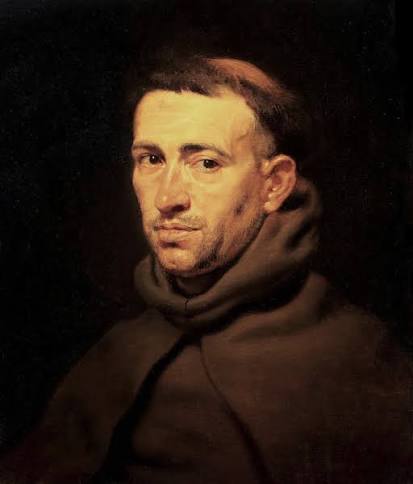
“Never Should Be Posited Plurality Without Necessity”
(Latin: ‘numquam ponenda est pluralitas sine necessitate’)
William of Ockham: Questions & Discussions on the Four Books of the Sentences of Peter Lombard – Quaestiones et decisiones in quattuor libros Sententiarum Petri Lombardi (Book I, Distinction 27 – Question 2 – K).
Author’s Note: It is interesting that a number of Christian monastics have eventually become associated with concepts active within modern science – whilst being fully ensconced in the relative ignorance of theology. Indeed, many were being threatened with imprisonment, torture, and death should they persist in a secular, materialist, mode of thought. The despotic Church killed anyone who deviated or defied its authority structure as a means of quality control. And this was a reign of terror aimed at the most educated people in the land. Of course, the illiterate masses (particularly women) suffered tremendously at the hands of ecclesiastical men who imagined all types of superstitious infringements and Pagan skulduggery (this is not to downplay or deny the suffering imposed upon men and children). Remember, the practicing of “Midwifery” (the art and science of men but primarily women caring for pregnant women) was punishable by “Death” according to the Church. The Church and the State would have us believe that out of this quagmire of human ignorance and darkness – rays of light emerged. I can say that William of Ockham did write copious numbers of texts on all kinds of academic and theological topics, including politics, biographies, and philosophy. Part of the delay in the examination of his work by the Vatican in the 1320s was caused by its sheer volume. And it would seem that after his “Excommunication” – the nature of his work became ever-more defiant and questioning of Church authority. I think his conflict with the Church solidified his method of the efficient use of knowledge as a means of critiquing Church dogma and theology. Indeed, William appears to become nearly “Protestant” in his argument with Avignon. He may not have coined the term “Occam’s Razor” (why would a humble monk do such a strange thing?) – but he certainly earned the right to be considered a strong candidate for its modern inception due to the nature of the hostility he had to contend with. Although I am always suspicious of bourgeois sources (due to their a priori anti-Socialist position) – I believe we can trust the two I have included below. As always – think for yourself. ACW (22.8.2026)
The “Ockham” in the title is a small village around 18-miles Souh-West of Sutton. Until 1965, Sutton was part of East Surrey before becoming part of South-West Greater London (London Borough of Sutton & Cheam) – whilst “Ockham” stills resides in th county of Surrey. As an ethnic speaker of the English-language, my instinct is that “Ockham” probably refers to “Oak-ham”. When checking the etymology for this name – my assumption turned-out to be correct. In Old English, “oak” is rendered “Ucca”, whilst the Old English word for for “homestead” is “hamlet”. Therefore, when this place was settled, in was the homestead amongst the oaktrees – perhaps involving the original houses being made of sturdy oak. Overtime, “Oak-hamlet” evolved into “Oahkam” and then “Ockham” (incidentally, there is another place named “Oakham” in Rutland).
William was born in Ockham and as a commoner he possessed no distinctive surname. Within Latin (the language used by the Catholic Church), the name “William of Ockham” was written as “Guillelmus de Ockham”.In situations such as this during Medieval times, individuals sometimes assumed the place of their birth, or the title of their profession to serve as their second name. Occaaionally, an individual would become so famous that historians would apply a second name out of respect (Wat [Walter] Tyler, of course, was a common workman who performed the function of “Tiler”, or “Tyler”, etc). When William joined the Franciscan Order, (as a “monk” or “friar”) he probably had to declare where he was from for official Church reasons – hence the name. As Franciscan educated their monks to a very high degree – William (who trained in theology at London and Oxford) became renowned for his Biblical scholarship. William’s mind was so lucid that he clearly understood the tangled complexities of theology with a consumate ease.
This innate ability led him to declare that “explanations should never be more complicated than required”. In other words, “do not multiply explanations beyond what is needed – and strip away the unnecessary. Keep only what the evidence demands.”
During 1324, the Pope (John XXII) in Avignon (France) summoned William of Ocham to explain why it was that he did not support the overly-complex explanations that the Vatican used to keep the faithful masses in a state of confusion and ignorance? As the Vatican viewed literacy and learning as a threat to the dominance of the Church throughout Europe – the Pope was suspicious of any member of the clergy who advocated accommodating the innocence of the masses by taking the time to properly explain theological concepts in a simple manner. In reality, William had not done anything wrong. He had not contradicted Church dogma or suggested his own theories (the Chacellor of Oxford University had reported William for simplifying the Eucharist). This is why the Vatican Authorities kept William in Avignon for two- years awaiting their decision.
The Vatican had experts read through Williams work – line by line – trying to find something the Church could act upon, but nothing was found. It was the “method of clarification” that William employed – rather than the “content” of his work. After a two-year wait in 1326, the Vatican Authorities finally issued their decision which flagged “51” points of contention for “censure” (due to style) – but which did not constitute “Heresy”. Although William waited patiently for another two-years – there was no official condemnation or aquittal. Meanwhile, William had become embroiled in a theological argument regarding whether Christ (or the Apostles) “owned propery”. The Pope believed they did – whilst the Franciscan Order took the opposite position – as did William. As the situation was becoming dangerous, and given that William was not imprisoned, he (and another monk) decided to leave Avignon in 1328 – and head to a safer place. As William had left Avignon without Papal Permission – only on these grounds – was he “Excommunicated” from the Church. He spent the rest of his life living under the protection of the King of Bavaria – who was himself was embroiled in a power-struggle with the Vatican. He was never formally condemned or cleared by the Church – but his intellectual “method” of “extracting” and “clarifying” knowledge from a text has been firmly integrated into the methodology of modern science.
Most people today remain ignorant of the fact this Medieval Christian monk – who wrote profusely – seems to have developed an approach to the assessment of material reality (Parsimony) that was (later) termed “Occam’s Razor” by the Scottish Philospher – Sir William Hamilton – 9th Baronet (1788-1856). cultures. William M. Thorburn writes – in his “The Myth of Occam’s Razor” (1918):
‘The English variant (Occam’s Razor) is a century younger; having made its first appearance in Sir William Hamilton’s Discussions (1852), page 590 (On Causality). In the second edition (1853) it is used on pages 616 and 629. In the latter place it is for the first time distinctly associated with the current form.’
William never used the term “razor” – whilst it is also true that this type of thinking (which chooses the simplest theory that fits all the facts) – is evident in human-thinking all the way back to ancient Greek times – and perhaps throughout other ancient cultures. Britannica states:
‘The principle was, in fact, invoked before Ockham by Durandus of Saint-Pourçain, a French Dominican theologian and philosopher of dubious orthodoxy, who used it to explain that abstraction is the apprehension of some real entity…’

