Blogger’s Note: Let’s face, a “robot” is basically a car manifesting its fast manoeuvrability via “two-legs” – instead of wheels. A standard car, depending upon the skill of the driver, should be able to easily beat the fastest of humans. A human-body lacks the mechanical ability to accelerate from 0-60mph in five-seconds – on the grounds that it has not been an evolutionary necessity. The idea that an artificial machine, just because it has been given the moulded externality of a “human-shaped body” – does not mean it has any genuine relationship (or connection) to a “biologically-functioning” human-body. What is the difference between a “robot” and a “drone”? Answer – the ability to “flight”. And that’s about it. What’s next – parachuting? Rock-climbing? Diving? It is an interesting gimmick and I suspect the CPC might be using ths technology to intimidate the US by proxy – as these “funny little fellows” might be used as expendable infantry soldiers in a future war of self-defence against US aggression. ACW (24.8.2026)
Nathan Rennolds – Published on 23/08/2026
“In 1 year alone the robots competing have become twice as fast. This highlights the pace of advancement both in the market, and specifically in Chinese robotics,” organisers of the World Humanoid Robot Games said.
Step aside, Usain Bolt, there’s a new speed king in town – TienKung the robot.
The Chinese humanoid, manufactured by the Beijing Centre for Humanoid Robotics, ran the 100 metres in 9.39 seconds at the World Humanoid Robot Games on Saturday, beating the Jamaican great’s 9.58 world record time – which he set at the Olympiastadion in Berlin in 2009.
“This is a hugely impressive feat,” organisers of the Beijing robot games wrote in a post on X, noting that last year’s winning time clocked in at 21.50 seconds.
“In 1 year alone the robots competing have become twice as fast. This highlights the pace of advancement both in the market, and specifically in Chinese robotics,” they added.
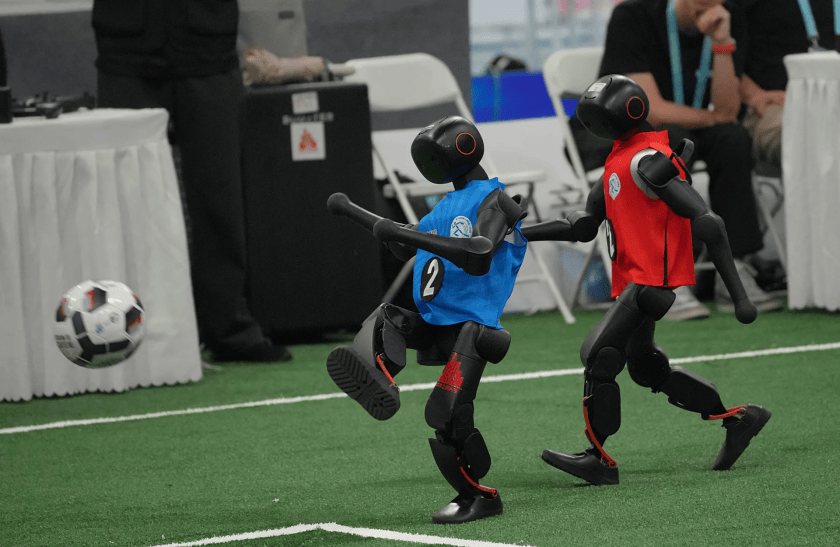
The World Humanoid Robot Games, held in Beijing’s “Ice Ribbon” stadium, is bringing together 666 teams and 2,056 robots from 16 countries as they compete across events including athletics, boxing, football, weightlifting, and gymnastics.
Video footage of the robots has been shared widely on social media over the last few days, particularly clips showing the humanoids slamming into large mats and slowly falling backwards at the end of races.
While the rather amusing clips have been entertaining viewers, organisers of the games say people should be impressed.
“It shows a pace of technological advancement that almost beggars belief,” they said. “Only a year ago, at the last WHRG, robots were slow, ponderous machines that struggled to complete a track sprint. This year they are expected to obliterate world records. The pace that the Chinese robotics industry is advancing at, much like the robot in the video shows no sign of deceleration”.
China has been leaning in hard to the humanoid robot industry, and investors appear to be on board.
Morgan Stanley Research has estimated that the humanoid market is likely to reach $5 trillion by 2050, with more than a billion of the robots potentially in use by then.
According to a report published by the bank last year, China is expected to have around 302.3 million humanoid robots in use by 2050.

