Blogger’s Note: Although Karl Marx only wrote and spoke German – he knew about Shakespeare and wrote highly of his work. Indeed, Marx believed Shakespeare possessed a keen insight into the plight of the worker and peasant – as well as the human condition in general. As for King’s College London – this is like Cambridge University in London. Gee studied Midwifery at this University. However, King’s also appears to be a nest of pro-Zionist propaganda with various of its academics placating Israel’s genocidal policies in Palestine (and elsewhere). King’s students had to be careful attending pro-Palestinian protests just in case their Tutors found out and took sanctions against them. So much for impartiality in education. Shakespeare would probably have a dim view of the rhetorical position King’s tends to take. This highlights the snobbery and delusion that exists in the UK’s most well-established educational institutional. Knowledge should belong to humanity – not only those with deep enough pockets to afford to access it. Shakespeare left school at 14 and never attended any bourgeois university – and yet he possessed the mind of a genius and a quill of a master! ACW (17.4.2026)
17.4.2026
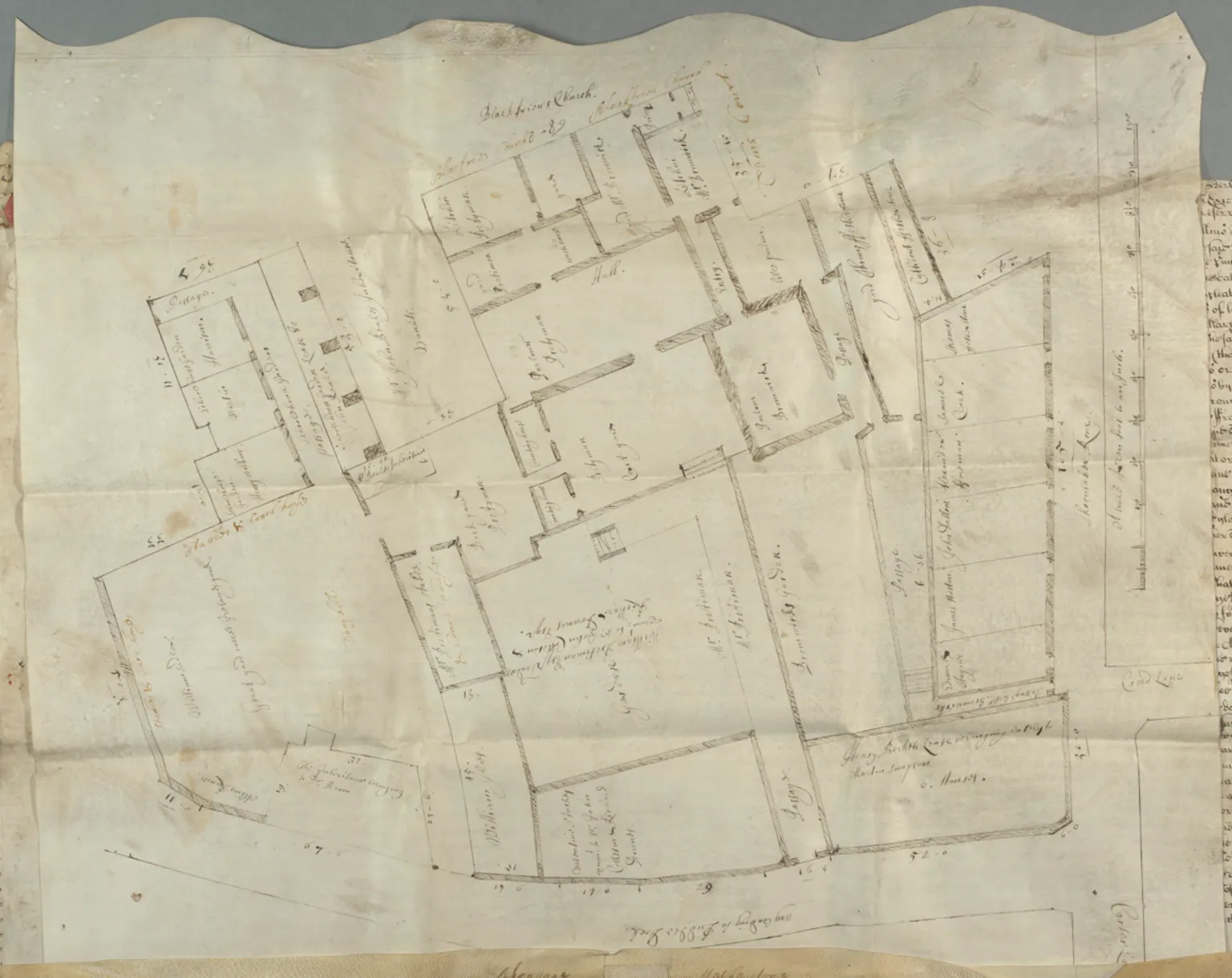
The exact location of William Shakespeare’s only London property has been pinpointed to a Blackfriars street, after an unknown floorplan was discovered.
Shakespeare expert Prof Lucy Munro from King’s College London identified the location and size of the property he bought in 1613.
It had been thought that Shakespeare retired from his theatre career not long after he bought the house and returned to Stratford-upon-Avon. However, academics believe the discovery could indicate that the playwright spent more time in London than previously believed.
It also means that the blue plaque for Shakespeare on St Andrew’s Hill is not “near” the site of his London house, but on the spot it used to exist.
Shakespeare’s Blackfriars property was thought to have been part of “the Great Gate” over the entrance to the Blackfriars precinct, a major 13th Century Dominican friary.
Munro uncovered three documents – two from the London Archives and one from the National Archives – that provided more information.
Munro said: “I was doing research as part of a wider project and couldn’t believe it when I realised what I was looking at – the floorplan of Shakespeare’s Blackfriars house.
“It had been assumed that there wasn’t much more evidence to gather about it, so research on it has laid dormant for a while.
“These findings really help us tell the complete story of Shakespeare’s Blackfriars house, and thanks to this new discovery we now know exactly where it stood.”
One of the documents was a plan of part of the Blackfriars precinct, drawn up in 1668, two years after the Great Fire of London, which confirmed the precise location and size of Shakespeare’s Blackfriars house.
The part of the property that spanned the gate did not appear in the post-fire plan because it had no foundation.
Munro said: “This house was close to [Shakespeare’s] workplace at the Blackfriars theatre.
“We know that Shakespeare co-authored Two Noble Kinsmen with John Fletcher later in 1613, and this new evidence that the Blackfriars house was quite substantial makes it not inconceivable that some of it may have been written in this very property.”
The other two of these documents relate to the sale of the Blackfriars property by Shakespeare’s granddaughter in 1665.
The property covered what are now the eastern end of Ireland Yard, the bottom of Burgon Street and parts of the late 19th Century buildings at 5 Burgon Street and 5 St Andrew’s Hill.

