
Wed, 11 Nov, 2026 – Laoise Murray
It is at Ireland’s edge that Gaeilge is still commonly spoken, but centuries ago, Celtic languages like it most likely belonged to a people at the heart of Europe.
This is what a new research paper published in the science journal Nature suggests, based on an analysis of the ancient DNA of more than 4,500 people.
Its findings challenge a century-old theory that Celtic languages originated in western Europe, providing evidence that the language group originated in central Europe, in what is today the Czech Republic, before spreading with people as they migrated across the continent.
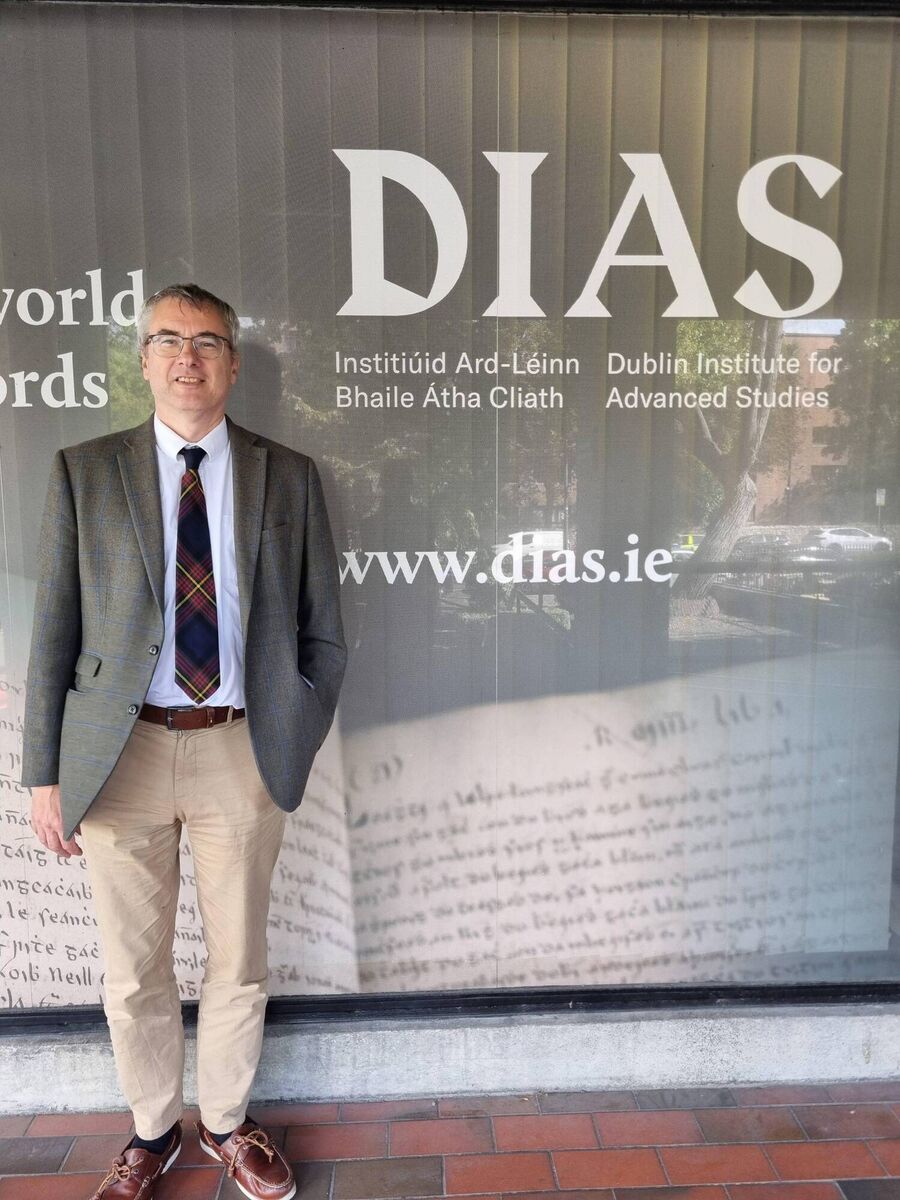
David Stifter, professor of historical linguistics at the Dublin Institute for Advanced Studies, who reviewed the paper before publication, said the findings were exciting.
“I’m looking at words and languages and seeing how they relate to each other… But this genetic data actually gives us guidelines where we can look for connections,” he said.
Palaeogenetics, the analysis of biological data from humans who lived thousands of years ago, has developed rapidly over the past decade, becoming a “massively fast-moving field”, Mr Stifter said.
Genetic markers, which are passed down through generations, act as a kind of “tracer dye”, allowing scientists to track the movement of people over time, Guus Kroonen, a historical linguist at Leiden University in the Netherlands and a co-author of the study, told Nature.
Mr Kroonen was part of an international collaboration led by researchers from the University of Copenhagen in Denmark and Leiden University. The team compared evidence of prehistoric population movements contained in DNA with archaeological and linguistic evidence of the spread of Celtic and Germanic languages.
How Celtic languages spread across Europe
“The Celtic languages are one branch of the much, much bigger Indo-European language family,” Mr Stifter explained. “Fundamentally, there are twelve big sub-branches, and Celtic is one of them, namely the most westerly one.
“The proto-European language was spoken about 4000 or 3,500 BC in roughly the area north of the Black Sea.
“And after that, various waves of speakers moved in all kinds of directions, in Europe and in Asia. And ultimately, they turned into the various languages that we see today – one of those one of those branches is Celtic.”
The Anglo-Celtic or modern Celtic languages include Irish, Scottish Gaelic and the Manx language, while Welsh, Breton and Cornish form a second branch.
“But in antiquity, so about 2,000 years ago roughly speaking, there were many many more Celtic languages also on the continent of the on the European continent which all died out in the meantime,” Mr Stifter said.
His research seeks to establish when and where a common ancestor of all Celtic languages emerged by examining connections and differences in the words people used and how they constructed sentences.
The latest genetic research provides “a very strong argument” that early Celtic languages moved westwards from around 1200 BC with people associated with the Bronze Age Urnfield culture of central Europe, followed by the Iron Age Hallstatt and La Tène cultures. The languages spread into France and Great Britain, eventually reaching north-eastern Spain.
This closely matches the model developed by historical linguists for the spread of Celtic from central Europe. However, Mr Kroonen and his colleagues note that an earlier migration from south-western Europe to Britain means the process was “potentially more complex”.
Why Ireland’s ancient DNA remains elusive
While this genetic research offers historical linguists such as Mr Stifter new insights, mysteries remain in Ireland.
“The problem for Ireland, for instance, is that we scarcely have any ancient DNA surviving at all. For the simple reason that people, precisely in that period that is of interest for us, at least in the prehistoric period, they burned their dead.
“So, if you burned the dead, there’s no DNA surviving. It’s only from the early Middle Ages that DNA is surviving.”
Mr Stifter is optimistic, however, that geneticists and linguists will be able to work together to uncover more of the past.
“The methods of paleo-genetics are constantly improving, and they are refining the methods every year or every couple of years.
“So my hope is that in the next couple of years they will be able to find even finer differences in genomic movements.
“I’m constantly hoping that we’ll know more.”

