Lenin Leads the Way!

Surrey: Mobile Workmen’s Home! (29.5.2026)

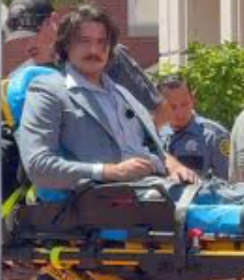
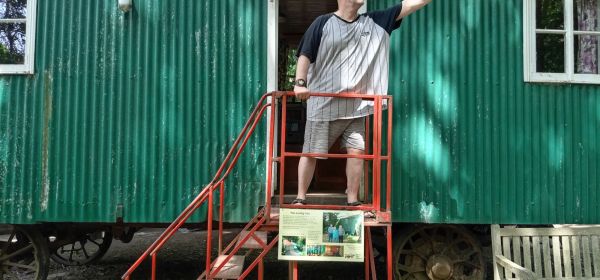
This seems to be an early caravan – although much larger – affixed upon an army carriage dating back to WWI (although the Beatles were playing on the interior radio when we visited). I thought it might have travelled on rails – and think it could travel on a number of different surfaces (the wheels look rail-based – but I might be wrong). Basically, workmen tasked with building or clearing, etc, in remote areas – could live in these types of devices for extended periods – between shifts. This was when labour Unions ruled the roost and this type of relative luxury was demanded! I suspect for many workers this temporary accommodation might be better than the places they actually lived in! It reminded me of the carriage Lenin spoke from when he declared the end of capitalist exploitation in 1917! A left-leaning Labour government improved the lives of millions in 1948!

Badge - Meizhou Hakka Football Club!

China Football Association: 3rd Batch of Match-Fixing Penalties Issued – Gambling & Black Market Corruption – 17 [Including Hakka] Banned! (22.5.2026)

The first Article is the official “English” announcement permitted by the Chinese Court and/or government. Good to see the Meizhou Hakka people at the fore-front of sporting corruption. The Hakka are always industry-leaders – and I expect nothing less of their innovative activity (I jest – of course). Even in the UK – Hakka take-away owners cannot resist wasting thousands of their hard-earned money on gambling! It is an issue amongst the Chinese community – or at least a certain strata of it. From gambling speculation there creeps-in all other types of corruption. Let this be a lesson. Although the US government (and the far-right) does allow and encourage “gambling” (as a form of capitalistic social control) – the far-left (and certainly not the CPC) will allow this cancer to fester within Chinese society. Enjoy sport but participate fairly and without exploitation! Hakka people need to police their communities more effectively and demand the law is followed. Remember, the Hakka were avid supporters of the Socialist Revolution – do not spoil this achievement!

Chud the Builder

Montgomery County Courthouse: The Sorry Tale of “Chud the Builder”! (16.5.2026)

Of course, both camps have started highly lucrative money-raising campaigns amounting to hundreds of thousands of dollars. Although Eatherly says he was released on bail – news reports state that he might still be in gaol. Who knows? What happens is that the State isolates the accused completely from the outside world so that they are at the mercy of the State apparatus. I suspect the far-right support network takes over all the posting on behalf of Eatherly – so what we see is part-true and part-manipulation. Eatherly is a construction worker from Tennessee who seems to style his appearance after that of a dashing Confederate Officer – as the British press used to report in the 1860s. He decided to livestream his racial antagonism of African-American and broadcasting their anger at being abused. He then sold t-shirts and hoodies with the words “Chimping-Out” printed upon them. He was then sacked from his employment for being racist. He then went self-employed for a time – but claims he is a victim of “BLM” violence and terrorism in that no one will employ him. He is known throughout te far-right as “Chud the Builder” – I suppose a type of malignant “Bob the Builder”! I have forwarded an article and a post made in Dalton’s name from his Telegram Channel.

The discovery may indicate that Shakespeare spent more time in London in his later years than previously thought

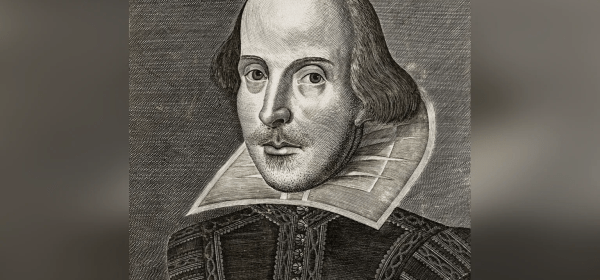
UK: Location of Shakespeare’s Blackfriars House Discovered! (17.4.2026)

One of the documents was a plan of part of the Blackfriars precinct, drawn up in 1668, two years after the Great Fire of London, which confirmed the precise location and size of Shakespeare’s Blackfriars house.

The part of the property that spanned the gate did not appear in the post-fire plan because it had no foundation.

Munro said: “This house was close to [Shakespeare’s] workplace at the Blackfriars theatre.

“We know that Shakespeare co-authored Two Noble Kinsmen with John Fletcher later in 1613, and this new evidence that the Blackfriars house was quite substantial makes it not inconceivable that some of it may have been written in this very property.”

The other two of these documents relate to the sale of the Blackfriars property by Shakespeare’s granddaughter in 1665.

The property covered what are now the eastern end of Ireland Yard, the bottom of Burgon Street and parts of the late 19th Century buildings at 5 Burgon Street and 5 St Andrew’s Hill.

Carshalton Ponds - Slip-Way!

Honeywood Museum: Charshalton Ponds & Billiard Room! (21.2.2026)

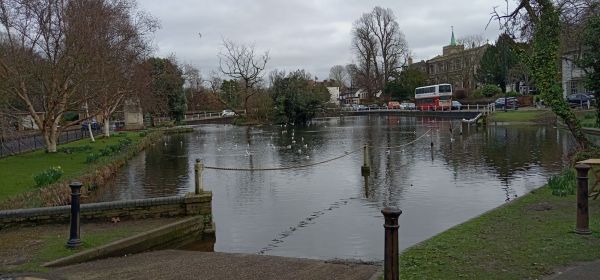
We visited the Honeywood Museum in nearby Carshalton Ponds – as the Staff and Management added a Chinese New Year display to the usual mixture of local history artefacts. We have visited in the past – but I do not recall the impressively “large” Billiard Room which seems to have been converted to a “Snooker Room”. Me and Gee sat and drank a cup of coffee outside the Honeywood Museum – watching the numerous types of birds traverse the surface of the water. I think we entered the Museum probably in the wrong direction – and immediately emerged in the Billiard Room – which seemed to corelate seamlessly with Pond itself. During Victorian times, the well to do, those who owned local business and large country-homes – often could often afford all the lateest scientific devices. The air around the Ponds was fresh and yet mild – a thoroughly invigorating experience!

Market Overton - 17th Century Window!

Market Overton: 17th Century Window! (6.11.2025)

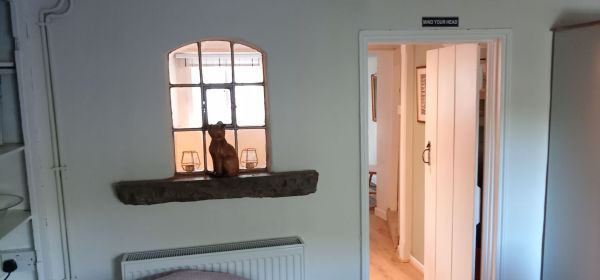
What is now the dining area – where I set-up my study space – was probably once part of the garden. Therefore, the window itself was once considered the height of building technology. In those days, draughts from blowing winds were a major issue. The frame of this window is firmly embedded in the wall-structure so that no wind can penetrate. The cement and plaster hold it robustly in place – whilst its relatively small surface area allows for strength and stability. As glass was not as strong then as it is now – the panes of glass used were far-smaller – with each held in-place by its own frame. Furthermore, and a feature I like, is the central pane that possesses a stout hinging and opening and shutting mechanism. Even today – this design still retains much of its original strength – whilst being now inside the house means it is now better preserved.

1 2 3 5