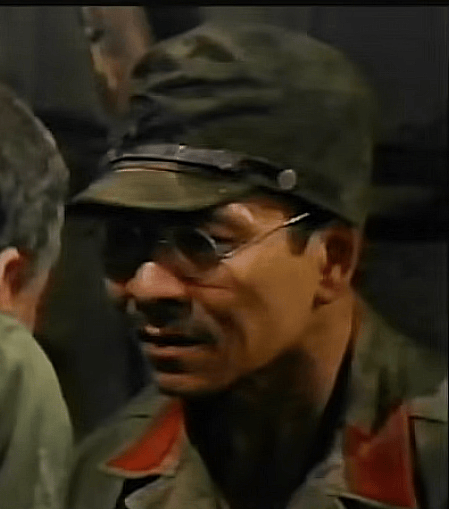
Author’s Note: In the original 1959 theatre play, the part of the captured “Japanese” soldier was played by Japanese actor – Kenji Takaki (1884-1984). However, in true BBC tradition, a British-Chinese actor named “Vincent Wong” [黄永光 – Huang Yong Guang – Wong Wing-Gwong) (1928-2015) was chosen to play the part. He was born in the British colonies of the West Indies (Jamaica). I suspect he was a Hakka Chinese person whose family was originally from Hong Kong. A Chinese-language tribute states:
‘Vincent Wong is a renowned actor, known for his outstanding performances in film and television. He was born in 1928 in Jamaica, a British colony, and later emigrated to the United Kingdom. Huang Yongguang had a career in the film industry spanning over 50 years, participating in many well-known works, including the “Batman” series and the “Detective Chinatown” series. His diverse performance styles are deeply loved by audiences.’
The BBC, unencumbered by the intricacies of history, were not bothered that the Hong Kong and New Territories Chinese suffered terribly under Imperial Japanese Occupation. This is what happened to the Chinese-side of my family. Although Vincent Wong had a remarkable acting career – for many non-White actors, parts were few and far between, particularly in the early days of TV. I suspect that is why he took the part. A small British Infantry Unit is caught off-guard by the speed of the 1942 Imperial Japanese Army advance through the Malayan jungle. ACW (12.11.2026)
During the late 1979, whilst at school in Exeter, my class had to study this [1959] play penned by Wallis Hall. Although designed for live theatre, it was not long before cinema films and TV adaptations appeared. We had to read the play (I still possess my old paper-copy) – and then watch the above TV-play as a class activity (we would sit in the TV Room whilst BBC showed the film – with all the curtains closed). This was part of our “English Literature” Studies (English Language was a separate subject). As I have said elsewhere many times – the UK was more left-wing than most people realise – including younger British people who now have to pay for their University education (usually the price of an average mortgage for a basic degree). Thatcher abolished free education in 1988. What is interesting is that this play was written in the late 1950s following the disastrous (anti-Socialist) “Malaya Emergency” and “Korean War” – during the height of the US-derived “Cold War”. Many in the UK, particularly WWII Veterans, were uncomfortable being made by the US to “hate” their former allies of the Soviet Union (whose Red Army stood with them when no one else would). Private C “Bammo” Bamforth was presented (to us) as a “barrack room lawyer” or someone who caused trouble for no reason – but this is obviously not the case. He seems to embody the rebellious spirit of the working-class – and its advanced proletariat morality. Bamforth is the only one with the guts to protect the unarmed Japanese POW – and would have been the only one not charged with “War Crimes”. Surely, if we are better than Japanese fascists – why would we behave like Japanese fascists? Some say that this play is subversive and “anti-war” – perhaps it is (the enemy is just like us). During the late 1970s the UK had the last far-left Labour government.

