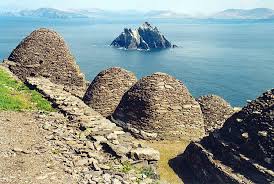
Meditating Cells Skellig Michael - Ireland

BMA-UK: Qumran: How Meditating Jews Borrowed from Buddhism to Build Christian Monasticism! (12.4.2026)

The Jewish community in Qumran chose to sit in meditation cells to seek a communion with their god. Why did some Jews do this? This is not a Jewish tradition and is certainly not recognised as a Jewish practice – even in a peripheral sense. Meditating in a cave must have come into Judaism from an alien teaching and different culture. Two prime candidates are Buddhism and Hinduism – with the edge leaning toward Buddhism (due to the lack of polytheism). Not only this, but Buddhism was flourishing in India during the 3rd century BCE and the 1st century CE – the time era attributed to the Qumran texts (the Dead Sea Scrolls). Christian monasticism (as practiced by the Celtic Church) must have originated in Buddhist India – and was adopted by a small group of Jews in the Qumran area of the Judean Desert (situated on the North-western shore of the Dead Sea). This meditational practice was continued by the early Jewish followers of Jesus Christ and was spread to the Egyptian Desert – where the first (distinct) Christian monastic communities were first formed.
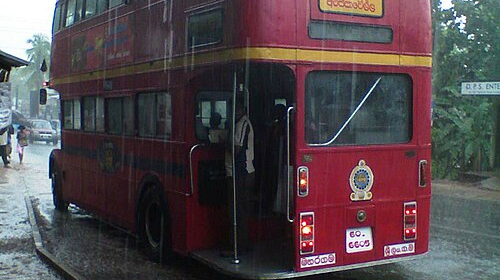
A double-decker bus in Godagama - Sri Lanka - a British Colony

Sri Lanka: Census Shows Overall Literacy Reaches 97.4%! (12.4.2026)

This creates begging and a sense of “lacking” (there is no money to purchase the necessities of life). Within the traditional modes of existing – money – a) does not exist and b) therefore does not dictate well-being or existence. On the other hand, tradition never changes or is permitted to alter – as such deviation from established norms present a “danger” to the well-being of those who live under its sway. Buddhist monastic life was developed within an ancient agrarian system – but not a modern or capitalistic version. It was a reaction to the Brahmanic caste system. The Buddha lived in a North Indian Republic which elected its secular officials. Followers of Brahma definitely existed – but at that time Brahmin priests had not yet usurped the kings and warriors (Kshatriya) who then administered society (the Buddha was of the Kshatriya caste – before he rejected Brahmanism) and his father the elected leader, etc. Later, the Brahmins would manoeuvre themselves above the warriors and kings – creating a revolutionary repositioning within the caste system (this is where matters stand in India). Sri Lanka, of course, is a Buddhist country with only a small Hindu population – although I did witness Buddhist monks carrying-out various (vegetarian) rituals for local Hindus living in areas around Colombo. This might be because Hindus today view the Buddha as an avatar of the god Vishnu.