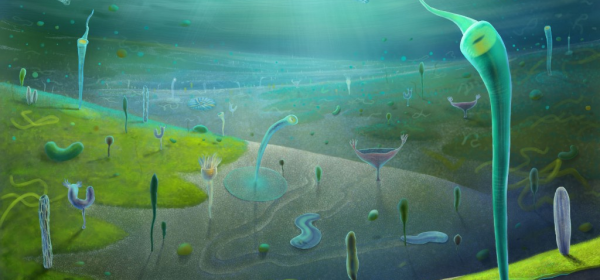
The explosion of complex life may have occurred four million years earlier than previously thought. © Xiaodong Wang

China: The Origins of Complex Life Pushed Back to Before the Cambrian! (6.4.2026)

Associate Professor Fan Wei, a leader of the group, says, “After years of fieldwork, we finally found several sites with the right conditions where animal fossils are preserved together with abundant algae.”

Unlike most Ediacaran sites, where organisms are preserved as impressions in sandstone, the Jianchuan fossils are preserved as thin carbon-rich films. This is type of preservation is more typical of famous Cambrian sites such as the Burgess Shale in Canada.

This exceptional preservation reveals anatomical details rarely seen in Ediacaran fossils, including feeding structures, digestive systems and organs used for movement.

Associate Professor Ross Anderson, a co-author of the study from the Oxford Universities Museum of Natural History, says, “Our results indicate that the apparent absence of these complex animal groups from other Ediacaran sites may reflect differences in preservation rather than true biological absence.”

“Carbonaceous compressions like those at Jiangchuan are rare in rocks of this age, meaning that similar communities may simply not have been preserved elsewhere.”
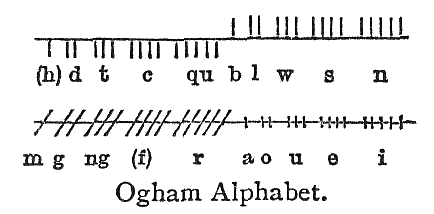
How Ogham Was Aligned with the Greci-Roman Alphabet.

Eire: Speaking [and Writing] the Irish Tongue! (6.4.2026)

She was also taught English at school by brutal school-masters. The children were beaten until they learned the English words – and this was by Irish teachers. As far as I am aware, Irish is a spoken language that was first written down in Ogham (lines pressed into the edges of clay tablets before firing – or engraved along the edges of standing stones – and known as the tree alphabet). Later, the sounds of Irish were transliterated into the received Greco-Roman alphabet – but this development was a contrivance – so that the invading English could understand what the Irish were saying. It would seem that the modern Irish learn to speak their language as normal – but now write it down using a foreign alphabet (English). Not only is this the case, but it would seem that a “French-like” accent (termed a “fada”) is used in modern Irish literature – such as over an “á” and other letters. Adding this mark – or taking it away – alters the sound of words and therefore the meaning of words. I suppose it amounts to “context” – but regarding literature (that is – the written word of modern Irish). As I cannot speak, read, or write “Irish” – I’m busking at the moment. My claim to fame is that my paternal grandmother (Gladys Kilmurray) could speak Irish – and that when her family members came to the UK to attend her funeral – they spoke Gaelic to one another and English to us. They seemed surprised that we could not speak Irish – but Nana was always reluctant to speak it in England due to the racism she used to receive for being “Irish”. Now, the racists would have believe the Irish have been “White” all along.