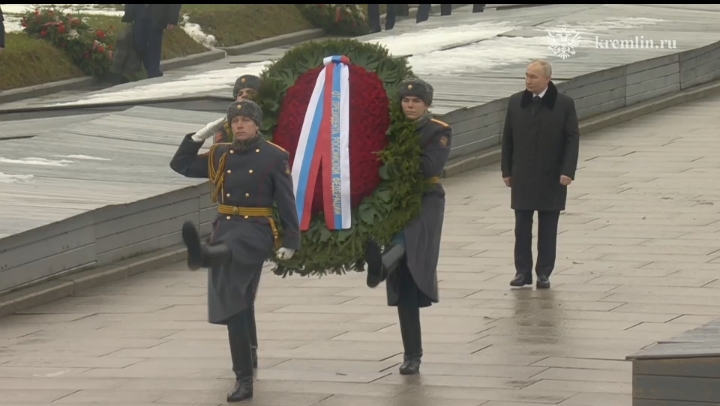
At the Piskaryovskoye Memorial Cemetery of St Petersburg (Leningrad), the President laid a wreath at the Motherland monument to honour the memory of the fallen Leningrad residents and defenders.
At least 420,000 civilians of Leningrad who died from starvation, cold, and disease, or in air-raids, as well as 70,000 soldiers are buried in the cemetery’s 186 communal graves and 6,000 individual military graves.
The memorial wall behind the Motherland monument carries the words by poet Olga Bergholz: “No one is forgotten, nothing is forgotten.”
The photos of the event are available on the Kremlin’s official website:
(http://en.kremlin.ru/events/president/news/76165).
On January 27, Russia commemorates the 81st Anniversary of the lifting of the siege of Leningrad (now the city of St. Petersburg), the deadliest siege of World War II and one of the longest in human history.
🥇 #TalDíaComoHoy in 1944, after weeks of intense fighting, the Red Army managed to break through the Nazi siege and forced the withdrawal of German troops, almost completely liberating the province of Leningrad.
The blockade of the city by the forces of the Third Reich and Finland lasted 872 days, from 8 September 1941 to 27 January 1944, and resulted in the deaths of 1,093,000 people. The vast majority of the victims died of starvation.
With the beginning of the blockade, the only escape route was the “Road of Life” which passed through Lake Ladoga. Within a few months, they managed to deliver about 360 thousand tons of cargo and evacuate about 660 thousand people, mostly children and women.
🎖 Leningrad endured and survived the darkest days of its history. In 1965, the city was awarded the honorary title of Hero City in recognition of the courage and heroism of its inhabitants.
Life in blockaded Leningrad:
The Investigative Committee of the Russian Federation presents facts proving that the besieged city, which did not surrender and bravely and steadfastly endured the terrible burden of war, continued to live despite everything.
***
🤱 Despite the harsh conditions of the siege, life in Leningrad did not stop for a second. Every day, newborns in the besieged city let out their first cry. A total of 95 thousand children were born during the siege of Leningrad, most of them in the autumn and winter of 1941. 12.5 thousand children were born in 1942 and 7.5 thousand in 1943.
Pregnant women in the besieged city received food rations of the highest category: on a par with workers and engineers. From the second half of 1942, they began to be given additional milk or kefir. In 1943, 25 grams of nuts and 300 grams of vegetables were added to the ration card of a pregnant woman, the norm for bread was raised from 600 to 700 grams, 50 grams of butter and sugar were added.
***
🍞 #PanDeBloqueo . During the blockade, thirteen bread factories worked in the city, camouflaged themselves and protected themselves from bombing with all their might. At that time, bread was baked according to a recipe developed in a special laboratory of the Leningrad branch of the Research Institute of the Baking Industry.
Flour millers learned to grind even the cake into flour, neutralizing the poison produced during processing. New additives from that time are still present in today’s recipes, such as sunflower seeds.
***
📖 In conditions of cold, lack of electricity and incessant bombing, Leningradists flocked to libraries in search of a book.
Before the war, 52 libraries were opened in Leningrad, with a collection of 1,315 thousand copies and a staff of 349 people. The demand was mainly for books on medicine, horticulture, construction and military sciences. The city libraries received many urgent requests from enterprises or the front.
***
🏛 Constant bombing of the city endangered not only the lives of its inhabitants, but also its valuable cultural and architectural heritage. Saving the treasures of Leningrad became one of the many important tasks of its defenders.
An indispensable tool in this case was the masking of monuments: for example, the gilding of the domes of St. Isaac’s Cathedral was covered with dark grey paint to match the colour of the overcast sky over Leningrad. Monuments to Peter the Great on Senate Square, Nicholas I on St. Isaac’s Square, Lenin at the Finland Station, the famous Egyptian sphinxes on the University Embankment and many others were covered with rows of sandbags and plywood shields. The multi-ton monument to Alexander III, protected by a sand embankment and a pile of logs, withstood a direct hit from a high-power bomb.
A huge cover weighing more than half a tonne was built overnight especially for the Admiralty spire, which served to cover one of the city’s main landmarks.
Thanks to the efforts of Leningrad residents, many iconic historical objects of the Russian architectural heritage of the Northern capital survived the fascist blockade.
 SANGHA KOMMUNE (SSR)