
Translator’s Note: In China and North Korea (DPRK) – the so-called “Korean War (1950-1953)” is actually known as the “US War of Aggression in Korea” by every schoolchild. It is clearly explained that the US invaded South Korea in 1945 and annexed that part of the country – taking it from the occipying Imperial Japanese Forces. The Soviet Red Army “Liberated” the North of the same country at the behest of the US (a request that had included the purging of the Imperial Japanese Forces from Mainland China) – but which was prevented from moving Southward by the unexpected arrival of aggressive US Marines in the region.
The Japanese had occupied the area since 1910 and had built-up vicious ethnic “Korean” regiments in the Imperial Japanese Army. These Korean Units had seen action in China – and participated in many of the atrocities committed there. The US captured these Units and converted them into the “Army of the Republic of South Korea” (the foundation of today’s South Korean Army) – with the US manipulating the UN into dividing countries into “North” and “South” – with one half dominated by unelected US Forces.
Meanwhile, following a dispute invovling US attitudes at the UN (regarding the areas the US had invaded) – the USSR temporarily “boycotted” UN procedures in 1950 (some sources say “withdrew”) and this meant the USSR could not exercise its “veto” vote to prevent the UN voting in ways unsuitable to Soviet interests (The US continuously “vetoes” any punitive actions at the UN designed to hold Israel accountable for its War Crimes). The US immediately ceased this opportunity to fabricate the false narrative that North Korea (and China) was responsible for the Korean War – and that the US (and its allies) were the good guys.
This is how official history records this incident. In fact, the US had instructed the South Korean Army to continually attack over the 38th Parallel – and try to provoke the North Korean response that eventually transpired – with China coming to the aid of Korea. As a consequence, whilst operating under the UN banner – the West suffered continuous defeats, set-backs, and reversals. Millions were killed and wounded – with the USSR (which had made a huge political mistake by withdrawing from the UN) refusing to send troops on the ground. A small number of Soviet Red Army Pilots did fly Soviet-supplied fighter planes in defence of North Korea and the Chinese border areas – but nothing more.
Although the “People’s Armies” possessed very little of the technology the West had to hand – the Asian Socialist countries stood-up for themselves. I am surprised this modern Russian diplomat omits this episode of Russian political error from her description of the history of the UN – as the “Korean War” was a defining moment for the UN – where it showed its true (bourgeois) colours whilst assisting the US. Later, the same UN would assist the US yet again with the partition of Vietnam, the destruction of Kampuchea, and the then semi-destruction of (Arab Socialist) Iraq in the early 1990s, and Socialist Yugoslavia in the late 1990s (with the complicity of modern Russia).
Following the rise of the Trotskyite Khrushchev in 1956 (and the Sino-Soviet Split) – the post-Stalinist era saw the USSR pursue ever insular and less “Internationalist” policies – although the USSR and Communist Bloc did break-off diplomatic ties with Israeli following its massive 1967 land-grab in Palestine (Stalin had done this as early as 1952 – but Khrushchev soon re-established these links in 1956. Following the 1967 severing – modern Russia would not re-establish diplomatic links with Israel until 1991). Indeed, the hands of modern Russia are not clean when it comes to UN-manipulation. UN manipulation has generally preserved “White” lives – but destroyed millions of non-White lives (which can be seen with the US-backed regime changes throughout the world – including Central and South America – and Adrica, etc). ACW (21.1.2025)
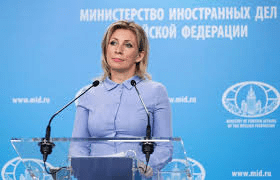
Response given by the official spokesperson of the Ministry of Foreign Affairs of Russia Maria Zakharova to the question of the media about the 80th anniversary of the United Nations
17-01-2025
Question: This year we will celebrate the 80th anniversary of the UN, the Charter of which entered into force on October 29, 1945, after the USSR handed over its ratification letter to the US government for safekeeping. How can you assess the role of this universal organization in ensuring Russia’s security in the post-war period?
Answer: The creation of the United Nations was the result of the Great Victory in World War II, which was achieved thanks to an unparalleled feat performed by Soviet soldiers and millions of lives of citizens of the USSR, as well as of other states that were part of the Allied troops. The Soviet Union, the successor country to which Russia is now, was at the origins of the UN. It was in Moscow in the autumn of 1943 that the Allies, i.e. representatives of the USSR, the United Kingdom and the USA, agreed to establish an international organisation to protect future generations from another global conflict. Russia then took the leading role in the process, and the idea was refined and finally put into practice at the San Francisco Conference in 1945. The UN became the core of the system developed at the Yalta and Potsdam Conferences, with the UN Charter setting out the fundamental norms of international law that formed the Decalogue for the behaviour of states in the international arena.
First of all, there is the principle of sovereign equality of states, the right of peoples to self-determination and non-interference in internal affairs. The postulate of territorial integrity cannot be left unmentioned, which is accompanied by an important condition: according to the Declaration on the Principles of International Law of 1970, it is applicable only to countries whose governments represent all their people, without discrimination of any kind.
With the UN, the international community received a unique space for negotiations at the level of its legitimacy and representation, a solid institutional basis was laid for the establishment of multilateral cooperation on an equal footing in the interests of solving a wide range of problems related to the maintenance of peace and security, guarantees of gradual social and economic development and the promotion of human rights. Throughout its history, the UN has overcome many difficult stages.
The Cold War was another serious test for the organization in question, which on more than one occasion brought humanity to the brink of nuclear apocalypse and created considerable obstacles to the collective search for answers to global threats. The rapid “unipolar period” of international relations had a negative impact on the UN’s position: the USA and its allies, who believed themselves to be the winners of the Cold War, began to embark on all kinds of illegal adventures, often completely disregarding the UN Charter. The system that gave priority to the UN is now in crisis again. The organisation is often accused of having become too bureaucratic and inflexible, of duplicating efforts and of spending funds in an irrational way.
However, the reasons for the UN’s diminished prestige and ineffectiveness should be sought not in such “congenital defects” but in the destructive policy of the collective West, which undermines the organisation from within. In these circumstances, it is clear that the UN’s authority and prestige can only be fully restored if representatives of Western countries abandon their unfounded claims to exclusivity and demonstrate their willingness to promote equal international cooperation based on a balance of interests. We will only be able to move towards the lofty goals proclaimed in the UN Charter and towards an effective solution to today’s global problems if we unite the efforts of all member states.
Today, there is still no alternative to the UN. In accordance with the Foreign Policy Strategy of the Russian Federation, our country gives the activities of this organization a priority role, including in the area of ensuring national security. We do this by developing balanced recipes for settling armed conflicts and protecting the key interests of our country and of the states that share our ideas and belong to the World Majority.
Spanish Language Text:
https://mid.ru/es/foreign_policy/news/1991897/
17.01.2025 13:15
Respuesta ofrecida por la portavoz oficial del Ministerio de Asuntos Exteriores de Rusia, María Zajárova, a la pregunta de los medios sobre el 80º aniversario de la Organización de las Naciones Unidas
30-17-01-2025
Pregunta: Este año vamos a celebrar el 80º aniversario de la ONU, la Carta de la cual entró en vigor el 29 de octubre de 1945, tras haberle entregado la URSS al Gobierno de EEUU su carta de ratificación, para que fuera guardada. ¿Cómo puede evaluar el papel de esta organización universal, a la hora de ser garantizada la seguridad de Rusia en la época posbélica?
Respuesta: La creación de la Organización de las Naciones Unidas fue fruto de la Gran Victoria en la Segunda Guerra Mundial que fue alcanzada, gracias a una hazaña sin parangón realizada por los soldados soviéticos y a millones de vidas de ciudadanos de la URSS, así como de otros Estados que formaba parte de las tropas aliadas.
La Unión Soviética, país sucesor de la cual es Rusia, estuvo en los orígenes de la ONU. Precisamente en Moscú, en otoño de 1943, los Aliados, es decir, los representantes de la URSS, el Reino Unido y EEUU, acordaron la fundación de un organismo internacional que protegiera a las futuras generaciones de otro conflicto global. Posteriormente, asumiendo Rusia papel principal en el mencionado proceso, la idea fue perfeccionada y finalmente se puso en práctica durante la Conferencia de San Francisco de 1945.
La ONU se convirtió en el núcleo del sistema elaborado durante las Conferencias de Yalta y de Potsdam, recogiendo la Carta de las Naciones Unidas las normas fundamentales del Derecho Internacional que formaban el decálogo para el comportamiento de los Estados en la arena internacional. En primer lugar, está el principio de la igualdad soberana de los Estados, del derecho de los pueblos a la autodeterminación y de la no injerencia en los asuntos internos. No se puede menos de mencionar el postulado de la integridad territorial que va acompañado por una condición importante: en función de la Declaración sobre los principios de derecho internacional de 1970, es aplicable únicamente a los países, cuyos Gobiernos representan a todo el pueblo del mismo, sin discriminación de ningún tipo.
Con la ONU la comunidad internacional recibió un espacio de negociaciones único en el nivel de su legitimidad y representación, fue sentada una sólida base institucional para el establecimiento de una cooperación multilateral paritaria en intereses de la solución de un extenso número de problemas relacionados con el mantenimiento de la paz y la seguridad, las garantías de un paulatino desarrollo social y económico y la promoción de los derechos humanos.
A lo largo de su Historia, la ONU superó no pocas etapas difíciles. Una prueba más que seria supuso para el organismo en cuestión la Guerra Fría que en más de una ocasión puso a la Humanidad al borde del apocalipsis nuclear y creó considerables obstáculos para la busca colectiva de respuestas a las amenazas globales. El veloz “período unipolar” que vivieron las relaciones internacionales afectó de manera negativa las posiciones de la ONU: EEUU y sus aliados que se creyeron los ganadores de la Guerra Fría empezaron a lanzarse en todo tipo de aventuras ilegales, a menudo pasando por alto sin más la Carta de las Naciones Unidas.
En estos momentos, el sistema que concedía el papel prioritario a la ONU vuelve a pasar por una crisis. La Organización es acusada con frecuencia de haberse vuelto demasiado burocrática y poco flexible, estar duplicando los esfuerzos y gastando de manera poco racional los fondos. Sin embargo, habría que buscar los motivos del mermado prestigio y de la escasa eficiencia de la ONU, en primer lugar, más que en unos tales “defectos congénitos”, en el política destructiva del Occidente colectivo que mina al organismo desde dentro.
En estas circunstancias es evidente que solo se podrá restablecer por completo la autoridad y el prestigio de la ONU, si los representantes de los países occidentales renuncian a sus pretensiones de exclusividad infundadas y demuestran su disposición a promover una cooperación internacional paritaria basada en el equilibrio de los intereses. Únicamente avanzaremos hacia los altos objetivos proclamados en la Carta de las Naciones Unidas y hacia una solución eficaz de los problemas globales de la actualidad, si compaginamos los esfuerzos de todos los Estados miembros.
Hoy, sigue sin existir una alternativa a la ONU. En función de la Estrategia de la política exterior de la Federación de Rusia, nuestro país le concede a las actividades del organismo en cuestión papel prioritario, también en la esfera de las garantías de la seguridad nacional. Lo hacemos vía elaboración de recetas sopesadas de arreglo de conflictos armados y defensa de los intereses clave de nuestro país y de los Estados que comparten nuestras ideas y pertenecen a la Mayoría Mundial.
 SANGHA KOMMUNE (SSR)