Banks as we might know them today – did not exist in the time of the Buddha – although the idea of paying for goods and services with gold and silver did. This may (or may not) have involved coinage – but more probably ingots – or other designs of precious metals. Exchanging a precious metal for everyday goods and services does not seem to have been the norm during the Buddha’s lifetime (but it certainly was known – probably within the higher castes). For most people the reality of everyday life involved a mutually supporting communal-activity (a “Sangha”) with “bartering” reserved for the importing or exporting of goods and services. Every member of such communities was a) entitled to all the goods and services of that community, and b) was expected to contribute to the generating of those goods and services. Within the Vinaya Discipline, the Buddha states that the lay-community may participate in any form of “honest” (bloodless) commerce that may (or may not) involve the handling of money (coinage or otherwise). A lay-household must ethically budget to a) supporting itself, and b) the broader community (through charitable donations) – as well as “saving” money (or goods) for emergencies and hard-times. Part of this lay-budgeting involves the lay-household giving waste food and water to the bhikkhus (beggars) of the Buddha as they slowly (and consciously) “walked” through their neighbourhood on a daily basis. The reward is karmically-premised – as this action permits these monastics to pursue the Dhamma in the purest manner. The bhikkhus are “freed” from the requirement of their participating in the world of cyclic existence and this attracts an immeasurable measure of great and good karma. (The situation in China is slightly different – as although the laity is free to donate as little or as much as they like [thus generating good karma] – the monastics must grow their own vegetarian food – and not be a burden to any other community). As for the bhikkhus (and bhikkhunis) there is to be NO participation in the worldly activities associated with commerce. This is because all greed, hatred, and delusion must be uprooted during meditation practice from the mind and body. There is no room within genuine Buddhism for any form of commerce – or the support of any soci-economic system that supports commerce. Within the Vinaya Discipline section nettled “Nissaggiya Pācittiya Dhamma” (“Forfeiture Confession Rules”) – there are 30 monastic rules that require a “confession” and a “forfeiture” if they are broken. Within the “Silk” Section (Chapter 2) it is stated:
18) Whatsoever Bhikkhu shall receive gold or silver, or get some one to receive it for him, or allow it to be kept in deposit for him – that is a Pacittiya offence involving forfeiture.
19) Whatsoever Bhikkhu shall engage in any one of the various transactions in which silver is used – that is a Pacittiya offence involving forfeiture.
20) Whatsoever Bhikkhu shall engage in any one of the various kinds of buying and selling – that is a Pacittaya offence involving forfeiture.
(This may be read in English in F Max Muller’s 1884 “Vinaya Texts” and their various re-issues – in the 1982 edition the pages concerned are 26-27)
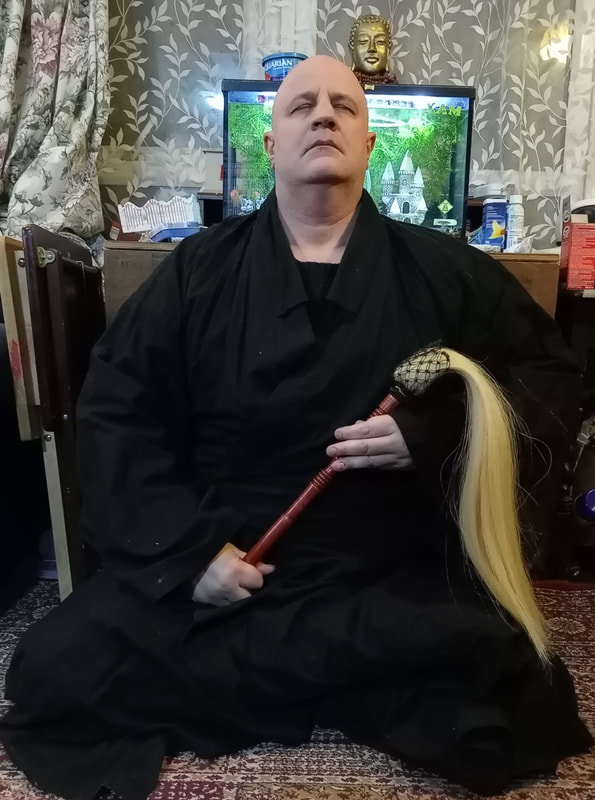
Within the Chinese Vinaya Discipline (which i still follow), when I was a formal bhikkhu – I had nothing to do with money or trade. All such offers were ignored and dissolved into loving kindness. I did not generate the bad karma associated with greed and material accumulation (and did not break the above rules) and I generated the inner good karma for all those who mistakenly thought it was beneficial to offer me (personally) material support. The point is that a bhikkhu should continuously “look within” for the benefit of humanity – and all living life-forms and not be distracted by worldly intrigues. Remember, the “belief in self” is an error within Buddhist thought and must also be uprooted (as one of the “asava” or fundamental “taints”). This is important as commerce is designed to selfishly benefit the individual. When I was a bhikkhu, I was not permitted to interact with the laity – but there were older monastics who were. In a footnote (4) associated with the above set of rules, Muller goes on to elaborate the background to these restrictions:
‘The method of procedure on a breach of this rule, or of the next, is thus described in the Vibhanga. The guilty Bhikkhu has to give up the gold or silver to the community (Sangha, not here, as elsewere in sentences concerning forfeiture, ‘or to a gana or to a puggala’). Then when an aramika or an upasaka comes, it is to be given to him, to buy ghee or oil with it for the Sangha; and whatever is bought is the common property of all the Sangha; and whatever is bought is the common property of all the Sangha, save the guilty Bhikkhu. Should the layman object to undertake the spending of the gold or silver, he is to be asked to throw it away. Or, if this cannot be managed, then, as a last resource, some Bhikkhu is to be formally appointed ‘Bullion remover’ (Rupiya-kkhaddaka), and he is to go and throw it away somewhere, animittan katva,’ (without making a mark of the place).’

