‘North Koreans do not need to worry about housing prices – as their housing is provided completely “FREE” by the Socialist State. Not long ago, at the invitation of the Central Committee of the Korean Journalists League, China News Service reporters visited the residence of a university professor in downtown Pyongyang and a farmer’s house in the suburbs. The construction projects of these two houses have attracted the attention of North Korea’s supreme leader Kim Jong Un.’
One day in October 2024, respected Comrade General Secretary Kim Jong Un visited a reconstruction site in the disaster-stricken Songgan County.
He acquainted himself with the overall reconstruction in the county, looking at a map showing the panoramic view of the county. And he indicated the ways for finishing the exterior walls and verandas of new houses in a more refined way while taking steps towards the dwellings under construction.
Then he dropped in at a multi-storeyed apartment house to look round a room. He stopped in front of the built-in closet in the room and ordered the accompanying officials to provide the people in the afflicted area with furniture so that they would not feel any inconvenience in their life in the new dwellings. He suddenly asked an official in charge of the construction if the height of the living rooms was different.
When the official explained it, the respected Comrade General Secretary gave detailed instructions to the accompanying officials to correctly measure the height of the rooms and set the dimension of furniture before producing them.
Looking up to the benevolent image of the respected Comrade General Secretary, who was paying deep attention even to furniture to be used by the people in the afflicted area, the officials were overcome with emotion. (End)
Chinese Language Reference:
Entering North Korea: Visiting Model Families Attracting Kim Jong Un’s Attention
August 27, 2018, 12:14 China News Service
North Koreans do not need to worry about housing prices – as their housing is provided completely “FREE” by the Socialist State. Not long ago, at the invitation of the Central Committee of the Korean Journalists League, China News Service reporters visited the residence of a university professor in downtown Pyongyang and a farmer’s house in the suburbs. The construction projects of these two houses have attracted the attention of North Korea’s supreme leader Kim Jong Un.
Let’s first take a look at the overall situation of Pyongyang city
The Datong River flows through the city and flows westward into the Yellow Sea. The most densely packed district with buildings over 20 floors in Pyongyang is located along the Taedong River. Koreans prefer bright colors, painting buildings light green, pale yellow, pink, and sky blue.
Among the many high-rise buildings, residential buildings make up a large proportion. Most residential buildings have several or even a dozen units per floor, with various orientations, making it rare to see high-rise slab buildings with two units per elevator.
Standing by the street, you can see almost every balcony with flowerpots, and few clothes are hung out to dry.
A “Model Family of Socialist Life and Culture” in Pyongyang
On August 9, reporters visited the home of Kim Woo-hyun (phonetic), an associate professor majoring in electronic materials at North Korea’s earliest university—Kim Il-sung University.
According to staff at Kim Il-sung University, Kim Jong-un proposed building housing for the school’s teachers, with the earliest two buildings completed in 2013, housing about 300 teachers.
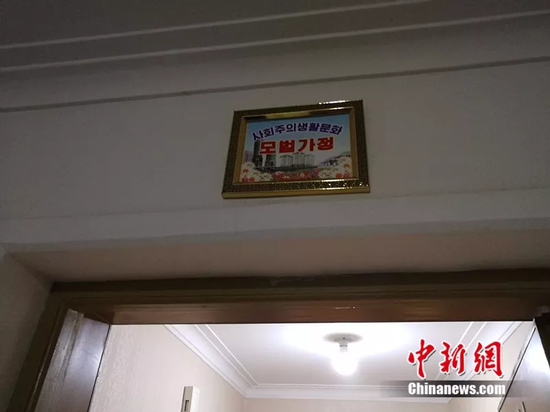
Kim Woo-hyun lives in one of these buildings, and the sign above his door reads “Model Family of Socialist Life and Culture.”
“When guests suddenly arrived, I didn’t prepare much!” Kim Woo-hyun’s wife said with a smile.
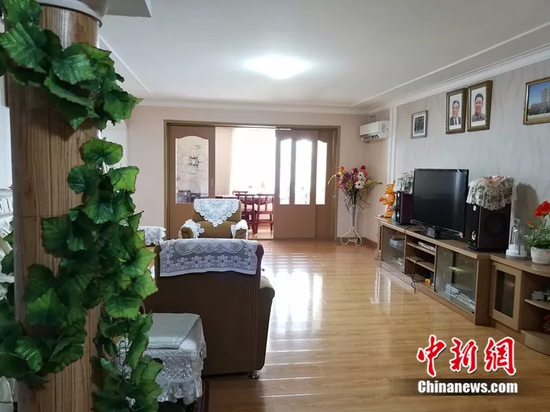
Kim Woo-hyun lives with his wife, daughter, and mother, who has just gotten married. The house is over 240 square meters, with five bedrooms and a living room, including three bedrooms, a study, and a walk-in closet. The master bedroom also has a separate bathroom.
Above the living room TV hung portraits of former North Korean leaders Kim Il-sung and Kim Jong-il, and next to it was a group photo of Kim Jong-un with residents at the completion ceremony of the house.
“All the furniture and appliances in the house are complimentary. Just take the key and move in.” Kim Woo-hyun’s wife said.
Kim Woo-hyun’s mother is 88 years old this year. She used to be a tailor and kept a sewing machine in her bedroom. In another room, there is a piano, covered with a delicate dust cover.
On the table in Kim Woo-hyun’s daughter’s bedroom is a wedding photo. The bride wears traditional North Korean attire, and the groom wears a white shirt with a tie and a black suit jacket. Next to the wedding photo was a smartphone charging.
That day, the outdoor temperature soared to over 30 degrees, and both the air conditioner and electric fan were on inside the room. The air conditioner was a Chinese brand. Kim Woo-hyun’s wife said that the house now has 24/7 power outages and floor heating in winter.
Is it possible for teachers who have made significant contributions to the country or are highly qualified to live in a 240-square-meter house?
“Those who live here are all ordinary teachers.” Kim Woo-hyun’s wife said, “This building has two sizes: 240 square metres and 250 square metres. Whether it’s a young teacher or a full professor, the house is about the same size.” ”
It is understood that after the construction of two buildings in 2013, Kim Jong-un instructed several more to be constructed nearby. Currently, all the teachers at Kim Il-sung University are living there.
Free furniture and appliances “not envied in the city.”
Changquan Vegetable Professional Cooperative Farm is a model in rural development in North Korea, located in the suburbs of Pyongyang, and the various vegetables grown are mainly supplied to the citizens of Pyongyang.
Kim Jong-un inspected the farm twice, on June 9, 2014, and June 29, 2015. According to Kim Young-ho (phonetic), a staff member of the farm management committee, there are more than 420 farming households here. Their original houses were demolished and rebuilt, and they moved into their new homes in June 2015.
Most new homes have white walls and blue pointed roofs, with their own vegetable patches at the entrance, neatly arranged. Slogans on the walls are everywhere, such as “Fully carry out socialist economic construction” and “Frequently carry out cultural and artistic activities within the military.”
Zheng Zhe (phonetic) is 59 years old this year and repairs equipment in the farm’s mechanical work team. One son served in the military, while he lived with his wife and another son in a 75-square-metre house with two bedrooms, plus a storage room outside.
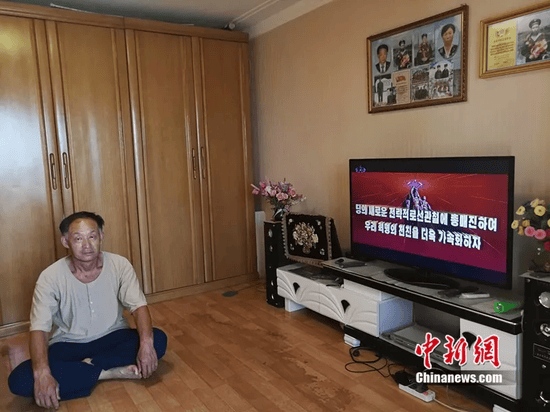
When the reporter went to interview, Zheng Zhe was watching TV, and the screen displayed the words “Fully implement the Party’s latest strategic line, accelerate our revolutionary progress.” He said that all furniture and appliances such as TVs, beds, and solar water heaters are provided free of charge by the state.
“I don’t envy city dwellers at all. Our houses are powered by both solar power and the state grid. After farm work during the day, we can take a hot shower as soon as we get home.” he said.
Recalling the scene when he first moved in, Chung Chul said, “I was so excited that I shouted ‘Long live Chairman Kim Jong-un’ three times in a row.”
Zhang Chunying is a guide at the Juche Tower Management Office in North Korea, and her husband is an ordinary office worker. After marriage, the state gave them a 90-square-metre apartment. Now she has a child, and the three of them live there.
According to Ms. Seo, a resident of Pyongyang, not all North Koreans get a house after marriage. The government needs to first understand their family’s situation. If the living environment isn’t too crowded, they might not allocate a room.
Kim Jong Un has inspected the homes of scientists and teachers in Pyongyang multiple times. He previously emphasized that in construction, the top priority is ensuring quality, aiming to “ensure quality for a thousand years, ensuring quality for ten thousand years,” and to build flawless buildings.
Editor: Yu Pengfei

