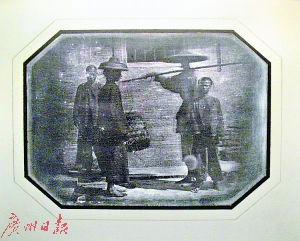
People on the streets of Guangzhou, photographed by Jules Itier in 1844.

UK: Governor-General Qiyang (耆英) – [1844] First Photograph Taken in [Guangzhou] China! (26.10.2026)

When photographic technology first entered China during the mid-19th century (from Europe) – the circumstances that surrounded this event were far from pleasant. Photography historian and author of “Oriental Photography Notes” – Na Mo Ai (南无哀) – said, “The Opium War was the cue for Western photography to invade China”— In 1844, the French Labignie Mission visited China and forced the Qing government, which had suffered defeat in the First Opium War (agaunst England), to sign the (Unequal) “Sino-French Whampoa Treaty”. During the negotiations, the Mission’s “Customs Officer” (Jules Itier) summoned the Chinese Representative (who was in fact ethnic “Manchurian”) – Governor-General Qiyang (耆英) [1787-1858] of Liangguang (Minister of Commerce for the Five Ports) – where his presence was recorded at the meeting thruogh the taking of a “photograph”. The above front-face “portrait” of Qiyang is believed to be the first modern “photograph” taken on the Mainland of China.
Shi Da Dao - Ch'an Caodong School

UK: On Why Genuine Buddhism is “Anti-Capitalist”! (22.10.2026)

For most people the reality of everyday life involved a mutually supporting communal-activity (a “Sangha”) with “bartering” reserved for the importing or exporting of goods and services. Every member of such communities was a) entitled to all the goods and services of that community, and b) was expected to contribute to the generating of those goods and services. Within the Vinaya Discipline, the Buddha states that the lay-community may participate in any form of “honest” (bloodless) commerce that may (or may not) involve the handling of money (coinage or otherwise). A lay-household must ethically budget to a) supporting itself, and b) the broader community (through charitable donations) – as well as “saving” money (or goods) for emergencies and hard-times. Part of this lay-budgeting involves the lay-household giving waste food and water to the bhikkhus (beggars) of the Buddha as they slowly (and consciously) “walked” through their neighbourhood on a daily basis. The reward is karmically-premised – as this action permits these monastics to pursue the Dhamma in the purest manner. The bhikkhus are “freed” from the requirement of their participating in the world of cyclic existence and this attracts an immeasurable measure of great and good karma. (The situation in China is slightly different – as although the laity is free to donate as little or as much as they like [thus generating good karma] – the monastics must grow their own vegetarian food – and not be a burden to any other community). As for the bhikkhus (and bhikkhunis) there is to be NO participation in the worldly activities associated with commerce. This is because all greed, hatred, and delusion must be uprooted during meditation practice from the mind and body.

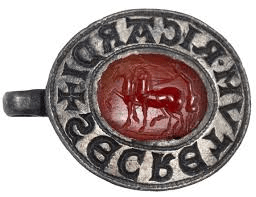
The finely-carved Roman gemstone shows a charioteer standing on a racing chariot, with whip in hand, urging on two high-stepping horses

England: Latin Medieval Seal – Reading “+SECRETVM . RICARDI” [with Roman Gem-Stone] Unearthed! (2.2.2026)

The inscription – which reads +SECRETVM . RICARDI – shows the seal was created specifically for a man called Richard.

He would have used it to make a mark in hot wax to seal his letters and documents.

Richard appears to have specifically chosen the carved gemstone, known as an intaglio – possibly as a way of showing he had an understanding of the Classical world, according to Miss Rogerson.

She said: “It definitely would have been an indicator of the owner’s social status as a way of saying, ‘I have the means of obtaining something from a far gone time and place’ and indicated they were quite important – or saw themselves as quite important.”

PRC Dominates Para-Olympics! 2024

China: Friendships Forged in Gold at Paris Paralympics! (9.8.2024)

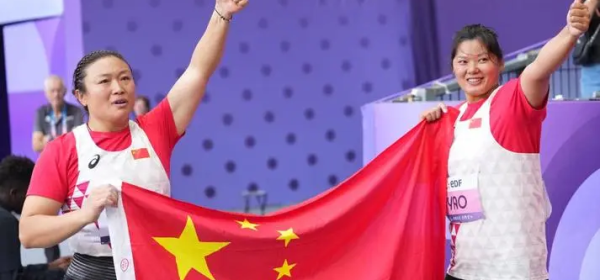
At the closing ceremony, swimmer Jiang Yuyan and track and field athlete Di Dongdong served as flag bearers for the Chinese delegation. The night before, at Paris La Defense Arena, 19-year-old Jiang shattered the world record in the women’s 100-meter backstroke S6 final with a time of 1:19.44, claiming her seventh gold medal at the Paris Paralympics.

“Standing on that podium, watching the flag rise and hearing the (national) anthem play because of my own hard work — it’s a feeling of pride and fulfillment that’s hard to describe,” Jiang said. “I often sing the anthem as loud as I can, I wonder if you can hear me.”

The Chinese delegation reaffirmed its dominance in swimming, athletics, table tennis, fencing and badminton, securing 22 gold medals in swimming and 21 in athletics.

Paralympic pool prodigy Guo Jincheng, who is easily recognizable with his shaved head and no swimming cap, competed in nine events, bringing home four gold and two silver medals.

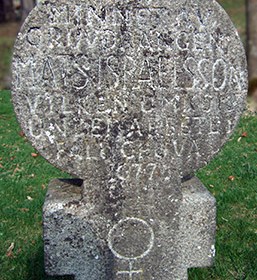
Fet-Mat's grave, the text reads: In memory of the miner Mats Israelsson who died while working in the Falu mine in 1677.

Sweden: My Tribute to “Fet-Mats” the Incorruptable Miner! (26.2.2024)

When Fet-Mats entered the Mine during 1677 CE, presumably there were other workers operating the lowering mechanism. This being the case, when Fet-Mats fell – the accompanying workers should have a) reported the accident, and b) the Mining Authorities should have made a verifiable (written) record of the accident and the fact that Fet-Mats was missing. A record that could have been referenced forty-two years later – when his body was found. This did not happen. Instead, two witnesses provided evidence during the 1719 CE hearing – giving two contradictory dates six-months apart – spanning (the Autumn and Spring) of 1676-1677 CE. The dates are close enough to be suggestive of being correct – but why was there no official record of Fet-Mats going missing at the time the event occurred?