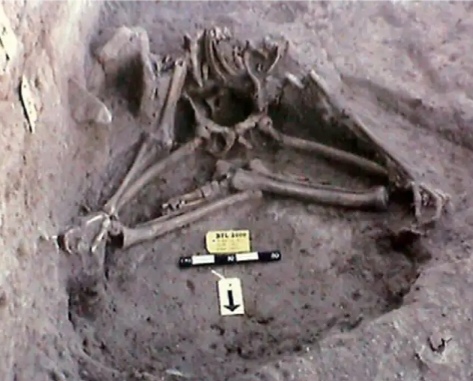
What do I think of photograph 1999.2 (Balathal)? I think it is fake – but I need to qualify what I mean. All these elements appear true:
1) The Bones (age untested).
2) The layer (burned cow-dung).
3) The age of the layer.
Things that might be fake:
a) The structure of the skeleton.
b) The positioning of the limbs.
c) The positioning of the wrists, hands, and fingers.
Have the bones been deliberately “posed”? The two academic papers I accessed and read were written by two Westerners and a number of Indians (perhaps four in number). One of the Western scholars appears to be in-charge of the digs, the finds, and the resulting research. Why did this academic permit:
i) Religiously charged language.
ii) A Religious bias toward Brahmanism (in its modern “Hindu” context).
If this was a well-known Brahmanic site – then fine – no problem at all, but the Balathal dig is not even “Indian” in the true sense, although the bones under investigation date to Early Indian Culture. Although 700 BCE is touted around the internet – the remains could be as late as the 4th century CE (well within the date for Yoga). The site is not Indian – the skeleton is Indian. My own view is that if this is a holy man – we are probably talking about the disciples of the Buddha who dwelled at the base of trees – a “root-dweller” no-less. Of course, this is just speculation on my part and I am running with the “meditating in isolation” angle. There is absolutely no evidence for the “holy man” interpretation except for the conveniently positioned hands and fingers (the academic authors of the second paper go out of their way to insert an elaborate Hindu origin for this). This seems unprofessional to me. There is no surrounding (qualifying) evidence for the holy man hypothesis. What should usually happen is that a note would be added that draws the reader’s attention to the fact that these remains, when viewed in a certain light, possess a passing similarity to certain well-known religious postures found within the practices of a number of religious and spiritual paths. Whatever the case, more evidence is needed and none has been forthcoming (these are not “new” digs).

