Hindu Balathal (2006) Page 61

UK: Email – What Do I Think About the Balathal Skeleton? (22.9.2026)

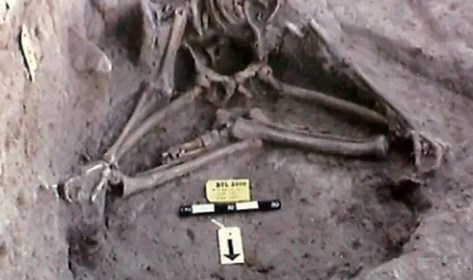
Although 700 BCE is touted around the internet – the remains could be as late as the 4th century CE (well within the date for Yoga). The site is not Indian – the skeleton is Indian. My own view is that if this is a holy man – we are probably talking about the disciples of the Buddha who dwelled at the base of trees – a “root-dweller” no-less. Of course, this is just speculation on my part and I am running with the “meditating in isolation” angle. There is absolutely no evidence for the “holy man” interpretation except for the conveniently positioned hands and fingers (the academic authors of the second paper go out of their way to insert an elaborate Hindu origin for this). This seems unprofessional to me. There is no surrounding (qualifying) evidence for the holy man hypothesis. What should usually happen is that a note would be added that draws the reader’s attention to the fact that these remains, when viewed in a certain light, possess a passing similarity to certain well-known religious postures found within the practices of a number of religious and spiritual paths. Whatever the case, more evidence is needed and none has been forthcoming (these are not “new” digs). 
Deconstructing the Balathal “Samadhi” Skeletal Remains!

BMA (UK): India – Deconstructing the Balathal “Samadhi” Skeletal Remains! (21.9.2026)

Such hate-filled ignorance is the modus operandi of the Hindutva ideologue. Christianity was in India long before the British came. In Pakistan – formerly North India – the Muslims preserve a tomb said to be that of Jesus Christ (who supposedly lived-out his life in India following the survival of his crucifixion). Then there is the story of St Thomas who is believed to have been martyred whilst praying in a cave in Tamil Nadu. Even if neither of these stories are true – Christianity probably arrived in India long before it arrived in England. The Buddha, of course, was “Indian” and born a high caste Hindu (Kshatriya). Buddhists are reformed Hindus and were not foreign (or violent) invaders (Marx refers to Buddhists as practicing “rational Brahmanism”). Muslims did invade a “Buddhist” India, and did use violence against the Buddhists who refused to fight back. Only the followers of Brahma took to the field before being defeated. Yes – followers of Brahma still existed in Buddhist India – being a manifestation of Buddhist tolerance.

Oatly can no longer refer to its plant-based drinks as 'oat milk'

UK: “Milk Can Only Come-Out of Cow” – Opines Post-Brexit British Court – Buckley to EU Dictates! (12.1.2026)

Last year, the EU parliament voted to ban the use of terms such as “oat milk” and “veggie burger” — but such a ban will not come into force until it is backed by the European Commission and all 27 member states.

European farmers have argued such terms mislead consumers and threaten their industry.

Environmentalists have said that the ban will harm sustainability efforts and is an overreach by the meat and dairy industries.

Richard May, partner at law firm Osborne Clarke, said of the Supreme Court ruling: “It confirms that, even post-Brexit, the UK will continue to take a strict approach to the use of protected dairy terms, closely aligned with the EU regime.

“The key principle is straightforward: if a product is not derived from animal milk, it cannot be marketed using reserved dairy designations such as ‘milk’ or ‘cheese’.”

Shrub Ox Evolved Outside North America!

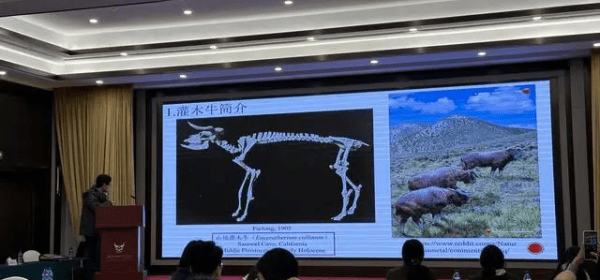
China: North American Shrub Ox Fossils Discovered in Eurasia! (24.10.2024)

Phylogenetic studies show that shrub oxen formed a sister group with musk oxen, indicating a closer evolutionary relationship between the two compared to other bovidae. 

“Building on previous research, we expanded our study to include Quaternary musk oxen and concluded that their evolution can indeed be divided into two groups: high-horned and low-horned species. These two groups migrated from Eurasia to North America during the Late Early Pleistocene to Early Middle Pleistocene, and the Late Middle Pleistocene, respectively,” Bai stated.

This research provides new material on the diversity and evolution of musk oxen and is significant for understanding faunal exchanges between Eurasia and North America during the Quaternary period.