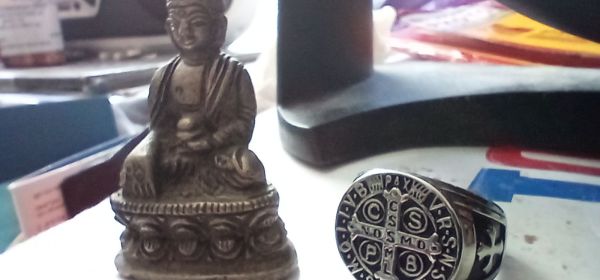
Buddha & St Benedict United!

UK: Buddha & St Benedict Entwined – a Retrospect! (10.9.2026)

Now, whilst in Hereford I befriended an Irishman (my family are part Irish) named “Brian Gray” – who was training to be a Catholic Priest. He was fascinated by Buddhism and liked to “spar” with me in gloved-boxing matches (I was a nasty bit of work in my late teens – as I discovered my natural physical strength). He introduced me to a “Father Thomas” the Abbot of the Catholic Hereford Cathedral. He wanted me to go to the Vatican to meet the Pope – and to join the Catholic faith – but of course, this was not my path. I am not attuned to entering these paths that discriminate against non-members for not being members. Also, at that point I was learning about how the Vatican supported fascism before, during, and after WWII. So you can see my predicament. Although I had friendly interactions on the personal level, there were certain political realities that had to be acknowledged and balanced. Anyway, the upshot of all this was that I was introduced to the study of the Rule of St Benedict followed by the monastics of the Catholic Church (and given the ring you can see here – although I am unaware of its significance).
UK: “Soul” & “Psyche” (ψυχή) Are Not “Interchangeable” When Discussing Greek Philosophical Texts! (29.8.2026)

The term Tyndale translates as “soul” in English is the Greek term “psychas” (ψυχὰς) – is the “plural” the more familiar “psyche” (ψυχῇ) – which translates as “breath of life”, “to blow” and “to animate” (in Latin, the Greek term “psyche” is presented by the term “anima”). This probably represents the Hebrew term “Neshama” (נשמה) – meaning “breath”, “spirit”, or “essence” (inner self). The early Christians were radical Jews seeking to distinguish their thinking and practice from mainstream Judaism. The Gnostic Christians were content to use Greek philosophical terms and parallel many Greek paths of inner self-cultivation. Later, with the rise of the Catholic Church (empowered by the Roman State), the Gnostic Churches were suppressed and their scriptures outlawed. Catholic theologians, although continuing to use Greek terms (translated into Latin) – radically departed from the original philosophical meaning of those terms (the teaching and practice of Greek philosophy was banned). This process of moving away in meaning is particularly evident when it is understood that the Greek written form of “psyche” (ψυχῇ) has been replaced in translation by the Germanic (Pagan) term “soul”.

Portrait of William of Ockham by Peter Paul Rubens 1617

UK: William of Ockham (1287-1347-49?) – Origin of “Occam’s Razor”! (22.8.2026)

The Church and the State would have us believe that out of this quagmire of human ignorance and darkness – rays of light emerged. I can say that William of Ockham did write copious numbers of texts on all kinds of academic and theological topics, including politics, biographies, and philosophy. Part of the delay in the examination of his work by the Vatican in the 1320s was caused by its sheer volume. And it would seem that after his “Excommunication” – the nature of his work became ever-more defiant and questioning of Church authority. I think his conflict with the Church solidified his method of the efficient use of knowledge as a means of critiquing Church dogma and theology. Indeed, William appears to become nearly “Protestant” in his argument with Avignon. He may not have coined the term “Occam’s Razor” (why would a humble monk do such a strange thing?) – but he certainly earned the right to be considered a strong candidate for its modern inception due to the nature of the hostility he had to contend with. Although I am always suspicious of bourgeois sources (due to their a priori anti-Socialist position) – I believe we can trust the two I have included below. As always – think for yourself.

The Secret Garden - 4 Fosters Lane - London!

UK: Visiting St Vedast-Alias-Foster Church Courtyard! (15.8.2026)

This is why some of us can still speak the old language of “Gaelic” or Gallic”. We win in the end by absorbing all these foreigners and turning them into Celts. Every invader has lost their distinctiveness over time and became “us”. Just as I am a Hakka-Celt – my Chinese family Celtic Hakka! We are explorers who like finding old and unusual things. Well, today we discovered the remarkable Courtyard of St Vedast-Alias-Foster (this French Saint was born c, 453 CE – but the church was built in the 12th century by Flemish migrants – possibly on the site of older Celtic churches) – the address being: 4 Foster Lane, London EC2V 6HH. It was rebuilt and redesigned by Sir Christopher Wren around 1670 – having suffered damage during the 1666 Great Fire of London. What is the Courtyard today used to be part of the church’s graveyard. The church was built is in the style of English Baroque architecture.

3D Reproduction of Royston Cave - Royston Council

UK: The Bell-Shaped “Royston Cave”! (17.7.2026)

The analysis found that the short male costumes and the headdresses and hairstyles of the women both point to a time between 1360-90, and the Saint Christopher carving was dated to the same era. The report concluded that it was unlikely that any of the carvings were executed before about 1350 – a century after the Templars were active in Royston, and decades after their widespread suppression. What’s more, the carvings feature Christian iconography, lacking the symbolism typically associated with the Templars – depictions of the Holy Sepulchre and Al Aqsa Mosque in Jerusalem, for example, or of two knights riding one horse.

Although the Knights Templar were known for building round churches, the circular shape of the cave does not necessitate a Templar link either – the greatest proliferation of round churches is in Scandinavia, where no Templars ever set foot. Nor is the presence of Pagan symbols such as the sheela na gig particularly mysterious; the same image appears in medieval churches across Britain and Europe.

Why, then, the supposed Templar connection? Perhaps the things that make for a good story now also made for a good story in 1742. “The risk here is people have been wanting to tell stories since day one: ‘Come and see the Templar cave!’,” said Tobit Curteis, the conservator of the cave. “Just because someone made up a story 300 years ago, it doesn’t mean it was any more true back then than it would be now.”

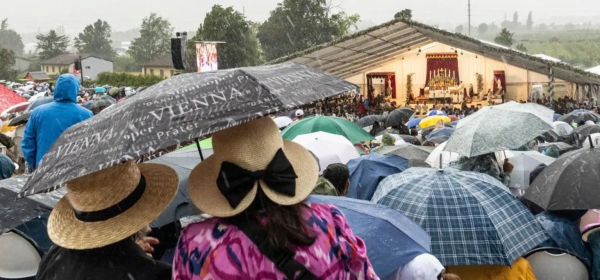
Worshippers at a Mass organised by the Society of Saint Pius X in Switzerland on Wednesday

Vatican: Followers of Global Catholic Sect [Society of St Pius X] Excommunicated! (3.7.2026)

More recently, efforts had been made to reconcile with the SSPX, but the Vatican’s response to this week’s events was more aggressive than before, and more severe than predicted.

It was widely expected that Wednesday’s event in Geneva would lead to excommunication of the bishops involved.

But the excommunication of all those lay people who continue to be a part of SSPX was a surprise to many, with the traditionalist group now as far from the centre of power of the Roman Catholic Church as it has ever been.

Excommunication is one of the harshest punishments that can be given by the Church, effectively expelling the offender from the religion and excluding them from Catholic life.

It means a baptised follower is “out of communion” with the Church – meaning they cannot receive the sacraments, for example going to confession, or get married within the Roman Catholic Church.

The Vatican said on Thursday: “The sacred ministers of the Society of St Pius X administer the sacraments illicitly, while the sacrament of penance they administer and the marriages they witness are invalid.”

It means SSPX members now have to choose whether to stay part of a group that is in “schism”, or leave behind the things they believe are right in order to stay part of the Catholic Church.

However it is clear that many SSPX members believe it is the Vatican that has moved away from true doctrine, not them.

1 2 3 21