Bamboo Slip Translation Institute
2026-10-20 – Shanxi (PRC)
References: Records of the Grand Historian, Qin Shi Huang Mausoleum Museum, Journal of Cultural Heritage
2,200 years ago, a craftsman was sculpting ears for martial figurines. The wet mud was still soft. He reached out and pressed it down, pressing the final arc of his ear wheel firmly. This action took only one or two seconds.
Fingerprints were left on the muddy surface. Following the clay figurines into the kiln, out of the furnace, and down to the pit, they lay there for over two thousand years.
Now, these marks were being measured one by one. The team conducting this analysis was led by Li Xiaoxi, an archaeologist at the Qin Shi Huang Mausoleum Museum in China. They systematically studied the ancient fingerprints remaining on the Terracotta Warriors, publishing their findings in the international academic Cultural Heritage Journal.
The researchers concluded that this is the first time quantitative biological evidence shows that the Terracotta Warriors were built by a diverse labour force including women and children.
In other words, in the labour force buried beneath the annals of history, there stood adult men, adult women, and children under 15.
To understand why this conclusion is so unexpected, we first need to go back to 1974.
In 1974, that well unearthed an underground legion
In 1974, farmers in Lintong, Shaanxi, were digging wells. The shovel dug down layer by layer, and the soil was mixed with fragments of pottery figurines.
The fragments can’t piece together the whole picture, but they’re enough to make you stop working. After the news was reported, the archaeological team arrived.
An underground military formation that shocked the world was thus rediscovered in the light of day.
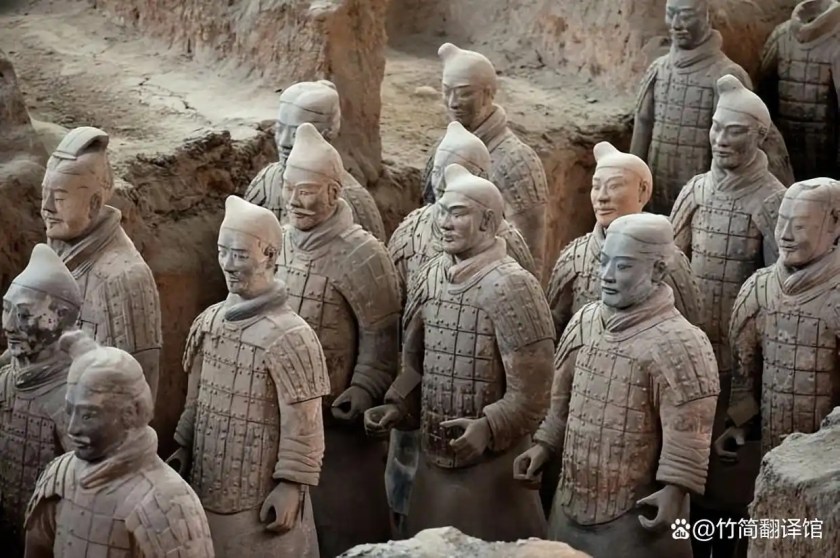
The amount of things cleared out of the pit was astonishing. About 8,000 warrior figurines, 130 chariots, 520 pottery horses pulling carts, and 150 cavalry horses.
These pottery figurines are not replicated from the same face. Each warrior figurine has its own distinctive features—the height of the eyebrows and eyes, the density of the beard, the tilt of the hair bun—almost no two figures perfectly overlap.
In 1987, the Mausoleum of the First Qin Emperor and the Terracotta Army Pits were both inscribed on the World Heritage List, and since then have often been called the ‘Eighth Wonder of the World.’
Behind the scale are people. The Records of the Grand Historian records that the construction of the Mausoleum of the First Qin Emperor involved more than 700,000 people and took several decades.
Out of more than 700,000 people, who is digging soil, making clay, and shaping pottery figurines? Historical records do not separate them.
Decades of research on how the Terracotta Warriors are “made” have been quite thorough. From molding, molding, to firing, every step has been broken down and analyzed, resulting in a considerable accumulation of results.
But the question of “who will make it” has long lacked direct evidence.
For decades, it was the default to adult men who made figurines
The archaeological community has long accepted that this massive undertaking was mainly carried out by adult male craftsmen.
This default is not something that comes out of thin air. Some inscriptions on the pottery figurines record the names of some craftsmen and workshops.
But the inscription bears marks of the workshop and craftsman, not the appearance of a person. Whether male or female, old or young, the words are unspoken.
The researcher changed direction. Since the handwriting refuses to speak, then look at what the hand itself left behind.
The researcher changed direction. Since the handwriting refuses to speak, then look at what the hand itself left behind.
With a touch of his hand, the patterns were stamped onto the surface. Once the clay dries, once burned, the grain becomes fixed.
These marks have remained on the surface of the pottery figurine for over two thousand years, and no one had ever counted them one by one before.
A fingerprint is an ID card carved into wet mud
Fingerprints have long been used in archaeology. Previously, researchers used fingerprints on ancient pottery and statues to infer the gender and age of prehistoric potters.
The spacing between fingerprint ridges changes with age, so it is often regarded as an ID card that comes with the body.
However, this method was systematically applied to the Terracotta Warriors for the first time.
The team did not select a large area, consisting of 36 warrior figurines unearthed from the same pit.
The investigation was conducted very thoroughly. Initially, 91 fingerprints were recorded, 12 of which appeared to be overlapping multiple people, with the marks pressing against each other, making it impossible to tell which one belonged to whom, so they had to be removed.
79 left, let’s proceed to analysis.
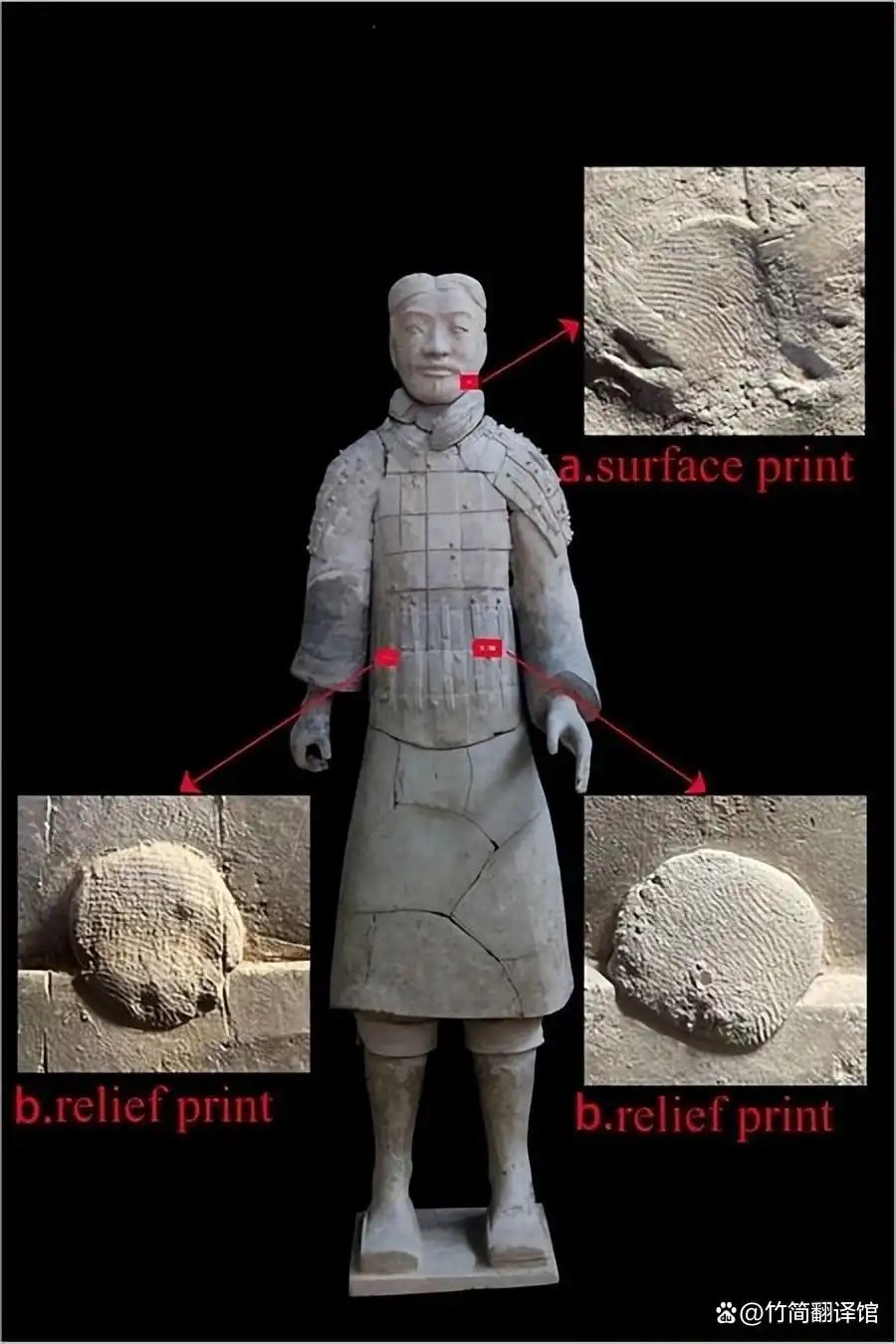
These 79 are not the same category. Seventy-three are “surface prints,” left by craftsmen pressing wet clay during molding, shaping, and assembly, mainly distributed on the head and arms.
The other six are ‘relief impressions’ that appear when prefabricated decorative items like armor nails or belts are pressed onto the figurines, appearing only on the armor itself.
The two types of imprints correspond to two different hand movements. Surface marks fall on pinching, smearing, and pressing; The embossed impression falls on the process of pressing each finished small piece into place.
To determine whose fingerprint belongs to, we rely on an indicator called “average line width,” which refers to the average spacing between the fingerprint ridges.
The spacing between human lines changes with age. After reaching adulthood, males usually have slightly wider lines than females.
The problem is that the data ranges for men and women overlap significantly. Just looking at a fingerprint, it’s hard to tell whether it’s a man’s or a woman’s.
Therefore, the research team did not “determine the gender” of each fingerprint individually, but instead used algorithms to estimate the proportion of different groups in the total fingerprint.
There’s another easily overlooked problem: the mud shrinks.
During drying and firing, the volume of clay shrinks. If you measure directly from the finished product, the value will be smaller than when you pressed it back then. The team included this layer and adjusted the measurements accordingly.
Only after calibration does the proportions emerge.
The analysis results are divided into three parts:
- About 45% of fingerprints come from adult males
- About 32.7% are adult women
- About 22.3% came from children under the age of 15
In other words: about one out of every five fingerprints comes from a child’s hand.
This result does not conflict with transmitted literature.
Qin dynasty historical records already mention the apprenticeship system.
Researchers believe that men and women worked together in government-run workshops, with adult craftsmen accompanied by young men who acted as helpers or beginners.
Younger workers may be responsible for relatively simple tasks like gluing armor nails.
This closely matches the phenomenon of relief marks concentrated on amour parts. The small items that need to be pressed on are usually handled by children.
Of course, the research team maintained a cautious attitude toward their conclusions.
The sample covers only 36 pottery figurines in one pit. In the vast Terracotta Warriors site, this number is only a small fraction.
The proportion of fingerprints does not necessarily equal the proportion of people. Inexperienced beginners with repeated movements leave even more marks; Skilled craftsmen work cleanly and sharply, leaving far fewer marks.
Reference data also brings uncertainty. The comparison data used in the study mainly came from modern European populations.
Whether the fingerprint characteristics of ancient Chinese and modern Europeans are completely comparable still requires further verification.
Researchers stated that expanding fingerprint samples in the future will help more clearly reconstruct the true nature of this labor force.
This craft can even uncover even more old issues
Methodologically, this study opens a new window.
Bronze models, ancient bricks and tiles, and mud layers on murals may all bear the maker’s handprints on their surfaces. In the future, these marks may become clues to tracing the identities of ancient labourers.
Its significance goes far beyond the Terracotta Warriors themselves.
Grand ancient projects have never belonged solely to emperors and master craftsmen.
It also contains the sweat of many ordinary people overlooked by historical records. The name didn’t remain, but the hand movements remained.
Back to the ears of the warrior figurine. The outline of that ear was pressed by a specific person on a day two hundred years ago.
He probably never thought he would be remembered.
In fact, he really did not leave a name. The Terracotta Warriors only bear marks of workshops and craftsmen; no one has written down “so-and-so’s hand.”
But that mark remained, in the wet mud, and remained until today.
Those delicate, tender, rough fingerprints became the only personal account their owner left behind that could be measured by later generations.
Their place is not in the history books; they are buried in the mud.
Chinese Language Text:
2200年前,工匠在兵马俑耳朵上按下指纹,李晓溪团队查了79枚印痕:捏出这支地下军阵的
参考来源:《史记》、秦始皇帝陵博物院、《文化遗产杂志》(Journal of Cultural Heritage)
2200年前,一个工匠在为武士俑塑耳朵。湿泥还软着,他伸出手指按了一下,把耳轮最后那道弧线压实。这个动作只用了一两秒。
指纹留在了泥面上。跟着陶俑进窑、出炉、下坑,一躺就是两千多年。
如今,这些按痕被人一枚枚量了出来。带团队做这项分析的是中国秦始皇帝陵博物院考古学家李晓溪,他们对兵马俑上残存的古代指纹进行了系统研究,成果发表在国际学术期刊《文化遗产杂志》上。
研究者给出的判断是:这是首次用量化的生物学证据表明,建造兵马俑的是一支包含女性和儿童在内的多元劳动队伍。
也就是说,压在史册底下的那支劳动队伍里,站着成年男人,也站着成年女人,还站着15岁以下的孩子。
要明白这个结论为什么出人意料,得先回到1974年。
1974年那口井,挖出了一支地下军团
1974年,陕西临潼的农民在打井。铁锹一层一层往下探,翻出来的土里混着陶俑的残片。
残片拼不出全貌,但足够让人停下手里的活。消息报上去之后,考古队来了。
一座震惊世界的地下军阵,就这样重见天日。
从坑里清出来的东西,数量惊人。约8000尊武士俑,130辆战车,520匹拉车的陶马,150匹骑兵马。
这些陶俑不是同一张脸复制出来的。每一尊武士俑的面容、发型、神态都各具特色,眉眼的高低、髭须的疏密、发髻的偏斜,几乎没有完全重合的两尊。
1987年,秦始皇陵和兵马俑坑一起进入《世界遗产名录》,此后常被称作“世界第八大奇迹”。
规模背后站的是人。《史记》里记着,秦始皇陵的修建动用了七十余万人,前后历时数十年。
七十多万人里,谁在挖土,谁在制坯,谁在捏陶俑?史书没有分开写。
关于兵马俑“怎么造”,过去几十年的研究已经相当透彻。从模制、捏塑到烧制,一道道工序都被拆开来分析过,成果积累得不少。
可“谁来造”,一直缺直接证据。
过去几十年,默认捏俑的是成年男人
考古界长期默认,这项浩大工程主要由成年男性工匠完成。
这个默认并非凭空来的。陶俑身上的一些刻字铭文,记录了部分工匠和作坊的名字。
只是铭文留下的是作坊与工师的记号,不是人的模样。是男是女,是老是少,字里不说。
研究者换了个方向。既然字迹不肯说,那就去看手本身留下的东西。
陶俑是用湿泥做出来的。模制、塑形、组装,每一道工序都要用手去碰泥。
手一碰,纹路就印上去。泥一干、一烧,纹路就固定住了。
这些印痕在陶俑表面待了两千多年,此前没有人一枚一枚地数过。
指纹是刻在湿泥上的身份证
指纹在考古学里早有用途。此前有研究人员借助古代陶器和雕像上的指纹,推测史前陶工的性别与年龄。
指纹的脊线间距会随着年龄增长而变化,所以它常被看作人体自带的一张身份证。
不过,把这种方法系统地用在兵马俑上,还是第一次。
团队选取的范围并不大,是同一个坑里出土的36尊武士俑。
排查做得很细。最初记录到91枚指纹,其中有12枚疑似多人重叠,印痕互相压着,分不清哪一道属于哪个人,只能剔除。
剩下79枚,进入分析。
这79枚不是一类东西。73枚属于“表面印痕”,是工匠在模制、塑形和组装的过程中用手指按压湿泥留下的,主要分布在头部和手臂。
另外6枚属于“浮雕印痕”,出现在甲钉、腰带这类预制装饰件被按压到陶俑身上的时候,只见于铠甲部位。
两类印痕对应的是两种不同的手部动作。表面印痕落在捏、抹、按上;浮雕印痕落在把做好的小件一件件按到位这件事上。
判断指纹属于谁,靠的是一项叫“平均纹线宽度”的指标,指的是指纹脊线之间的平均间距。
人的纹线间距会随年龄增长而变化。成年之后,男性的纹线通常比女性的略宽。
麻烦在于,男女的数据范围大量重叠。单看一枚指纹,很难断定它是男人的还是女人的。
研究团队因此没有对单枚指纹逐一“判性别”,而是用算法估算全部指纹中不同人群所占的比例。
还有一层容易被忽略的麻烦:泥会缩。
陶泥在干燥和烧制的过程中体积会收缩。如果直接从成品上量,数值会比当年按下去的时候更小。团队把这一层算了进去,据此对测量值做了校正。
校正之后,比例才浮出来。
每五枚指纹里就有一枚来自孩子
分析结果分三块:
- 约45%的指纹来自成年男性
- 约32.7%来自成年女性
- 约22.3%则来自15岁以下的儿童
换个说法:每五枚指纹里,大约就有一枚出自孩子之手。
这个结果与传世文献并不冲突。
秦代史料中就有关于学徒制度的记载。
研究者认为,男女在官营作坊中协同劳作,成年匠人身边还跟着充当帮手或初学者的少年。
年纪较小的劳动者,或许负责粘贴铠甲甲钉之类相对简单的工序。
这与浮雕印痕集中出现在铠甲部位的现象颇为吻合。需要一件件按上去的小件,多半是孩子在经手。
当然,研究团队对结论保持了审慎态度。
样本只涵盖一个坑里的36尊陶俑。放在庞大的兵马俑遗址里,这个数字只占很小一部分。
指纹比例也未必等同于人数比例。经验不足的新手,动作反复,留下的印痕反而更多;技艺娴熟的工匠下手干净利落,印子可能少得多。
参照数据同样带来不确定性。研究中使用的比对资料,主要来自现代欧洲人群。
古代中国人与现代欧洲人的指纹特征是否完全可比,仍需进一步检验。
研究者表示,今后扩大指纹样本,将有助于更清晰地还原这支劳动队伍的真实面貌。
这门手艺还能翻出更多旧账
从方法上看,这项研究打开了一扇新窗。
青铜器的范模、古代砖瓦、壁画的泥层,表面都可能留着制作者的手印。今后,这些印痕都可能成为追溯古代劳动者身份的线索。
它的意义已经超出了兵马俑本身。
宏伟的古代工程,从来不只属于帝王与名匠。
它同时凝结着大量被史书忽略的普通人的汗水。名字没有留下来,手上的动作留下来了。
回到那尊武士俑的耳朵。那只耳朵的轮廓,是某个具体的人在两千两百年前的某一天按出来的。
他大概没有想过自己会被记住。
事实上,他确实没有留下名字。兵马俑上只有作坊和工师的记号,没有谁把“某某人之手”写下来。
但那枚按痕留下来了,留在湿泥里,留到今天。
那些纤细的、稚嫩的、粗糙的指纹,成了它们的主人留在后世唯一一份能被人量出来的自述。
史书里没有他们的位置,泥里有。

