Pia Gra y – History – November 28, 2026 – Futura
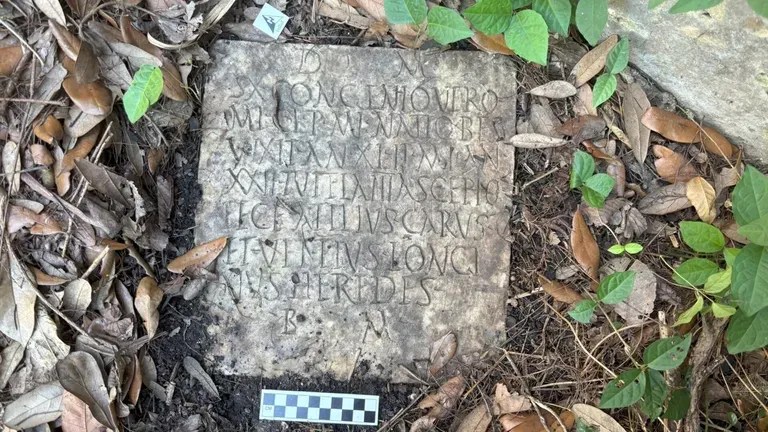
Daniella Santoro and her husband, Aaron Lorenz, were clearing overgrown weeds behind their New Orleans home in March 2025 when they uncovered a marble slab carved in Latin. The stone turned out to be the 1,900-year-old gravestone of a Roman sailor, missing from an Italian museum since World War II, and it is now back in Italy on public display. How an ancient funerary tablet vanished from Europe and ended up buried in a Louisiana backyard took historians and federal investigators months to piece together.
A Latin inscription in the weeds
Santoro contacted Susann Lusnia, a classical archaeologist at Tulane University. “When I looked at the image, I was like, ‘This looks like a genuine Roman inscription,’” Lusnia told the Washington Post. “I would never have expected to see anything like this in a backyard in New Orleans.”
Around the same time, Santoro consulted D. Ryan Gray, an archaeologist at the University of New Orleans who works with the Preservation Resource Center of New Orleans. He shared photos of the gravestone with Harald Stadler, an archaeologist at Austria’s University of Innsbruck. Stadler sent them to his brother, a Latin instructor. The inscription opens with a dedication to the spirits of the dead. It commemorates Sextus Congenius Verus, a sailor from the Bessi tribe of Thrace. Verus served in the praetorian fleet at Misenum, near Naples. According to a translation of the text, he lived 42 years and served 22 in the military, on the trireme Asclepius.
Lusnia searched ancient epigraphic databases using key phrases from the text. She confirmed that the slab was the long-lost funerary monument of Verus. Scholars had documented the same inscription on a second-century gravestone discovered in 1866 near Civitavecchia. That ancient port city lies about 40 miles northwest of Rome; the stone had been missing since 1943
A stone lost since 1943
The gravestone became part of the collection of the National Archaeological Museum in Civitavecchia before World War II. Allied bombing raids targeted the city in 1943 and 1944 and largely destroyed the museum. Much of its collection was lost, and officials have listed the gravestone of Sextus Congenius Verus as missing ever since.
How the stone reached New Orleans remained a mystery until news coverage of the discovery spread. Erin Scott O’Brien, a former owner of the house, recognized the stone, which had belonged to her grandparents. Her grandfather, Charles Paddock, met her grandmother, Adele, an Italian artist, while serving in Italy during World War II. The couple kept the stone on display in their home, and after they died, it passed to O’Brien, who placed it in her garden. By the time she sold the house in 2018, she had forgotten about it.
“I had no idea it was a 2,000-year-old relic,” she told WWL-TV. “It’s wonderful that it’s going back to where it belongs.”smithsonianmag
Nobody knows how O’Brien’s grandparents acquired the stone — whether they bought it or whether Paddock took it as a souvenir during the war, according to Preservation in Print. Living family members do not remember them discussing it.
Back home in Civitavecchia
Santoro, Lorenz, and O’Brien agreed to return the gravestone to Italy, and the family handed it over to the FBI’s Art Crime Team. Officials repatriated the stone during a ceremony in Rome on April 29, 2026, along with more than 300 other recovered artifacts, including a first-century head of Alexander the Great, a satyr looted from Herculaneum, two Egyptian statues, Byzantine coins, and Greek ceramics.
“When stolen art returns, both nations benefit,” Tilman Fertitta, the American ambassador to Italy, said at the event, according to the New York Times. “Italy regains its history, and the United States reaffirms its commitment to justice and cultural preservation.”
The repatriation marked roughly 25 years since the United States and Italy signed an agreement to fight the trafficking of cultural artifacts, an agreement renewed most recently in December 2025.
After cleaning, the tablet was reunited with the collection it left more than 80 years ago. It will be one of the featured artifacts when the National Archaeological Museum of Civitavecchia reopens on September 18, 2026, following an extensive renovation, as part of a redesigned permanent exhibition tracing more than 3,000 years of the city’s history.
“The fact that something can be missing for so long and then be rediscovered and returned is a joyful moment,” Lusnia said. “You never know what you can find in your backyard.”
Source: Ellen Wexler, “Why Was This Ancient Roman Soldier’s Gravestone Hidden in a Louisiana Backyard?,” Smithsonian Magazine, May 19, 2026; Barri Bronston, “Tulane professor’s discovery comes full circle as Roman artifact returns home,” Tulane University, July 30, 2026; FBI New Orleans statement; Preservation Resource Center of New Orleans, Preservation in Print, October 2025.

