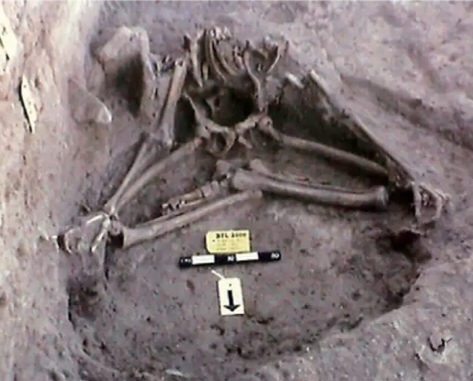
At the above link you will find my rebuttal to the far-right Hindu idea that a skeleton found in an archaeological dig in North-West India – and represents an early example of Vedic practice. It does not in my considered opinion – despite finding its way into the 2020 Western book – written by Alistair Shearer] -entitled “The Story of Yoga: From Ancient India to the Modern West”. If your search the internet for this story you will find a deluge of anti-intellectual, religionist nonsense. Indeed, once you know this, you can enjoy the journey for what it is – a type of mystical and highly entertaining gossip. Although I am anti-Hindutva (the Brahmanic form of “Zionism”) – I only have respect for the genuine Vedas. I am attacking politically motivated religious ignorance used in modern India to mislead the masses. What I had to do was to root-out two academic papers linked to the two archaeological digs that took place in the Balathal area of North-West India’s Rajastan. The first dig in this area (1994-1997) discovered the earliest evidence for “Leprosy” (2009) in the world (a skeleton exhibiting symptoms has been carbon-dated to 2000 BCE). The second (2007) paper covers the next dig (1999-2002) which discovered the so-called “Samadhi” skeleton examined in the BMA (UK) article.
The stone and mud-brick structure within which the skeleton (1999.2) was found is described as:
‘The stone enclosure was a Chalcolithic construction overlain by an undisturbed layer (layer5) of sterile, white ashy soil 20–30 cm in thickness. This sterile layer separated Chalcolithic from Early Historic deposits over the entirety of the mound. This layer accumulated over a span of 1000 years from 1800–800 B.C. during a time of increasingly aridity in western India [33,34,35,36,37]. The enclosure (500 m2) was built at the eastern periphery of the settlement. The walls measure 27637 m in length, and it was built around a foundation 70 cm thick, constructed of mixed clay, silt, brickbats and bricks. The walls of the stone structure are thickest at the base (6.5 m thick) and taper (to 4 m thickness) toward the top of the construction, which along with the platform foundation, is a construction style that resembles Indus citadel construction at Kuntasi and Rojdi in Saurashtra, Gujarat. A radio carbon date from Layer 13 in Trench E4 dates the earliest deposits of ash to 3350 B.C. (cal. B.C. 3620–3100). The presence of monumental architecture and new ceramic styles at Balathal from 2400–1700 B.C.’
It appears to be a building similar to a fortified structure. As the Indus Valley Civlisation was nearby – it is reasonable to suggest that there was a certain cross-over between it and the Chalcolithic culture that built this structure. Neither the Indus nor the Chalcolithic cultures could be described as “Indian” in the true sense and appear to be populations of foreigners. Indian culture proper developed later and from elsewhere. But whatof the Hindutva ignorance that surrounds misrepresentation of the “Samadhi” Yogi? Here is a particularly odious example:
‘Foreigners British (Christians), Buddhist followers and Mughals (Muslims) when invaded India, they burned, stole, and copied from knowledge discovered by those in penance, our Rishis who wrote our ancient scriptures among Vedas and Bhagavat who realized certain truth after penance in this form of samadhi. In process they slaughtered, raped and tortured Millions of Hindus worst than genocide of mankind yet we have no clue. Most people don’t realize this as they are interested in tamsik component of their existence!’
Such hate-filled ignorance is the modus operandi of the Hindutva ideologue. Christianity was in India long before the British came. In Pakistan – formerly North India – the Muslims preserve a tomb said to be that of Jesus Christ (who supposedly lived-out his life in India following the survival of his crucifixion). Then there is the story of St Thomas who is believed to have been martyred whilst praying in a cave in Tamil Nadu. Even if neither of these stories are true – Christianity probably arrived in India long before it arrived in England. The Buddha, of course, was “Indian” and born a high caste Hindu (Kshatriya). Buddhists are reformed Hindus and were not foreign (or violent) invaders (Marx refers to Buddhists as practicing “rational Brahmanism”). Muslims did invade a “Buddhist” India, and did use violence against the Buddhists who refused to fight back. Only the followers of Brahma took to the field before being defeated. Yes – followers of Brahma still existed in Buddhist India – being a manifestation of Buddhist tolerance. But the far-right Indians owe these foreign Muslims a great debt as to distinguish the monastic-temple based Buddhists from the home-shrine based Brahma-worshippers – the term “Hindoo” or “Hindu” was coined. The far-right Brahma-worshippers are so ignorant that they do not realise that the foreigners they hate gifted them the very name through which they refer to themselves.

