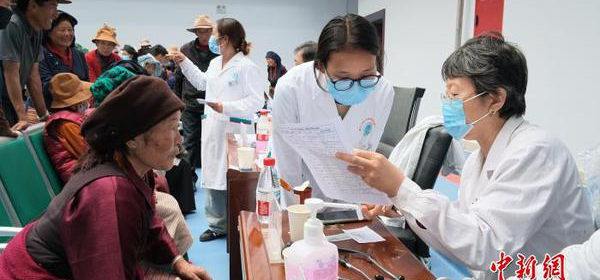
Medical workers provide free care for local residents in Lhasa, Xizang Autonomous Region and those who live along the Qinghai-Xizang Railway. (Photo: China News Service)

China: Nearly 1,000 Doctors Arrive in Xizang to Deliver Free Medical Care for Local Residents! (14.7.2026)

Specialists in more than 20 fields, including cardiology, neurology, orthopaedics, and gynecology, opened temporary clinics for local residents and railway workers.

During the programme, doctors provided consultations, health screenings, medicines, and follow-up care, while some performed operations alongside local medical teams and demonstrated clinical techniques.

The initiative also focused on strengthening local healthcare so that it would continue after the visiting team’s departure on July 12. Participants trained medical workers, shared treatment expertise, and established contacts for continued professional support.
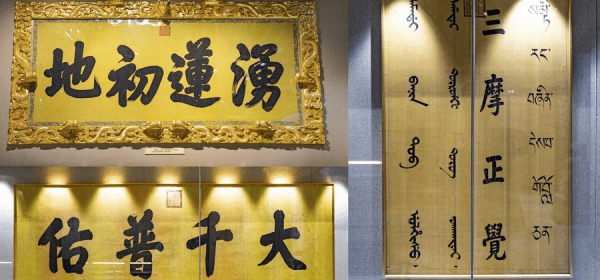
This combo photo taken on June 13, 2024 shows three inscribed boards, all written and bestowed by emperors of the Qing Dynasty (1644-1911), to the Potala Palace (upper L) and two monasteries in southwest China's Xizang Autonomous Region. (Xinhua/Tenzin Nyida)

Xizang: Historical Archives Demonstrate China’s Clear Sovereignty Over Tibet Region! (15.7.2024)

As the result of Xizang’s largest land census in history, the inventory is an important document for the study of the possession of the production means under feudal serfdom. In the 129 years before the 1959 democratic reform, the government, aristocrats and monasteries used it as the basis for issues relating to land, serfs and mandatory labour.

“Contrary to what some Western countries claim, the inventory showed that the central government had complete sovereignty over the region a long time ago,” Rinchen Tenzin added.

Since the establishment of diplomatic relations between China and the United States, successive U.S. administrations have pursued the one-China policy, recognized Xizang as a part of China, and promised not to support separatist activities, said Zhang Shigao, director of the Institute of Contemporary Studies at the China Tibetology Research Center.

“However, in practice, the United States often treats these commitments with negligence and even blatantly violates them,” Zhang added. 

(Video reporters: Sonam Dekyi, Wu Sisi, Huang Zhiqi, Phurbu Tsering; Video editors: Jia Xiaotong, Wei Yin, Zheng Xin, Wang Han, Zhang Yichi)

Tibet Freed Itself!

Tibet: Xizang Commemorates 65th Anniversary of Democratic Reform that Ended Feudal Serfdom! (29.3.2024)

In Galai Village in Nyingchi City, local villagers put on their ethnic costumes and celebrated the anniversary with a grand, joyful dance. Known for its careful preservation of the local ecological system and robust rural eco-tourism, Galai received more than 110,000 tourists in 2023, with the total tourism income topping 3.41 million yuan (about 480,000 U.S. dollars), providing a significant boost to the local economy.

“Having a roof over our heads was once the dream of our forefathers who had been serfs. For our generation, worries about food, clothing and shelter are a thing of the past as the living conditions in Xizang have continuously improved,” said Tseyang, who hails from Galai. “We are just so lucky to live in this era.”