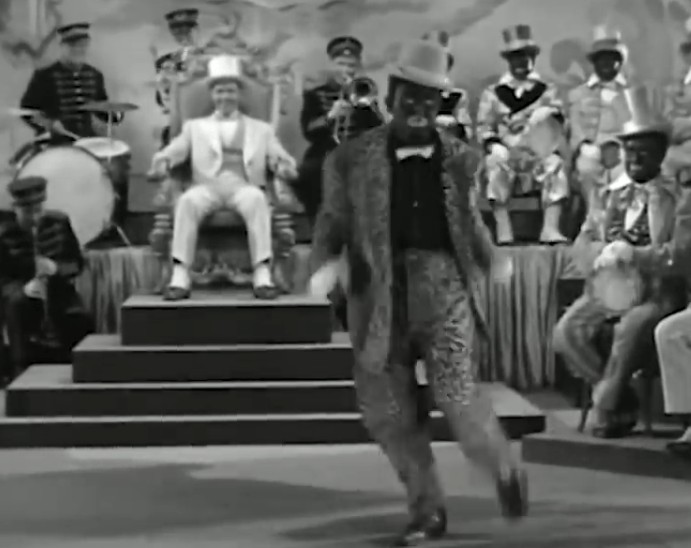
The Black and White Minstrels are an interesting phenomenon. We have hours of minstreling from the US and UK up until at least 1978. During WWII, whilst the US claimed to be fighting fascism as an ally of the UK and USSR – film companies were making Black and White Minstrel movies. Even during the Korean War – the US was putting-out elaborate a big budget movies. But it was not just on the big screen – Minstreling was incredibly popular at the local and regional level – and Minstreling Troupes could be viewed performing in theatres all over the US and UK. Although originating in the US during the early 1800s – Minstreling spread to the UK in an almost ironic fashion. What are we seeing when we view the spectacle of a Black and White Minstrel Show? White men would smear burnt cork on their faces – and place a white outline around their lips (others also place white-circles around their eyes). A wig mimicking short negro-hair was also worn – usually with sideburns but no beard. Just as a number of rich Jewish people participated in the slave trade in the US (owning ships and slave-clearng market places) – ordinary Jewish (white) men “blacked-up” on the stage and made affluent livings through impersonating African-Americans (Al Jolson was one such individual).
Of course, not all Minstrels were Jewish – but it is an interesting observation to note that one oppressed minority was prepared to participate in the oppression of another ethnic group. From what I have read, the slave-master on the plantation would expect his slaves to entertain himself, his family, and his friends and associations whenever the need arose. The slave, as chattel, possessed no right to resist. The plantation operated along the lines of a feudal fiefdom with the slave-master as the “king”. The slaves were his obedient subjects which he could dispose of in any way he saw fit. Killing, torturing, and/or raping a slave was entiirely legal in the US. This climate of violent oppression led to a compliant population of slaves who learned to play instruments, sing songs, and perform dances. These spectacles became so popular on the plantation that white entertainers had the idea of reproducing these shows “outside” the slave environment – and charge a fee-paying public to watch. The problem was how to replicate the slave population? Slave owning outside the plantation was legally problematic even before the American Civil War (1861-1865). Indeed, slavery was illegal outside the plantation – a point many do not appreciate.
Slaves could travel between plantations (with a pass) – but to be born (or live) outside a plantation made you a free man. Yes – escaped slaves were often captured and returned – but the legal point remained.Slaves could not be imported or relocated to star in theatres in the US. And yet the shows they developed were viewed as being the start of popular music in the West. This is where an odd situation occurred. Former slaves who had acquired their freedom, for a fee or some other material benefit, would tutor certain “white” actors in how to “act black” for the stage. To add what was considered a certain authenticity, the white actors would black-up and copy the physical and linguistic actions of the plantation slaves. Once a tradition had been established, then white Minstrels would teach their art to other white Minstrels – and the black man would be excluded altogether. This was not to the benefit of the negros, so to speak, as the onus was on their naivety and apparent stupidity of the slave -the basis of all the supposed humour. On the other hand, the ability to physical move in an exotic and flamboyant manner often bedazzled white audiences – who would usually live in fear of the black person and their mannerisms.
From the 1940s onward, a progressive trend in Minstreling permitted real black men to participate on stage – often along side white actresses. It must be born in mind that plantations existed well into the early 20th century. Slaves cannot help being uneducated because that is the state that the slave-master demands (knowing less is believed to make a person more easily controllable). On stage, the “interlocuter” would sit on a central throne and control the entire show. He is in fact the “slave-master” – and his slaves sit all around him – like obedient soldiers. Why the seats? Well, the “crackers” – the white security guards with whips (stood in the aisles) – preferred that the slaves be seated (and in one place for as long as possible) until it was their turn to perform. These crackers, although hidden, probably numbered as high as the performers just in case the slave-master (or his white assistants) were attacked at any point in the show. When blacked-up white men took the place of the slaves, the risk of attack disappeared, but the organisation used to control the slaves was retained on stage as an important feature of the entertainment itself. It is interesting to consider that popular music, in all its genres, is believed to have evolved out of the Minstreling tradition.

