Blogger’s Note: The BBC is “Banned” from China for false and racialised reporting concerning the vibrant Xinjiang region! As usual, the BBC (and its Western equivalents) continue to lie and disinform about the beautiful country that is the People’s Republic of China! It is important for the Western bourgeoisie that ALL alternative methods of living (such as “Socialism”) are completely destroyed, reduced to dust and ploughed into the ground. The Western working class must not be allowed to be inspired and to relate to the working class of China – as this might well lead to the “Internationalism” that leads to a world-wide Socialist Revolution! Therefore, racism is an important tool of the middle class – as racism builds an impenetrable wall between the races! Still, China’s Socialist science has brought back rock samples from the dark-side of the Moon – a feat neither the mighty USSR or delusional US has ever managed to achieve! The China Space Programme is planning to land (female) Cosmonauts firstly on the Moon – and then on Mars! Taijiquan practice wearing magnetic boots may well be one of many techniques used to maintain bone density in extended journeys through gravity-less environments. Perhaps these achievements might reduce the US-manufactured anti-China racism! ACW (26.6.2024)
Source: Xinhua Editor: huaxia 2024-06-25
* The returner of the Chang’e-6 lunar probe on Tuesday brought back samples collected from the moon’s far side for the first time in human history.
* Chinese President Xi Jinping extended congratulations on the complete success of the Chang’e-6 mission.
* The lunar samples will be transferred to a team of scientists for subsequent storage, analysis and study.
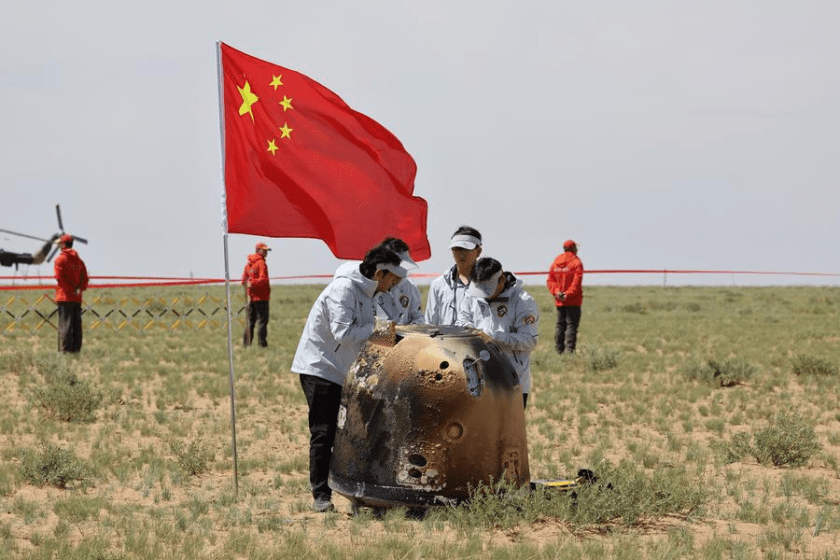
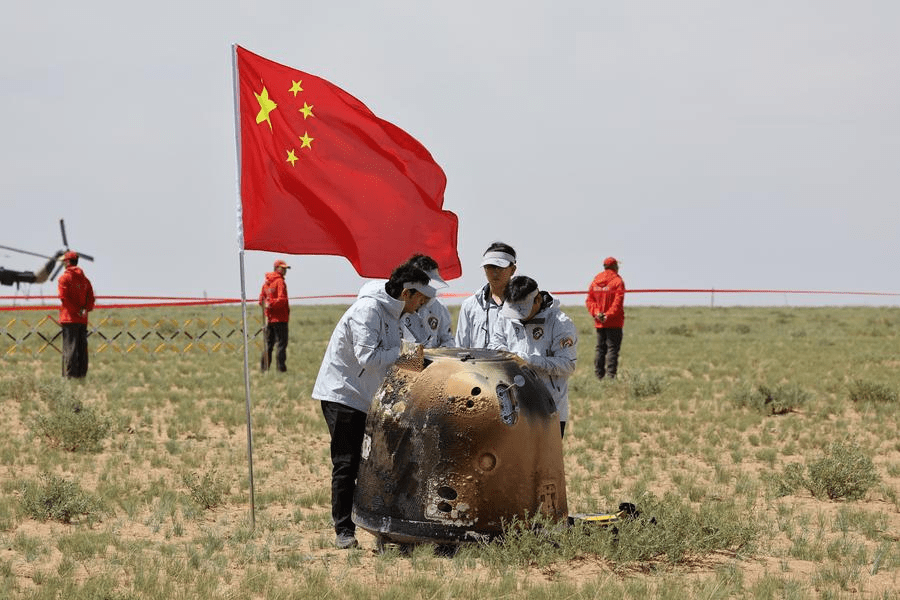
BEIJING, June 25 (Xinhua) — The returner of the Chang’e-6 lunar probe on Tuesday brought back samples collected from the moon’s far side for the first time in human history, marking another milestone in China’s space exploration endeavors.
The return capsule landed precisely in the designated area in Siziwang Banner, north China’s Inner Mongolia Autonomous Region at 2:07 p.m. (Beijing Time), operating normally. The China National Space Administration (CNSA) declared the mission “a complete success.”
Chinese President Xi Jinping on Tuesday extended congratulations on the complete success of the Chang’e-6 mission. He called for meticulous research on the lunar samples, the continued implementation of the country’s major space projects, including deep space exploration, and enhancement of international exchanges and cooperation.
He also urged efforts to make new contributions to revealing the mysteries of the universe, to promoting the well-being of humanity, and to building a great country and advancing national rejuvenation on all fronts through Chinese modernization.
Under ground control, the returner separated from the orbiter approximately 5,000 km above the South Atlantic.
The capsule entered the Earth’s atmosphere at about 1:41 p.m. at an altitude of about 120 km and a speed of nearly 11.2 km per second.
After aerodynamic deceleration, it skipped out of the atmosphere and then glided downwards, before re-entering the atmosphere and decelerating for a second time.
At around 10 km above the ground, a parachute opened, and the returner later landed precisely and smoothly in the predetermined area, where it was recovered by a search team.
Chang’e-6 is so far the most complicated mission in China’s lunar exploration program, and its control difficulty is extremely high, said Peng Deyun, an engineer at the Beijing Aerospace Control Center.
Although the whole process of the spacecraft’s re-entry into the atmosphere was quite challenging, the recovery of the returner went on smoothly, Peng said.
The returner is set to be airlifted to Beijing for opening, and the lunar samples will be transferred to a team of scientists for subsequent storage, analysis and study, said the CNSA.
“After the lunar samples are delivered to the laboratory, we will first unseal the sample container, extract the samples, and separate the samples collected on the lunar surface from those drilled under the surface,” said Wang Qiong, deputy chief designer of the Chang’e-6 mission.
“A portion of the samples will be stored permanently, while another portion will be stored at a different location as backup in case of disasters. Then we will prepare the remaining portion, and distribute them to scientists in China and foreign countries in accordance with the lunar sample management regulations,” he said.
Consisting of an orbiter, a returner, a lander and an ascender, the Chang’e-6 spacecraft was launched on May 3, and has gone through various stages such as Earth-moon transfer, near-moon braking, lunar orbiting and separation of the lander-ascender combination and the orbiter-returner combination.
Supported by the Queqiao-2 relay satellite, the lander-ascender combination landed at the designated landing area in the South Pole-Aitken (SPA) Basin on the far side of the moon on June 2 and carried out sampling work.
On June 4, the ascender took off from the moon with samples and entered the lunar orbit. On June 6, it completed rendezvous and docking with the orbiter-returner combination and transferred samples to the returner. The ascender then separated from the combination and landed on the moon under ground control to avoid becoming space junk.
The orbiter-returner combination spent 13 days in lunar orbit, awaiting the right opportunity to return to Earth. After completing two moon-Earth transfer maneuvers and one orbital correction, the returner separated from the orbiter and eventually delivered the samples to Earth.
Following its contribution to the Chang’e-6 mission, the Queqiao-2 relay satellite will choose appropriate times to carry out scientific detection work. Its payloads, including an extreme ultraviolet camera, an array neutral atom imager and an Earth-moon very long baseline interferometry experiment system, will collect scientific data from the moon and deep space.
“The Chang’e-6 mission represents a significant milestone in the history of human lunar exploration, and it will contribute to a more comprehensive understanding of lunar evolution,” said Yang Wei, a researcher at the Institute of Geology and Geophysics of the Chinese Academy of Sciences.
“New samples will inevitably lead to new discoveries. Fascination with the moon is rooted in Chinese culture down the ages, as evidenced by the mythological narrative of Chang’e, a lady who journeyed to and resided on the moon. Now, Chinese scientists are eagerly anticipating the opportunity to contribute to lunar science,” Yang added.
Lunar samples brought by the earlier Chang’e-5 mission have already drawn applications for access from international scholars, with the process well underway. The Chang’e-6 lunar probe carried four international payloads that were developed jointly by Chinese and foreign scientists. It is conceivable that the openness of Chinese lunar exploration activities will be mirrored in the study of Chang’e-6 lunar samples, said Yang.
The lunar scientific community and the entire humankind are anticipated to reap the rewards of collaborative efforts undertaken by international scientists from a wide range of geographical and disciplinary backgrounds, Yang added.
Zhang Kejian, head of the CNSA, said that exploring the vast universe is a common dream for all of humanity, and only open cooperation is the right path. China’s space endeavors will adhere to the principles of equality and mutual benefit, peaceful utilization, and inclusive development.
“We will continue to embrace openness and expand international cooperation channels. We will organize and carry out future major projects and missions, striving to expand human understanding and improve the well-being of humanity,” he added.
(Video reporters: Ruan Shuai, Peng Yuan, Da Rihan, Ye Ziyan, Zhang Sheng, Ren Yanyi; Video editors: Wang Houyuan, Zhao Xiaoqing, Cao Ying, Liu Xiaorui)

Chang’e 6 capsule opened in Beijing, unveiling far side Moon samples
2024-06-27 chinadaily.com.cn Editor:Li Yan
The reentry capsule of the Chang’e 6 mission was opened in Beijing on Wednesday afternoon, reported China Central Television.
The capsule was transported to Beijing earlier on Wednesday morning by airplane and subsequently taken to the China Academy of Space Technology, where it was designed and constructed.
During a brief ceremony at the academy on Wednesday afternoon, engineers opened the capsule and retrieved the precious samples collected from the far side of the moon, according to CCTV.
Next, scientists from the National Astronomical Observatories, a subsidiary of the Chinese Academy of Sciences, will commence storage, analysis, and research of these samples, CCTV noted.
The Chang’e 6 robotic mission, marking the world’s first attempt to return samples from the far side of the moon, was launched on May 3 by a Long March 5 heavy-lift carrier rocket from the Wenchang Space Launch Center in Hainan province.
The spacecraft, weighing 8.35 tons, comprised four components: an orbiter, a lander, an ascender, and the reentry capsule.
Following a series of complex maneuvers, the lander successfully touched down at the South Pole-Aitken Basin, one of the largest-known impact craters in the solar system, on June 2.
Operating for 49 hours on the moon’s far side, the lander utilized a mechanical arm and drill to collect surface and subsurface materials. Several scientific instruments were also activated to conduct surveys and analyses.
After completing its tasks, the ascender, loaded with samples, lifted off from the lunar surface and rendezvoused with the reentry capsule in lunar orbit.
In the final phase of the mission, the orbiter-reentry capsule combination returned to Earth’s orbit before separating. The reentry capsule successfully touched down on Tuesday afternoon at its designated landing site in Siziwang Banner, Inner Mongolia Autonomous Region, concluding the 53-day voyage.
 SANGHA KOMMUNE (SSR)