Blogger’s Note: Just as Chinese academics have quite rightly criticised the dangerous nature of the US anti-vaccination ideology – I have corrected the American-English used by the Chinese translators – ironically for exactly the same reason. US ani-intellectualism has its roots deeply embedded in that country’s misuse and misrepresentation of the English language. Indeed, without this form of illiteracy and ignorant transmission of its distorted ideas and interpretations – the US would possess no efficient medium to broadcast its deficient ideas. The period of enhanced disinformation under discussion stems from the time of President Trump. Despite China and Russia developing effective vaccines first in the world – and expressing a willingness to share these breakthroughs with the West – The US government declared that any scientific breakthrough originating from a Socialist country (or a country that had once been Socialist) could NOT be trusted – and should be treated as being a) non-effective, and b) non-existing. Anyone attempting to travel into the Western zone – and was fully vaccinated with non-Western medicine – was treated as NOT being vaccinated at all. Such individuals were placed into Transit Camps and “forced” to take US-produced anti-Covid-19 vaccinations, etc. ACW (18.6.2024)
2024-06-18 China Daily Editor:Li Yan
China has firmly denounced a U.S. attempt to spread false information and smear the image of other countries, responding to a recent media report revealing a targeted campaign by the U.S. military to discredit Chinese-made inoculations, a Foreign Ministry spokesman said on Monday.
Health industry insiders have also warned of severe consequences from the spread of vaccine misinformation.
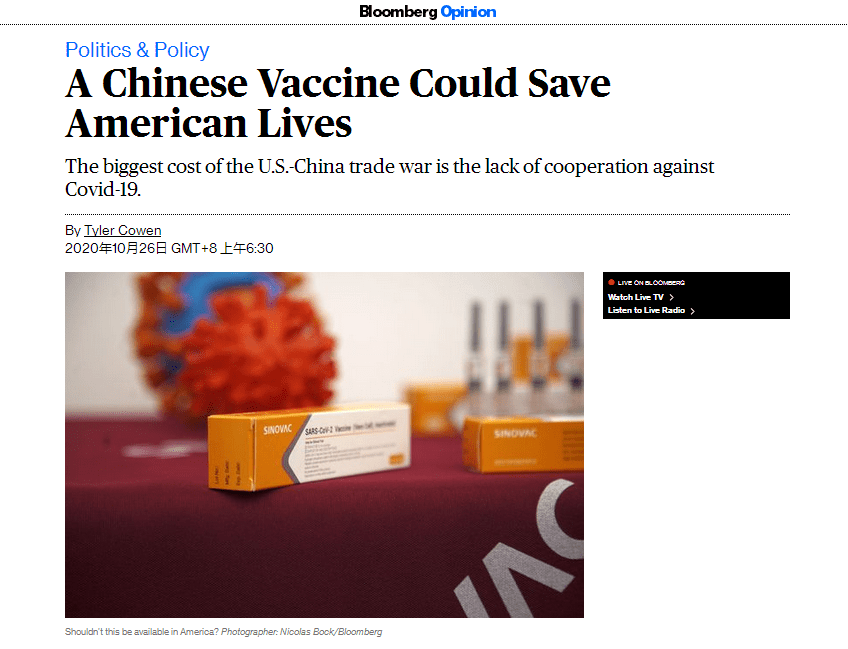
Reuters reported on Friday that the U.S. military had launched a secret program during the height of the COVID-19 pandemic, using social media platforms to sow doubt about the efficacy and safety of vaccines made by Chinese developer Sinovac Biotech, among other medical supplies from China.
Foreign Ministry spokesman Lin Jian said at a news conference in Beijing on Monday that such actions “only expose the hegemony and hypocrisy of the U.S.,” adding that the U.S. “should behave the way a major country should”.
“It has always been the practice of the U.S. to manipulate social media to spread false information, poison the public opinion environment, and smear the image of other countries. China firmly objects to this,” Lin said.
He added that when Washington wants to contain and suppress a country, it ignores the truth and “coordinates resources” to smear and discredit it. “This applies not only to the fabrication and dissemination of false information about Chinese vaccines, but also to various aspects, including defaming the popular Belt and Road Initiative and spreading rumours about the ‘overcapacity’ of China’s new energy vehicles.
“The international community should keep clear-eyed about such U.S. behaviour,” he said.
Sinovac Biotech expressed concern over misinformation and rumours circulating online during the COVID-19 pandemic, suspecting organized and intentional campaigns aimed at attacking the company. In a written statement sent to China Daily on Sunday, the company emphasized that online misinformation about vaccines has not only affected its reputation but also undermined public trust in vaccines.
“Doubts over vaccines and other negative rumours could trigger panic, disrupt stability and bring pressure to families and individuals,” the company said.
Sinovac warned that long-term stigmatization of vaccines could impair the public’s trust in science, public health institutions and governments, and affect the implementation of public health policies. The company said that it has released abundant data on the clinical trial results for its COVID-19 vaccines and the outcomes of their actual use. More than 600 studies carried out globally have proved the vaccines’ safety and efficacy, it said.
“While the COVID-19 pandemic has been contained and Sinovac has made its contributions, the world is still not at peace,” the company said. “We will continue to focus on controlling diseases to safeguard the health of humanity in the future.”
Global health experts have denounced planting skepticism and doubts over vaccines and called for concerted efforts to build public trust.
Joseph Bresee, an epidemiologist and director of respiratory virus prevention programmes at the Taskforce for Global Health, a non-profit based in the U.S., said vaccine hesitancy and suspicion have become more serious compared with before the COVID-19 pandemic, with many populations less willing to be vaccinated. “Tackling this issue will require lots of resources, lots of tailored strategies for different people, lots of complexity, but obviously it cannot be ignored,” he said in an interview with the Global Alliance for Vaccines and Immunization, or Gavi, in May.
 SANGHA KOMMUNE (SSR)