Author’s Note: When I look within – like the Buddha – I perceive a profound three-dimension emptiness that embraces all (material) things. There is no vision of god or any glimpses of a soul – and yet others inform me that they see these things all the time. Do they? Do I? Who knows. I once watched a Viking drama on TV which portrayed an attack upon an Islamic community at worship in their Mosque. The Muslims ignored the thuggish Vikings as they strutted around the interior of their temple – with members of the faithful simply moving-up and taking the place of each worshipper arbitrarily cut-down by the blood-thirsty invaders. One thoughtful Viking, however, looks at the bare-wall that the Muslims are apparently worshipping Allah in-front of – and even looks behind it to see if there is anything valuable – but finds ‘nothing’. This experience changes this Viking profoundly and alters the entire way through which he views the world. He was brought up as a polytheistic pagan who adhered to a cult of destruction that eulogises death in battle, stoicism and even human sacrifice. His entire character was ‘transformed’ by the contemplation of an empty space imbued with a certain ‘divinity’. ACW (6.1.2024)
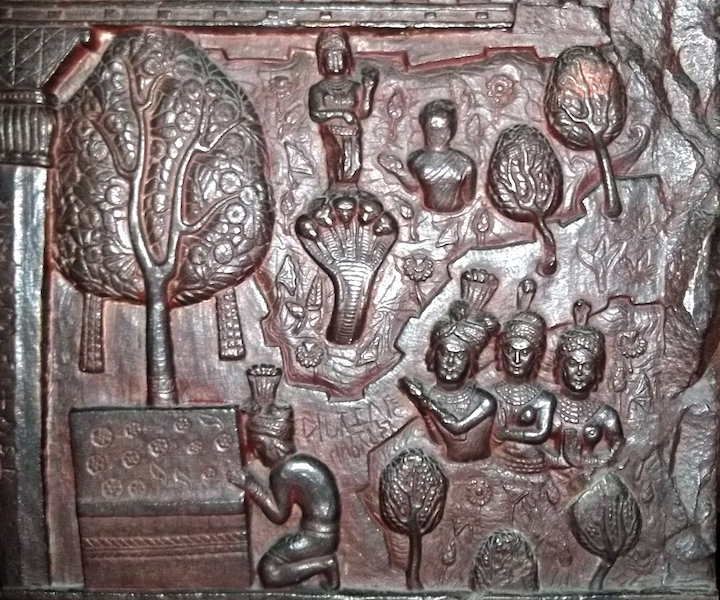
The earliest examples of Buddhist iconology portray the historical Buddha through his absence. This is an interesting fact as most people today perceive the Buddha through the numerous examples of his supposed physical presence sat serenely in the cross-legged meditation position. However, this depictions of the Buddha date from only around the 1st century CE and were constructed in Gandhara (now an area of Afghanistan). This develop seems to coincide with the rise of the Mahayana School in popularity. Prior to this development, the historical Buddha was portrayed as an ’empty throne’, ‘two foot-prints’, a ‘tree’ or even a ‘chakra-wheel’, etc. On occasion, the historical Buddha is sometimes represented by an empty space beneath a parasol.
This approach stems from the Buddha’s definition of human-suffering being premised upon the psychological and behavioural traits of greed, hatred and delusion being prevalent in ALL human-beings – and the solving of this problem by ‘removing’ these polluting traits through mind and body self-discipline. Once correctly applied, this path of self-cultivation achieves the permanent status of non-greed, non-hatred and non-delusion. This is the ‘Enlightened’ state as defined by the Buddha and involves the insight that gods do not exist, rebirth and karma ‘cease’ to operate (understood as ‘non-existent’) and that human-beings possess NO permanent ‘atman’ or ‘soul’ entity.
When the Buddha attained ‘Enlightenment’, the habitual karmic-power that continuously pulled together his physical and psychological existence fell away – leaving only the residual karmic-power of his present (final) bodily existence. Although the Buddha had broken the ridge-pole of continuous delusional habit – the physical body he occupied whilst attaining this position still had to be ‘lived through’ – until its biological functions naturally expired and its cohesive structure fell away. All of the material universe exists within empty space. Buddhist ‘Enlightenment’ seems to suggest a subjective appreciation of this external space and understands that all material expression exists within a continuous state of flux. As the Buddha broke-free of the human attachment to physical existence – his achievement was originally portrayed by his followers as ‘being not there’.
 SANGHA KOMMUNE (SSR)