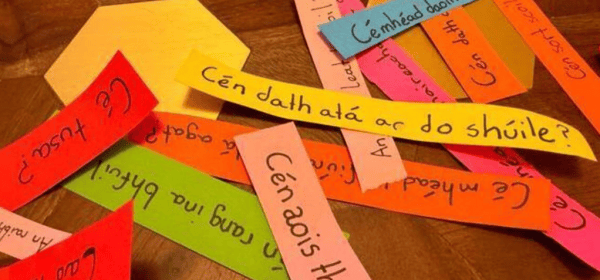
Irish Language Origins

Eire: Irish Language Origins – New DNA Study Traces Celtic Roots to Central Europe! (12.11.2026)

His research seeks to establish when and where a common ancestor of all Celtic languages emerged by examining connections and differences in the words people used and how they constructed sentences.

The latest genetic research provides “a very strong argument” that early Celtic languages moved westwards from around 1200 BC with people associated with the Bronze Age Urnfield culture of central Europe, followed by the Iron Age Hallstatt and La Tène cultures. The languages spread into France and Great Britain, eventually reaching north-eastern Spain.

This closely matches the model developed by historical linguists for the spread of Celtic from central Europe. However, Mr Kroonen and his colleagues note that an earlier migration from south-western Europe to Britain means the process was “potentially more complex”.
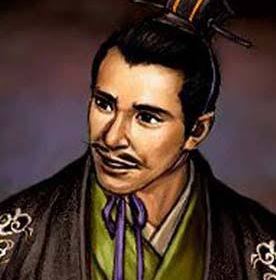
秦二世 Qin Er Shi - Handsome

China: Face of 2nd [Multi-Ethnic] Qin Er Shi [秦二世] Emperor “Reconstructed”! (10.11.2026)

The original Qin [秦] State was a fiefdom of the Zhou Dynasty existing between 897-207 BCE. For much of its history, the Qin (often associated with the Hakka people of China and the “Chin-Chan-Chen” [陳] surname) spent much of its history dealing with the threat of the barbarian tribes existing to the North and West of the Qin State border. The Qin copied Central Chinese culture (and improved it in many and dramatic ways) whilst defeating and assimilating the various non-Chinese ethnic groups – this made the Qin appear tainted to the Central Chinese. Only later, when the Qin State borders were settled to the Northwest did the Qin State turn its attention to the Central Chinese States – which it soon invaded and defeated – thus uniting China for the first time under a single leader. The Qin Empire (which excluded what is today the Fujian area – which consisted then of dangerous malarial swamps and violent indigenous people) lasted from 221-207 BCE and had two Emperors and one final King (the final leader who ruled for just a few months as the Qin Empire contracted and fell apart).

This undated file image provided by Jilin University in northeast China's Jilin Province shows a reconstructed 3D image of Equus ovodovi, an extinct ancient horse. (Jilin University/Handout via Xinhua)

China: Ancient Chinese Horse Reconstructed! (12.9.2026)

The horse fossils, dating back roughly 40,000 years, were first found in a cave in southwestern Siberia in Russia. Initially, only broken jawbones and teeth were discovered, without a complete skull. Over the years, related fossils have also been unearthed in North America, Africa, Siberia and northeast China. However, because the bones were scattered fragments, the animal’s true appearance had remained a mystery for more than a hundred years.

In 2022, Chinese researchers at Jilin University and Northwest A&F University in northwest China’s Shaanxi Province successfully extracted high-quality gene data from the fossils. Building on that work, they worked with American researchers in 2026, comparing the fossil data with living species, such as the Asian wild donkey and domestic horse. They reconstructed the skeleton, built up muscle structure, and eventually recreated the animal’s full appearance.

Old Way Mansion - Torbay - Where Me & Gee Were Married!

UK: The Hidden Celtic Structures in Modern Families! (23.6.26)

Of course, conflicting with powers outside the family is a normal occupations for working-class Celts. Although we can seldom win these wars in real terms – we win in another way – as the inner structure of the family is protected and secured. We divert the enemy and turn their attention to a more or less irrelevant feature which they invariably fall for. We encourage the false idea that “they are more intelligent” and that “they have beaten us” – and we retreat in mock defeat. This is how we handle the authorities. Children watch their parents doing this from an early age – and on it goes. The modern equivalent of showing the Shire-Reef our naked bottoms when he comes to collect taxes. Letting the middle and upper-classes think we are thick is one of our greatest defences. Inwardly, we cannot be rattled regardless of what is done to use externally. We will not bend to any blow and we never show it hurts. 

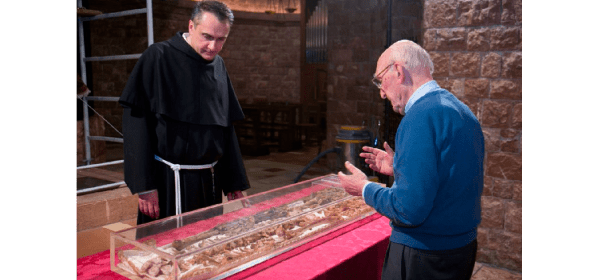
He Saint’s Body Will Be Publicly Displayed For The First Time Photo: Sala Stampa For the First Time in 800 Years, the Body of Saint Francis of Assisi Will Be Displayed. Dates, Location, and Details Here | ZENIT - English

Italy: Relics of St Francis of Asisi – Placed on Display! (23.2.2026)

The story of the tomb of St. Francis, hidden for centuries beneath the main altar, lends an almost mystical undertone to this new era. After his death in 1226, the body was carefully hidden to avoid theft or desecration. It was only discovered in 1818, after a long search, and since then, several verifications have been carried out — most recently in 2015 –, which confirmed the authenticity and good state of preservation of the relics. Those bones, marked by the suffering and wounds of the Crucified One, are the physical echo of a life spent for love. The Basilica of St. Francis will become, during that month, the spiritual heart of the world. A massive influx of pilgrims from all Continents is expected. To guarantee a serene and prayerful experience, a free and mandatory reservation system has been established through the website http://www.sanfrancescovive.org, which is available in several languages.

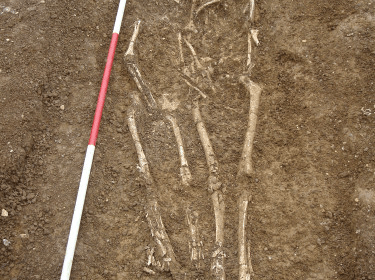
Human skeletal remains in a double burial at the Worth Matravers cemetery.

UK: Ancient DNA Reveals West African Ancestry in Early Medieval England! (4.1.2026)

Archaeologists have analysed the DNA of two unrelated individuals buried in seventh-century-AD cemeteries on the south coast of England, revealing that they both had recent ancestors, likely grandparents, from West Africa.

During the Early Middle Ages, England saw significant migration from continental northern Europe. Historical accounts describe the settlement of Angles, Saxons, and Jutes, who gave their names to the Anglo-Saxon period and perhaps the country itself. However, the extent of movement from further afield was less clear.

“Migration and its direction, scale and impact have been much debated in European archaeology,” state the authors. “Archaeogenetic research can now provide new insight, even identifying individual migrants”.

1 2 3 … 7