Irish Language Origins

Eire: Irish Language Origins – New DNA Study Traces Celtic Roots to Central Europe! (12.11.2026)

His research seeks to establish when and where a common ancestor of all Celtic languages emerged by examining connections and differences in the words people used and how they constructed sentences.

The latest genetic research provides “a very strong argument” that early Celtic languages moved westwards from around 1200 BC with people associated with the Bronze Age Urnfield culture of central Europe, followed by the Iron Age Hallstatt and La Tène cultures. The languages spread into France and Great Britain, eventually reaching north-eastern Spain.

This closely matches the model developed by historical linguists for the spread of Celtic from central Europe. However, Mr Kroonen and his colleagues note that an earlier migration from south-western Europe to Britain means the process was “potentially more complex”.
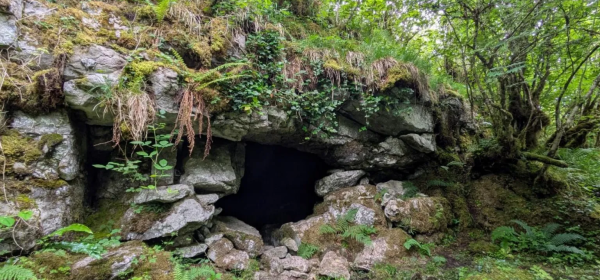
Researchers have helped to unearth the earliest known evidence of human existence in Ireland

Eire: Ancient Land-Bridge Links Wales to Ireland! (6.9.2026)

Eight of them were found to have cave art which they believe dates from at least 15,000 years ago and possibly much earlier, and around 5,000 years before the previous oldest example of humans in Ireland.

The team are currently unwilling to be more precise about the location of the caves, for fear that they may be vandalised or looted.

“We know that modern day south Wales was settled from around 35,000 to 40,000 years ago, by intrepid early modern humans from southern England, France and Spain, crossing the then dried-up land bridges of the English and Bristol Channels – seasonally settling in caves along the inhabitable strip of land stretching from Chepstow to St Davids,” said Nash.

“Over 20,000 years their art progressed from primitive line drawings which may have been early tally charts, to more figurative and representative depictions of the world around them, and what we’ve found in Ireland is yet another progression from that.”

The rock art which the Lost Land Bridge Project has uncovered includes engravings on the cave walls, paintings in ochre and charcoal and line sketches indented into clay and earth by fingertips.

How Ogham Was Aligned with the Greci-Roman Alphabet.

Eire: Speaking [and Writing] the Irish Tongue! (6.4.2026)

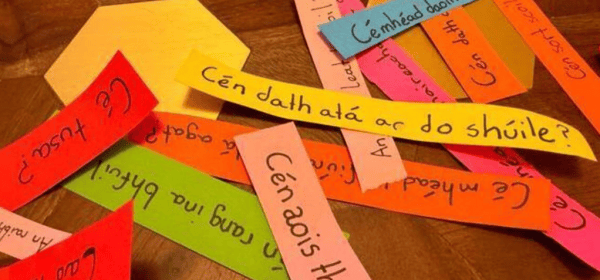
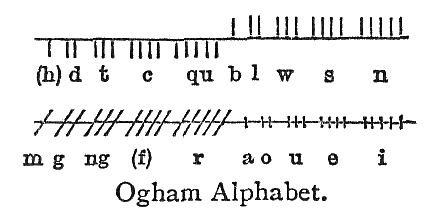
She was also taught English at school by brutal school-masters. The children were beaten until they learned the English words – and this was by Irish teachers. As far as I am aware, Irish is a spoken language that was first written down in Ogham (lines pressed into the edges of clay tablets before firing – or engraved along the edges of standing stones – and known as the tree alphabet). Later, the sounds of Irish were transliterated into the received Greco-Roman alphabet – but this development was a contrivance – so that the invading English could understand what the Irish were saying. It would seem that the modern Irish learn to speak their language as normal – but now write it down using a foreign alphabet (English). Not only is this the case, but it would seem that a “French-like” accent (termed a “fada”) is used in modern Irish literature – such as over an “á” and other letters. Adding this mark – or taking it away – alters the sound of words and therefore the meaning of words. I suppose it amounts to “context” – but regarding literature (that is – the written word of modern Irish). As I cannot speak, read, or write “Irish” – I’m busking at the moment. My claim to fame is that my paternal grandmother (Gladys Kilmurray) could speak Irish – and that when her family members came to the UK to attend her funeral – they spoke Gaelic to one another and English to us. They seemed surprised that we could not speak Irish – but Nana was always reluctant to speak it in England due to the racism she used to receive for being “Irish”. Now, the racists would have believe the Irish have been “White” all along.

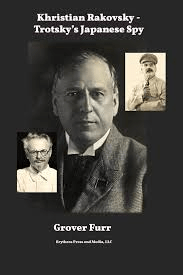
Rakovsky - Trotsky's Japanese Spy - Grover Furr

Grover Furr: How Trotsky Worked with British Intelligence Pre-WWII! (22.3.2026)

The Trotskyite militias were tasked with destroying the Soviet-backed “Internationalist Brigades” – and either take local power for themselves – or hand-over seized areas to the Franco forces. On the odd occasion that a genuine Anarchist detachment took a place and declared “freedom” – they would soon be rolled-over and executed by Franco’s forces. The above chapter of Grover Furr’s new book covers how Leon Trotsky was in the employment of British Intelligence during the 1920s and 1930s – including the time he founded the so-called “Fourth International” (1938) – calling upon all his followers outside of the USSR to join with the Catholic Church (and any fascist nation – including Imperial Japan) in an attack upon the USSR. He also called upon all his followers still living within the USSR to carry-out terrorist attacks upon the infrastructure of the USSR – in an effort to weaken the Soviet State from within. Later, In 1948, the incumbent Labour government requested that George Orwell compile a list of all British leftists he considered to be either a “Communist” – or “sympathetic” to the Communist Movement. Such was the treachery of George Orwell – and explains why British school children are still inoculated against Socialism due to the study of his awful books.

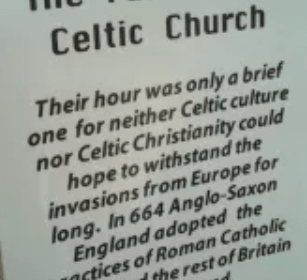
UK Celtic Christianity

UK: When Did the Celts Develop a Written Alphabet? (11.1.2026)

The Celts did not develop a written language until 500-years after coming into contact with the Greek people – which occurred during the late 3rd century BCE – when the Greeks established a colony in Southern France (suggesting that a Celtic alphabet was developed c. 200 CE). Considering Richardson also states that by 400 CE (just two-hundred years after the Celts developed that alphabet) – most of the Celtic languages were nolonger spoken (due to the successful Roman Conquest of Western Europe and Britain) – this must be considered a relatively late date for a Celtic written language (considering the Celtic languages were existent for thousands of years prior to this).

Chinese President Xi Jinping meets with Taoiseach of Ireland Micheal Martin at the Great Hall of the People in Beijing, capital of China, Jan. 5, 2026. (Xinhua/Yan Yan)

China: Xi Meets Taoiseach of Eire – Micheal Martin! (6.1.2026)

Both China and Ireland cherish peace, embrace openness and inclusiveness, and strive for self-reliance and progress, Xi said, adding that the Chinese and Irish people won national independence and liberation through struggles and are advancing toward modernization through sustained efforts of successive generations.

Since the establishment of the China-Ireland strategic partnership for mutually beneficial cooperation in 2012, bilateral trade volume has quadrupled, with a balanced development in mutual investment, he noted.

Xi said the two countries should maintain friendly exchanges at multiple levels and across diverse fields, continuously enhance communication and mutual understanding, accommodate each other’s core interests and major concerns, consolidate political mutual trust, and solidify the political foundation of bilateral relations.

1 2 3 … 7