Being literate and well-educated can be a blessing and a curse. A blessing because more can be seen and understood – and a curse because very little can be immediately done about the corresponding injustice. Due to the threatening nature of the Bourgeois State, any budding Revolutionary must adopt the most effective type of frequency relating to the “slow-burn” approach. As the Bourgeois State can change the rules at any time, it is best to air on the side of caution. The Bourgeois State throws a “cordon sanitaire” (exclusion zone) around any troublesome individual using “isolation” and “remoteness” – more properly known as “imprisonment”. Being removed from circulation when you are attempting to divert the flow of that current is a major blow to your efficacy. And so, regardless of the hue of our ideology, we all take-on a Granscian approach. We don wigs, moustaches, and overcoats in the literatural sense, and attempt to drip-feed our ideas through certain networks. The Russian Bolsheviks did all this before us – and for decades prior to the 1917 Revolution (indeed, messers Lenin and Stalin and co were doing this before they were “Bolsheviks”).
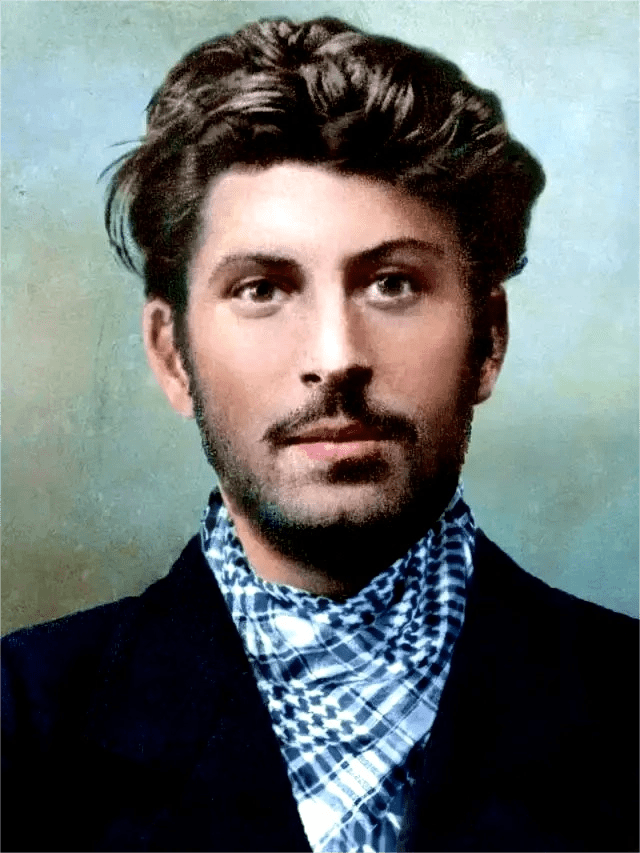
Joseph Stalin experienced a very religious upnringing – with Georgia being part of the Ottoman Empire (between the 16th and 19th centuries). Indeed, a Chinese-language article issued by the Hunan Educational Authorities states this about Stalin’s background:
‘The Stalin family were native Georgians living in the Gori region. Georgia is an ancient country situated within West Asia. Due to its small size, it was often annexed by neighbouring powers such as Persia and Turkey. At the same time, due to its geographical and cultural proximity to Europe, the Christian culture of the Orthodox Church spread there early on. Before 1800 CE, Georgia was still under Turkish control, and the religion and culture forcibly promoted was that of “Turkic Islamization”. Stalin’s great-grandfather and grandfather referred to themselves as “Turks”. After 1800, Turkey was defeated by Russia, its power completely withdrew from the Caucasus. This permitted the Orthodox Church to expand rapidly. By the time Stalin was born, Russia had already secured Georgia, and the locals had resumed living according to Russian cultural customs. Joseph Stalin was born into a family with distinct Turkic cultural heritage and rich Russian religious customs.’
Original Author – Da Yan (大岩) Historian – Hunan PRC
Of course, Stalin was not ethnic Russian, with many Georgians being a product of admixture between the different ethnic groups (many feel that Stalin as a “Persian” look about him). Nothing much is said about his father, or more precisely – nothing positive – but we should step carefully here. The type of assumptions drawn by many authors remind of the kind of nonsense displayed by quarrelling couples as their relationship comes to an end, and each attempts to paint the other in the worst possible light. Whatever the case, children tend to over-simplify the behaviour of their parents – not yet mature enough to understand life and what it does to an individual. To this distorting effect can be added all the lies and disinformation that have been poured upon Stalin. Even when Joseph McCabe wrote his excellent biography of Stalin in 1944 – there had been at least twenty-years of misrepresentation. From this book we learn that his mother was a strict Orthodox Christian (this is never said about his father) and that it is through her influence that Stalin was forced into education and learned to read and write. At fourteen-years of age, his mother enrolled Stalin in a local Seminary School with the intention of him becoming an Orthodox Priest (she had already named him after “St Joseph”). Ironically, it was amongst the students at this ecclesiastic school that he first encountered Marxism as a theory. Stalin entered Seminary at aged fourteen in 1894 – and was expelled in 1899.
Stalin immediately started agitating as a working-class activist linked to Lenin, with much Revolutionary work carried-out in Baku. Indeed, by around 1903, Joseph McCabe states the following:
‘At Baku he had a new and broadening experience. There was a large Moslem element, and many of the men had adapted revolutionary ideas. It was chiefly amongst these that he worked, and a couple of undated stories of his adventures amongst Moslems rebels may be told here, though possibly the incidents occurred later. The death of a youth in one of the shops was attributed to the malice of the management, and while the body lay in the mosque Stalin got a band to play the Funeral March outside it. The police shifted the muscian, but when the procession began Stalin had two choirs of workers, one preceding and one following the hearse, singing revolutionary funeral chants. The police again interfered, and he got the crowd of workers who followed the body to whistle their airs,slowly and solemnly.’
Joseph McCabe: The Life of Josph Stalin (1944) – Page 11
In 1917, Lenin became very dependent upon Stalin and appointed him “Commisar of Nationalities”. Indeed, I remember reading in EH Carr’s work regarding the Bolshevik Revolution that whenever a problem occurred within a particular ethnic group – Stalin would be sent to sort it all out – and this he always managed to do. This involved many incidents involving Islam and I would not be surprised if his relatives were not Muslims, or that Islamic culture was all around him in his youth. Indeed, Stalin possessed the ability to negotiate with these people, calm down all violence, and even persuade the Imams to side with Socialism! Of course, in 1928, Stalin established an academic centre dedicated to studying and understanding Buddhism. During WWII, Stalin relied upon his Seminary connections to persuade the Orthodox Church to oppose the invaders and assist the Soviet State. Stalin also made a point (found in his Collected Works) regarding the British Army murdering a number of surrendered Bolshevik officials in Baku during the Russian Civil War (1918-1921).

