Blogger’s Note: Marx discusses how the life expectancy of the workers in 1850s UK was very low considering the extent of the wealth their collective labour earned for the nation. Through a slow process of left-wing agitation and union activity – this low level (I believe just “40” in some areas) slowly began to rise, culminating in the 1948 founding of the Welfare State and NHS. This trend of improvement and growth continued until Thatcher in the mid-1980s when she switched the NHS from an ethos of “care” to “cost” – with the idea that the entire entity be privatised and transitioned into an exploitative US-style system. This unfolded parallel to the dismantling and reducing of the Benefit System, Social Housing, and effective Social Services – not to mention Elderly Care. All three main UK political parties – the Tories, Labour, and LibDems – have pursued this agenda at the behest of the US since the collapse of the USSR in 1991. Indeed, out of all the richest and advanced (21) most developed countries in the West – the UK lies at “20” with the US at “21” when it comes to all-round life-expectancy. Undiagnosed and untreated illnesses, coupled with untreated or inadequately treated injuries and disabilities have led directly to early deaths (ailments that can be easily cured and/or controlled with proper treatment) – a trend that is increasing. In the capitalist West – people are dying of medical neglect surrounded by hospitals, by starvation surrounded by food, and exposure surrounded by housing, etc. It is a crime against humanity unfolding against the workers perpetuated by the bourgeoisie – who live longer due to their unhindered access to all the resources they control and gate-keep. Revolutions happen due to the need to forcibly re-distribute already existing ample levels of wealth and resources – as the bourgeoisie always refuses to share on a voluntary basis. This is the practice of basic class interests! ACW (29.4.2026)
UK healthy life expectancy falls by two years in past decade
27.4.2026 – Hugh Pym,Health editorand – Nick Triggle,Health correspondent
The number of years people in the UK spend in good health is falling, according to a new report.
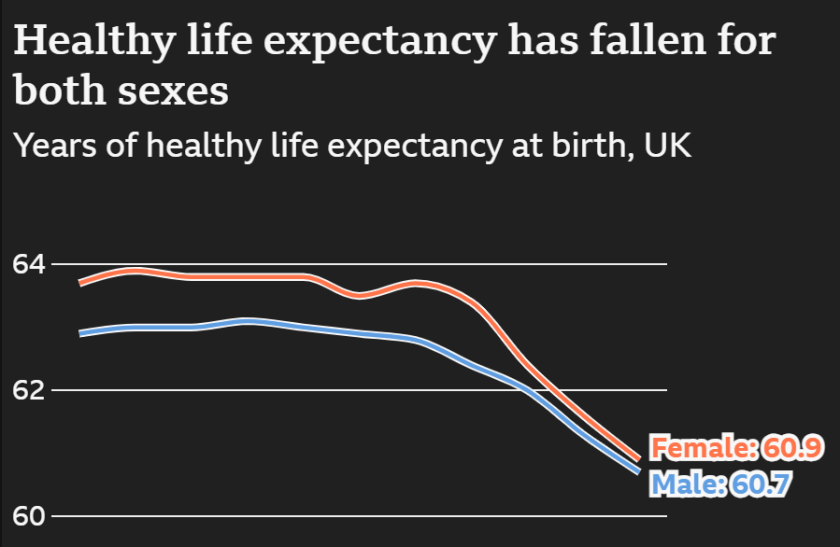
Over the past decade healthy life expectancy (HLE) has dropped by around two years to just under 61 for both men and women.
The UK is one of only five of the richest 21 countries to see HLE decline and its fall was the second steepest.
The Health Foundation, which produced the analysis, said there was a significant economic cost to this trend and the findings should act as a watershed moment.
It said poverty, poor housing and lifestyle factors such as obesity were to blame along with the impact of the Covid pandemic.
The analysis, based on data from the Office for National Statistics between 2022-24 and 2012-2014, found those in the wealthiest 10% of areas could expect to have around 20 more years of good health than those in the poorest.
In England, Richmond in London had the highest rates of HLE at 69 for men and 70 for women.
In comparison, in Blackpool it was 51 for men and in Hartlepool it was 51 for women.
London was the only region that saw an improvement in HLE over the period.
In more than 90% of areas the HLE was now below the state pension age of 66 or 67 and in one in 10 it was below 55.
The report said this had a significant impact on the ability of people to work and said this aligns with other figures showing high numbers out of work because of ill-health.
The global comparison, based on World Health Organization data, compared the UK to other nations in western Europe, the Nordics, North America and Oceania. It is now ranked 20th out of 21 with only the US seeing its population live for fewer years in good health.
HLE is the technical term used by experts for an estimate of how much of a lifetime is spent in good health, based on how people feel and report in surveys, as well as on mortality data.
The Health Foundation said the findings revealed a stark decline in the nation’s health and that this should be a wake-up call for policymakers.
Andrew Mooney, the think tank’s principal data analyst, said: “The UK has the highest levels of obesity in western Europe and there has been a surge in mental ill health, especially among young people.”
This had created “a significant economic cost, with poor health driving people out of the workforce and locking young people out of education, employment and training”, he added.
In comparison to HLE, the Health Foundation found that overall life expectancy had remained broadly stable.
Dr Layla McCay, policy director at the NHS Alliance, said: “The figures are a stark reminder of how deeply health inequalities are affecting people’s lives, with too many communities in deprived areas spending more years in poor health.
“Our members have been clear that the answer has to be prevention first – tackling the wider determinants of health, strengthening community-based care and improving access to support closer to home.”

