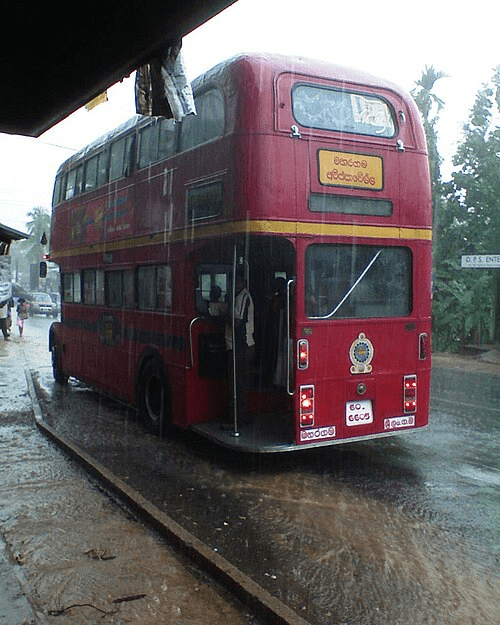
Blogger’s Note: I was in Sri Lanka in 1996 – where amongst other things – I took the opportunity to study Theravada Buddhism under Mangalo Thera at the Ganga Ramaya Temple (situated in the jungle near Beruwela). I found the country to be a mixture of modernity and tradition – with Dhamma everywhere mixed with a left-leaning Western concept of economic development. Many buses on the street were provided by the PRC and had Chinese writing on their exterior. Technically speaking, Sri Lanka is meant to be a Socialist State with many educated Buddhist monks being fervently in favour of Socialism. Some of the villages possessed no modernity at all and lived through traditional modes of sharing. It is interesting that capitalist poverty is what happens when traditional modes of behaviour are completely eradicated and replaced by a lack of finance. This creates begging and a sense of “lacking” (there is no money to purchase the necessities of life). Within the traditional modes of existing – money – a) does not exist and b) therefore does not dictate well-being or existence. On the other hand, tradition never changes or is permitted to alter – as such deviation from established norms present a “danger” to the well-being of those who live under its sway. Buddhist monastic life was developed within an ancient agrarian system – but not a modern or capitalistic version. It was a reaction to the Brahmanic caste system. The Buddha lived in a North Indian Republic which elected its secular officials. Followers of Brahma definitely existed – but at that time Brahmin priests had not yet usurped the kings and warriors (Kshatriya) who then administered society (the Buddha was of the Kshatriya caste – before he rejected Brahmanism) and his father the elected leader, etc. Later, the Brahmins would manoeuvre themselves above the warriors and kings – creating a revolutionary repositioning within the caste system (this is where matters stand in India). Sri Lanka, of course, is a Buddhist country with only a small Hindu population – although I did witness Buddhist monks carrying-out various (vegetarian) rituals for local Hindus living in areas around Colombo. This might be because Hindus today view the Buddha as an avatar of the god Vishnu. ACW (12.4.2026)
Source: Xinhua – Editor: huaxia – 12-4-2026
COLOMBO, April 12 (Xinhua) — Sri Lanka’s overall literacy rate has risen to 97.4 percent by 2024, with the gender gap in literacy closing, according to the country’s report of the Census of Population and Housing 2024.
For the first time since the census began in 1881, the gender gap in literacy has closed, with male and female literacy rates reaching nearly equal levels of 97.9 percent and 97.0 percent, respectively, Shyamalie Karunaratne, director general of the Department of Census and Statistics, said. She added that digital literacy has reached 67.6 percent.
Sri Lanka’s total population stands at 21,781,800, with a national population density of 350 people per square kilometre, she said. The total fertility rate has dropped to 1.3, below the replacement level.
There are 87 elderly persons for every 100 children, and the median age has risen to 35 from 30 in the previous census conducted in 2012, she said.
A total of 3,223,413 people, or 157 per 1,000 population, reported at least one physical or mental difficulty. Of them, 727,293 were identified as having significant disabilities across six core functional domains: vision, hearing, mobility, cognition, self-care, and communication, said Karunaratne.
About 19.2 percent of the population, or 4.18 million people, are reported to be suffering from non-communicable diseases, she said.
A total of 672,249 Sri Lankans are temporarily living abroad, most of them male, she said.
 SANGHA KOMMUNE (SSR)