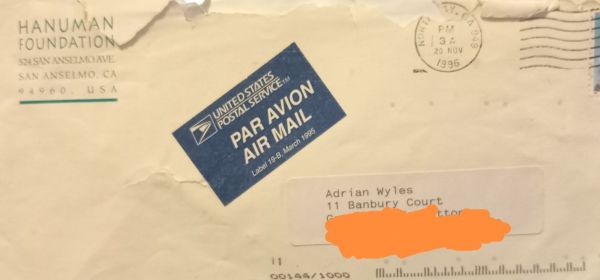
Ram Dass Envelop 1996

UK: A [1996] Letter Ram Dass Sent Me! (24.9.2026)

Typical of a White American, Alpert “sold” the spiritual teachings that are “free” in the genuine lineages. As a consequence, there were generations of individuals from around the world who fell under his spell. His teachings were seductive as he wanted to be liked. He was a homosexual who apparently sired a child with a woman. He was once a world-denying (celibate) yogi – but when he returned to the West he soon returned to his privileged (bourgeois) identity. I wrote to him to explain that he was wrong about Socialism and Chinese Buddhism. He had said that religion was suppressed in the Communist Bloc and that his texts were “outlawed” and illegally copied and passed around. None of this is true – but it is a common mythos in the US. The truth is that nobody cared what a rich Zionist had to say – who was busy co-opting the spiritual culture of a deeply impoverished country (India) – whilst denying that country the opportunity of breaking-out of this ignorance through the adoption of Socialism.
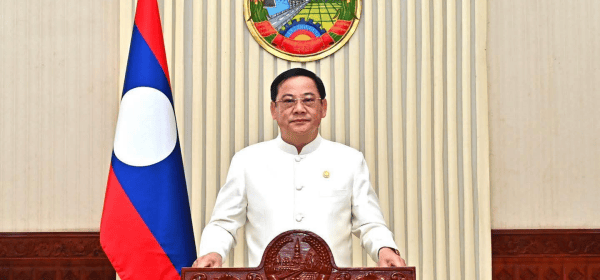
Prime Minister calls on education authorities, teachers, parents, students and society as a whole to strengthen efforts to improve education quality!

Laos Buddhist-Socialist Republic: PM Calls for Strong Improvement in All Education Standards During New Academic Year! (22.9.2026)

He commended education administrators, teachers, students, local authorities and development partners for their contributions during the 2025–2026 academic year, particularly in improving school infrastructure, expanding school meals in remote areas, promoting non-formal education, increasing student allowances and reducing school dropout rates.

For the new academic year, he called for stronger measures to address teacher shortages, reduce dropout rates, improve vocational and higher education enrolment, and enhance teaching quality through modern techniques and technology.

The Prime Minister urged teachers to uphold professional ethics and continuously improve teaching methods, while encouraging parents to ensure their children remain in school through at least compulsory lower-secondary education.

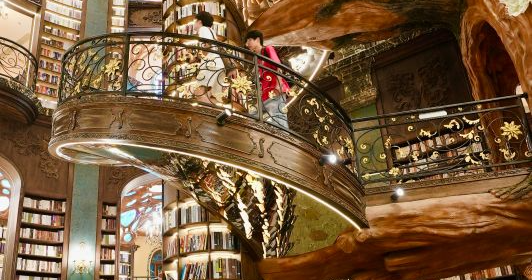
Sinkhole-turned library in Wuyuan County, east China's Jiangxi Province!

China: Sinkhole [天坑 – Tian Keng] Library in Juangxi – Offers Distinctive Reading Experience to Visitors! (27.8.2026)

A child reads a book at a sinkhole-turned library in Wuyuan County, east China’s Jiangxi Province on Aug. 26, 2026. A special sinkhole-turned library opened to the public recently in Wuyuan County of east China’s Jiangxi Province. It incorporates a natural sinkhole and surrounding rock walls into its architecture. The library features a carved spiral staircase and warm lighting, offering visitors a distinctive reading experience. (Xinhua/Hu Chenhuan)

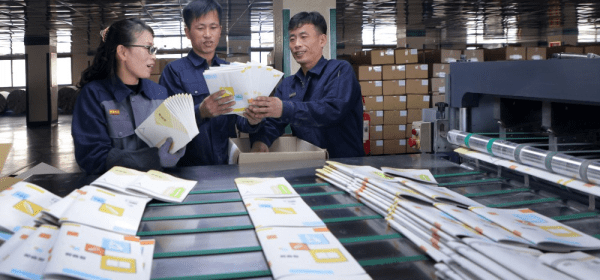
Mindulle Notebook Factory known as a treasure factory throughout the country

DPRK: Socialist Education Guarded By Mindulle Notebook Factory! (30.6.2026)

In Pyongyang, the capital city of the DPRK, there is a modern factory specializing in producing notebooks for children and students from kindergartens to universities across the country.

It is the Mindulle Notebook Factory known as a treasure factory throughout the country.

The factory has increased its annual production capacity from 50 million volumes in the early days of its operation to 150 million volumes. It produces various kinds of books including notebooks according to subjects, homework notebooks, diary books and parent-contact memo-books.

As there are scenes of Korean cartoons suited to children’s mind and interesting puzzles in the covers of notebooks, all children and students like to use the notebooks.

The Mindulle Notebook Factory was built on the direct initiative and under the meticulous guidance of the respected Comrade General Secretary Kim Jong Un.

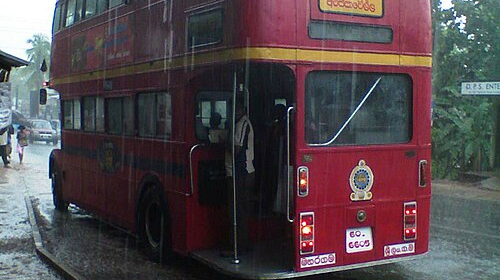
A double-decker bus in Godagama - Sri Lanka - a British Colony

Sri Lanka: Census Shows Overall Literacy Reaches 97.4%! (12.4.2026)

This creates begging and a sense of “lacking” (there is no money to purchase the necessities of life). Within the traditional modes of existing – money – a) does not exist and b) therefore does not dictate well-being or existence. On the other hand, tradition never changes or is permitted to alter – as such deviation from established norms present a “danger” to the well-being of those who live under its sway. Buddhist monastic life was developed within an ancient agrarian system – but not a modern or capitalistic version. It was a reaction to the Brahmanic caste system. The Buddha lived in a North Indian Republic which elected its secular officials. Followers of Brahma definitely existed – but at that time Brahmin priests had not yet usurped the kings and warriors (Kshatriya) who then administered society (the Buddha was of the Kshatriya caste – before he rejected Brahmanism) and his father the elected leader, etc. Later, the Brahmins would manoeuvre themselves above the warriors and kings – creating a revolutionary repositioning within the caste system (this is where matters stand in India). Sri Lanka, of course, is a Buddhist country with only a small Hindu population – although I did witness Buddhist monks carrying-out various (vegetarian) rituals for local Hindus living in areas around Colombo. This might be because Hindus today view the Buddha as an avatar of the god Vishnu.

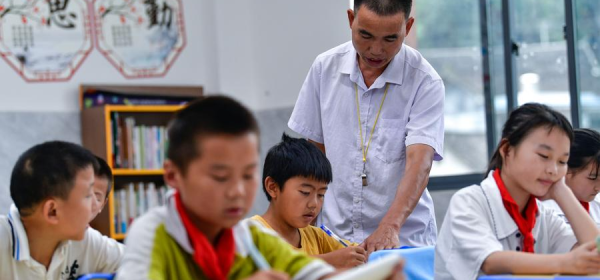
Ren Dabing instructs students at Molao Youyi Primary School in Biancheng Town of Huayuan County, central China's Hunan Province, Sept. 9, 2025. (Xinhua/Yang Wenbin)

China: CPC Re-Deploys Retired Teachers to Remote Areas! (7.10.2025)

This recruitment drive is part of an action plan the government launched in 2018 to enhance the quality of rural education by employing retired educators to teach in rural areas.

According to the statement, the drive will be aimed mainly at retired principals, teaching research staff and experienced teachers aged up to 65.

Teaching professionals recruited under the plan will work at county, town and village schools located in places that had been lifted out of poverty, underdeveloped ethnic counties, border regions and other areas that lack sufficient education resources.

1 2