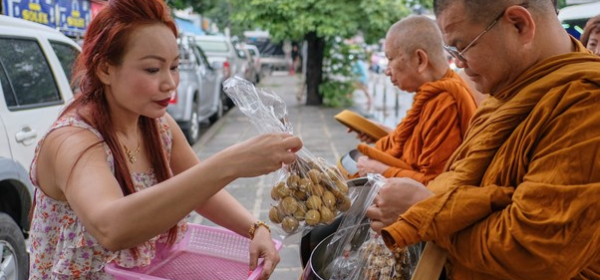
Rules in the Dhammic-sense serve only as basic guides toward moral-behaviour – hence the obvious latitude found in the night-life of places such as Thailand. Obviously, a lay-Buddhist is free to follow whatever path they perceive is correct for themselves and the circumstances they inhabit – after-all – it is their karma-producing habit. One issue is not to inflict suffering on others – including animals (this is why my family will never hurt animals in anyway). Hunger striking, in this sense, only physically “hurts” the individual participating in it – although a case can be made that those watching or caring “from afar” might suffer emotional pain. Of course, in the poor parts of Asia, Buddhist monastics exist whilst eating every other day – as the laity is so poor they have very little to share – but what an effort they make! Although starving themselves, the Buddhist laity will put aside a small amount for the Buddhist monastics. I was told that in the Northern forests of Thailand food is so scarce that Buddhist monastics often sieve a type of algae out of the local rivers – using their begging bowls – and share this to eat.