Military personnel participate in Togo's Independence Day parade in Lome, Togo, April 27, 2026. (Xinhua/Si Yuan)

Africa: Chinese Traditional Culture at Togo’s Independence Day! (28.4.2026)

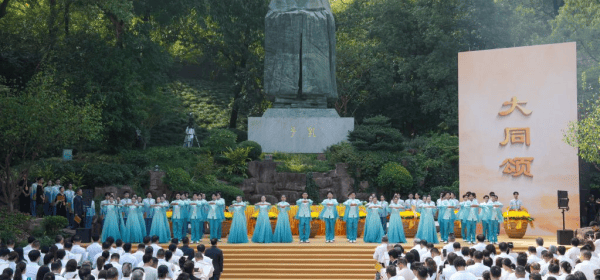
A Chinese traditional culture contingent composed of students from the Confucius Institute at the University of Lome made its debut as the first folklore group in the procession, marking the first appearance of a foreign cultural contingent in the history of Togo’s Independence Day parade.

A total of 34 Confucius Institute students, dressed in traditional Hanfu and ethnic costumes, held peony-patterned umbrellas, while dragon and lion dance performers moved among them.

The display conveyed sincere festive greetings to the Togolese people and won warm applause and high praise from the audience.

Wang told Xinhua that the presence of “Chinese red” stood out in the procession, complementing Togo’s traditional cultural formations and jointly painting a vivid picture of harmonious exchanges between Chinese and Togolese civilizations.

She added that the performance had become a highlight of the China-Africa Year of People-to-People Exchanges.

A double-decker bus in Godagama - Sri Lanka - a British Colony

Sri Lanka: Census Shows Overall Literacy Reaches 97.4%! (12.4.2026)

This creates begging and a sense of “lacking” (there is no money to purchase the necessities of life). Within the traditional modes of existing – money – a) does not exist and b) therefore does not dictate well-being or existence. On the other hand, tradition never changes or is permitted to alter – as such deviation from established norms present a “danger” to the well-being of those who live under its sway. Buddhist monastic life was developed within an ancient agrarian system – but not a modern or capitalistic version. It was a reaction to the Brahmanic caste system. The Buddha lived in a North Indian Republic which elected its secular officials. Followers of Brahma definitely existed – but at that time Brahmin priests had not yet usurped the kings and warriors (Kshatriya) who then administered society (the Buddha was of the Kshatriya caste – before he rejected Brahmanism) and his father the elected leader, etc. Later, the Brahmins would manoeuvre themselves above the warriors and kings – creating a revolutionary repositioning within the caste system (this is where matters stand in India). Sri Lanka, of course, is a Buddhist country with only a small Hindu population – although I did witness Buddhist monks carrying-out various (vegetarian) rituals for local Hindus living in areas around Colombo. This might be because Hindus today view the Buddha as an avatar of the god Vishnu.

Ren Dabing instructs students at Molao Youyi Primary School in Biancheng Town of Huayuan County, central China's Hunan Province, Sept. 9, 2025. (Xinhua/Yang Wenbin)

China: CPC Re-Deploys Retired Teachers to Remote Areas! (7.10.2025)

This recruitment drive is part of an action plan the government launched in 2018 to enhance the quality of rural education by employing retired educators to teach in rural areas.

According to the statement, the drive will be aimed mainly at retired principals, teaching research staff and experienced teachers aged up to 65.

Teaching professionals recruited under the plan will work at county, town and village schools located in places that had been lifted out of poverty, underdeveloped ethnic counties, border regions and other areas that lack sufficient education resources.

Serfdom Was Abolished in 1959!

Tibet: Xizang’s Remarkable Human Rights Progress Solid Rebuttal to Western Smears-Xinhua! (1.4.2025)

By the end of 2019, all 628,000 registered impoverished people in the region had been lifted out of poverty. In 2024, the per capita net income of those lifted out of poverty in Xizang increased by over 12.5 percent.

The average life expectancy in the region rose from 68.17 years in 2010 to 72.19 years in 2020. The medical and health service network has now achieved full coverage across the region.

The region’s road length had nearly doubled in 12 years and every town or township is covered by the 5G wireless network, with 2.14 million 5G mobile phone users.

Moreover, the cultural rights of all the ethnic groups in Xizang remain protected. For example, the Tibetan language is widely used in publishing, media, and daily life. By the end of 2024, Xizang had 17 periodicals and 11 newspapers in the Tibetan language and had published 46.85 million copies of 8,794 Tibetan-language books.

Science Starts with the People!

China: Country Set to Advance Sci-Tech Popularization! (5.11.2024)

The proportion of Chinese citizens with scientific literacy increased from 1.98 percent in 2003 to 14.14 percent last year, according to results of a survey released in April by the China Association for Science and Technology.

For the first time, the gap in scientific literacy levels of citizens in the eastern, central and western regions has narrowed, while gender disparities have also been further reduced, the data showed.

Meanwhile, China’s rank in the global innovation index has climbed from 34 in 2012 to 11 this year, making it the only middle-income economy among the top 30, according to the Global Innovation Index 2024, which was published in September by the World Intellectual Property Organization.

Genealogy: ‘DARIИGOLD’ – Provenance of a First-Name! (22.9.2023)

I hope this lady lived a long and happy life free from pain – as out of her genetics I have come into being -and so have my children! Over the years I have broached the subject of her ‘first’ or ‘Christian’ name – ‘Daringold’ – with a number of academic experts who state that they have never encountered this name before and that it must be the consequence of a ‘copying’ mistake or ‘hearing’ error! This certainly happens as in the past (particularly the 17th century CE) the English languish was not yet ‘Standardised’ and illiteracy abounded! Scribes (or ‘Scriveners’) were highly skilled – but these educated individuals often spelt the same word in different ways – even when this word appeared on the same page (Shakespeare was famous for ding this in his original texts)!

1 2 3