
Translator’s Note: Marxist-Leninism uses dialectical materialism (logic and reason) to discern the truth of a matter. Recently, I was asked about the odd idea of the US and Soviets collaborating to land a joint Astronaut-Cosmonaut mission on Mars during 1973. This obviously fake story circles around the Western internet (like Haley’s Comet). The long and the short of it is that neither country possessed then – nor possess now – the technology to achieve this. Only China is edging ever-closer. Below, I translate a Russian language article explaining exactly what the USSR was able to produce in 1973. As impressive as it is, this technology is nowhere near the level required to land living beings a) on the surface of Mars, and b) successfully retrieve these beings and safely back to Earth. I am reliably informed that the US was in a similar position – with both sides investing heavily in unmanned probes. Ergo – “NO” – the US and USSR did not pool resources and land on Mars in 1973. Finally, Joseph Stalin beat the Nazi Germans in 1945 and laid the foundation for the success of the later Soviet Space Programme. Just 12-years after suffering 41 million casualties at the hands of the Nazis – the USSR re-built and took-on the greed and self-serving delusion of the capitalist West. ACW (22.11.2025)
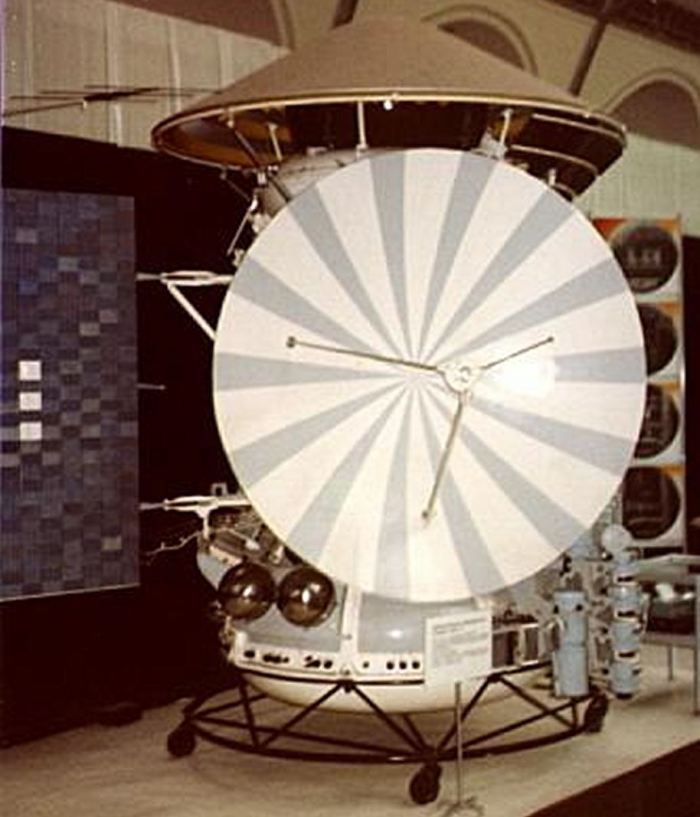
The M-73 series spacecraft are designed to explore the planet Mars and near-planetary space using a lander delivered to the surface of the planet, as well as an orbiter that performs the functions of an artificial satellite of the planet.
The M-73 series consists of two modifications:
• M-73S – spacecraft designed to function as satellites on and around Mars (Mars-4, M-73S No 52 and “Mars-5” ed. M-73S No 53);
• M-73P – vehicles designed for delivery to the near-planetary region and landing from a flyby trajectory to the surface of Mars of the research probe – an Autonomous Station (Mars-6, M-73P No 50 and Mars-7, M-73P 51).
The simultaneous use of spacecraft of two modifications in one expedition is caused by ballistic conditions flight to Mars in 1973. Duplication of devices of each type is made to increase the overall reliability of the target task. Launches of devices Mars-4 – 21.07.1973, Mars-5 – 25.07.1973, Mars-6 – 5.08.1973, Mars-7 – 9.08.1973 and transmitting information to Earth from the spacecraft M-73P landed on the Martian surface:
• Ensuring the second activation of the AMS in operation one day after landing;
• Implementation of the scientific programme, which largely coincides with the programme carried out by the M-73P flybys:
– Obtaining colour photographs of certain areas of the Martian surface
– Study of the distribution of water vapor on the disk of the planet
– Determination of the gas composition and density of the atmosphere
– Study of the relief according to the distribution ofCO2, determination of the distribution of gas concentration in the atmosphere, brightness temperature planets and atmospheres
– Determination of the permittivity, polarization and temperature of the planet’s surface
– Measurements of the magnetic field along the flight path and near the planet
– Measurements of electron and proton fluxes on the flight path and near the planet
– Study of the infrared spectrum of the planet in the region of 1.5 – 5.5 μm (in particular, for the search for organic compounds)
– Polarimetric studies of the planet in order to determine the structure of the surface
– Study of the spectra of the natural glow of the Martian atmosphere
– Registration of cosmic radiation and radiation belts of the planet.
for M-73P (Mars-6 and Mars-7) spacecraft:
• Delivery of descent vehicles to the near-planetary region and provision of the required ballistics conditions for descent vehicle penetration into the Martian atmosphere
• Landing of a research probe (Automatic Martian Station – AMS) on the surface of the planet
• Implementation of the scientific programme:
by a flyby
– Study of the distribution of water vapor on the disk of the planet
– Determination of the gas composition and density of the atmosphere
– Study of the surface relief
– Determination of the brightness temperature of the atmosphere and the distribution of gas concentration in the atmosphere
– Determination of the permittivity, polarization and temperature of the planet’s surface
– Measurement of the magnetic field along the flight path and near the planet
– Study of the electric field in the interplanetary medium and near the planet
– Study of the spatial density of meteor particles
– study of the solar wind during the flight
– Study of the spectrum and composition of solar cosmic rays
– Registration of cosmic radiation and radiation belts of the planet.
descent module
– Density, pressure and temperature of the atmosphere in terms of altitude
– Measurements related to the determination of the chemical composition of the atmosphere
– Studies of the type of surface rocks and the distribution of some elements in them
– Measurement of wind speed and gas density
– Obtaining a two-colour stereoscopic tele-panorama of the spacecraft landing site;
– Determination of the mechanical characteristics of the surface layer of the soil.
Flight scheme of the devices
A four-stage Proton-K launch vehicle with a launch weight of 690 tons was used to launch the M-73 series spacecraft. equipped with the same components as at the launch of the M-71 series spacecraft.
The relative position of the Earth and Mars in 1973 required that the spacecraft flight speed be higher – by 250-300 m/s determined by the capabilities of existing launch vehicles, restrictions on the total mass of the payload launched into the interplanetary trajectory, led to the need to use the so-called two-launch flight profile. According to it, the tasks of delivering the descent module and creating artificial satellite of Mars are carried out by two different devices. Taking into account the need for their joint work at a certain stage of the expedition (with the operation of the spacecraft on the surface), the future satellite of Mars will launch before the second spacecraft. The difference in their flight patterns is significant only at the final stages.

Each of these spacecraft is duplicated, so four spacecraft take part in the expedition: Mars-4, Mars-5, Mars-6 and Mars-7.
The phases of insertion into interplanetary trajectories and further flight up to approach Mars are identical for all spacecraft both with each other and with the corresponding stages of the flight in 1971.
In the flight of the M-73P (Mars-6 and 7) spacecraft, designed to deliver the descent module, the separation scheme is completely repeated and the landing of the descent vehicle on the Martian surface, which was developed for the previous M-71 expedition.

The most important stage of the expedition – landing on the Martian surface – is carried out as follows. Descent module input It occurs in a given range of entry angles, at a speed of about 6 km/sec. In the passive aerodynamic braking section, stability of the descent module is provided by its external shape and cantring.
An orbiter (flyby) after the separation of the descent vehicle and during the subsequent rendezvous with Mars – this is the difference from the flight profile of the M-71 – with the help of a gyro platform, it is deployed in such a way that the antennas of the metre range are rotated to receive a signal from the descent vehicle, and a highly directional antenna – to transmit information to Earth. After completing the work with the automatic Martian The spacecraft continues to fly in a heliocentric orbit
M-73 spacecraft
In the development of the M-73 series spacecraft, the M-71 series spacecraft with a maximum the use of its systems, units and equipment. The target tasks for which this series was created determined the presence of two modifications devices that make up it – M-73S and M-73P.
Orbiter (OA):
The main features of the orbiter in the 1973 launches are determined by the tasks of expanding scientific experiments and placement of attitude control system instruments in accordance with the kinematic characteristics of flight trajectories.
The main structural element of the OA, to which the spacecraft units are attached, including the propulsion system, panels solar arrays, parabolic directional and low-directional antennas, radiators of cold and hot circuits of the thermal support system mode and instrumentation, serves as a block of fuel tanks of the propulsion system.
An important difference between the M-73S and M-73P modifications is the placement of scientific equipment on the orbiter: in the satellite version, the scientific equipment is installed in the upper part of the tank block, in the version with a descent module – on a conical transition element connecting the instrument compartment and the tank block. For the vehicles of the 1973 expedition, the KTDU was modified. Instead of the main engine 11D425.000 11D425A was installed, the thrust of which in the low-thrust mode is 1105 kg (specific impulse – 293 seconds), and in the high-thrust mode – 1926 kg (specific impulse – 315 seconds).
The tank block was replaced with a new one – larger in size and volume due to the cylindrical insert, while enlarged consumable fuel tanks. Additional helium cylinders were installed to boost the fuel tanks.
As for the rest, the M-73 series orbiters are in terms of layout and composition of onboard equipment, with a few exceptions repeated the M-71 series.
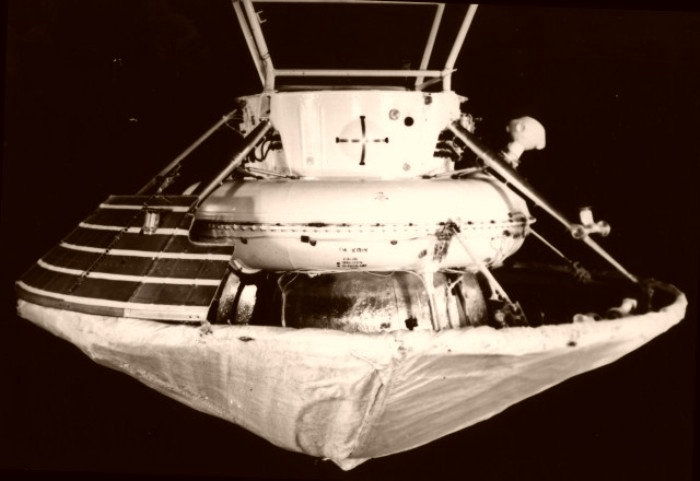
Descent module (DM):
On M-73P orbiters in the upper part of the propeller fuel tank block using a cylindrical the descent module is attached to the adapter and the connecting frame.
The descent module includes:
• an Automatic Martian Station (close to spherical in shape)
• aerodynamic (brake) screen
• a container with a parachute-jet system consisting of a parachute and a soft landing engine
• a connecting frame with systems that control the movement of the spacecraft at the stage of its separation from the orbital compartment and taking it away from the flight trajectory to the “hitting” one.
After the trajectory change maneuver, the frame is separated from the descent vehicle.
The descent module was equipped with equipment for measuring the temperature and pressure of the atmosphere, mass spectrometric determination of the chemical composition of the atmosphere, measurement of wind speed, determination of the chemical composition and physical and mechanical properties of the surface layer, as well as for obtaining a panorama using TV cameras.
Source: NGO LAVOCHKIN
Mars-4 and Mars-5 television systems
On Mars-4 and Mars-5, two types of television systems were used, differing in the principle of operation.
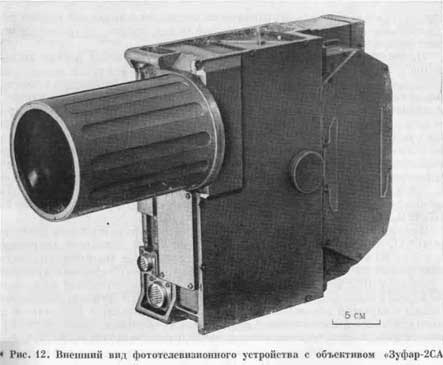
PHOTO-TELEVISION DEVICES ZUFAR and VEGA (FTU)
The first system, similar to the one previously installed on the Mars-2 and Mars-3 satellites, consisted of the so-called photo-television devices (FTU). Shooting in these devices is produced on photographic film, which is processed in on-board conditions. The image obtained on it is transmitted by television via a communication line to Earth. In contrast to from the television system of the Mariner spacecraft to the FTU the functions of shooting and storage devices are combined, which is due to the ability of photographic film to store the image.
This gives an almost twofold weight gain for the PTU with other identical system parametres. Saving weight is especially important when shooting TV is not the main task of the spacecraft. There are other advantages: higher image clarity than that of the vidicon (2-4 times more information in one frame); a large value of the contrast coefficient. The latter circumstance and the high spectral sensitivity in the red region are especially important for shooting such a low-contrast object. like Mars.
At the same time, the FTU is much more difficult to develop, and it is necessary to overcome great technical difficulties to ensure the required level of its reliability. This applies mainly to that part of the FTU that is related to the onboard chemical and photographic processing of photographic film, including the issues of its protection from cosmic radiation, the safety of reagents, etc.
1965-1966
The experience of these works was used in the creation of Martian PTUs, taking into account the new requirements arising from a much longer residence time of the equipment in space, which consisted of the flight time (about 8 months) and the time of active work in orbit under the programme (up to three months).
Two FTUs were installed at each station. FTUs were equipped with lenses with angles of view and, accordingly, focal lengths, differing by 7 times, This made it possible to obtain a resolution on the surface of about 700 and 100 m per television element when shooting from a nominal height. The wide-angle FTU had a set of replaceable light filters.

TELEVISION CAMERAS
The spatial position of the sighting axes in the survey sessions, the time of the sessions, as well as a number of characteristics of the FTU were selected based on considerations ensuring optimal shooting conditions for the area shifted towards the evening terminator. The main mode of shooting in the periapsis was carried out at a constant solar-stellar orientation of the satellite. At the same time, the sighting axes of the instruments, which are rigidly fixed on the satellite, are shifted in parallel in the process of its flight near the planet, remaining in the orbital plane.
In addition to shooting in the mode of constant sun-star orientation, it is possible to take photographs with a programme turn of the satellite, when the sighting axes can be directed to any point in space. This mode was used on 21.11.1974 when photographing one of the proposed landing areas of the descent module.
In most cases, the shooting was carried out in the main mode at the height of the Sun above the local horizon equal to 15-35°, the maximum altitude of the station close to 90°, and a constant phase angle of 65°. Under these conditions, the photographed surface had a close to maximum contrast of details with sufficient general illumination. Filming could are carried out in cycles of 12 frames both synchronously by both FTUs and by each device separately, and the beginning of shooting was set either automatically or on command from Earth. Also, on command, one of the two shooting rates could be chosen, differing by 4 times.
Due to the fact that the time allocated for image transmission from the Mars-4 and Mars-5 spacecraft was limited, the shooting capabilities significantly exceeded transmission capabilities. Therefore, the transmission of frames with nominal clarity from the PTU was carried out selectively after viewing all the captured information with clarity reduced by 4 times. Several shots were transmitted with clarity 2 times greater than the nominal. Image signals were transmitted via the radio channel by the pulse method at a speed of 512 and 1024 tel. electro/s.
FTUs are functionally divided into a number of units (see Fig.): photographic camera 1, chemical and photographic film processing unit 2, transmission device Images 3, film storage cassettes 4 and 5. These units are structurally united by a common tape path and are controlled by one automation unit 6. The automation of the FTU is based on principle of combined programme-command control. At the same time, the operation of the FTU in such modes as shooting, processing and partially transmission is carried out according to a rigid programme set by by an electronic programme device in accordance with the adopted mode of the 12-frame shooting cycle. Various versions of these modes are established on command from the Earth.
 SANGHA KOMMUNE (SSR)